USAID. MISSION TO PHILIPPINES
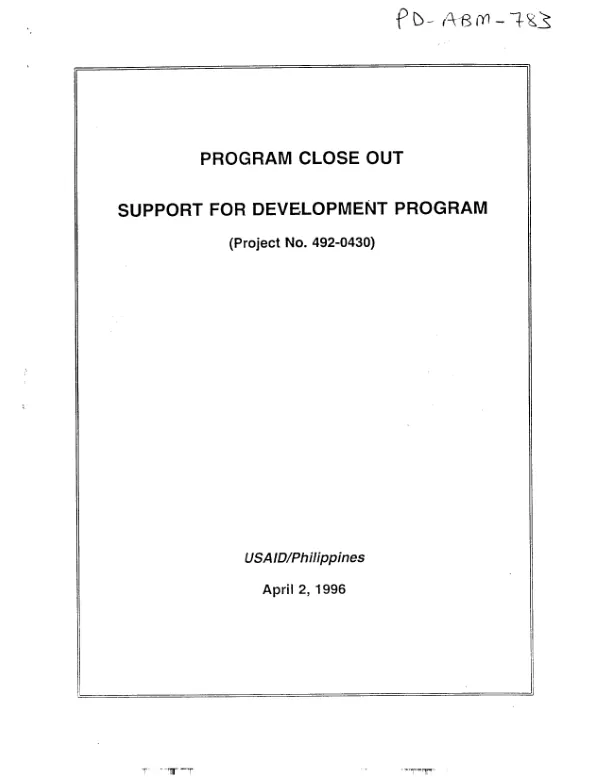
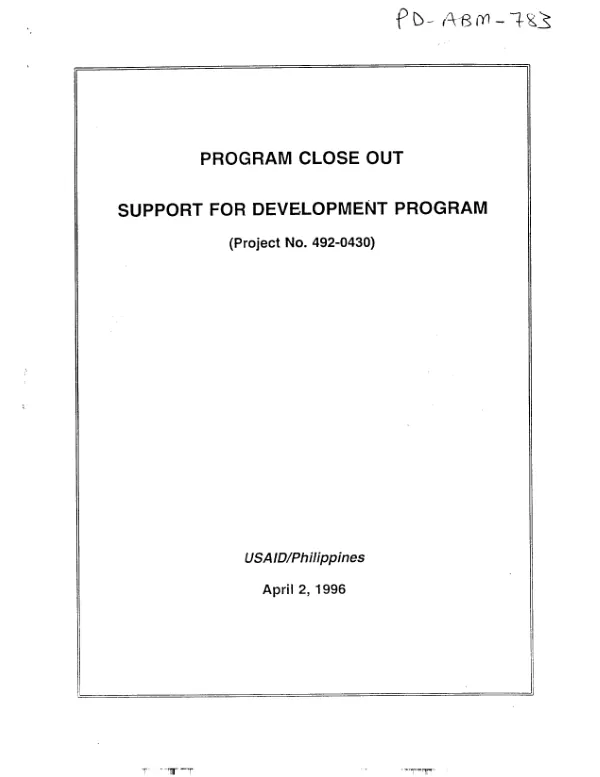
Program close out : support for development program (project no. 492-0430)
PACR of a program (8/89-1992) to support economic policy and administrative reforms in the Philippines.
1996
Sign in to readA free account is required to download.
Abstract
The program's conditions were met, disbursements were carried out more or less as planned, and almost all of its goals were met. Several problems in meeting policy targets arose, but all except one--increasing the number of VAT (value-added tax) filers to 78,000)--were resolved without significant difficulties. The Government of the Philippines (GOP) felt the VAT target was unrealistic (the most likely reason the GOP had accepted the target in the first place was lack of clear communication). In any event, USAID's withholding the disbursement of the third tranche and then disbursing less than the full amount may have caused GOP resentment out of proportion to the importance of the target (particularly considering the VAT revenue increase target was met). Alternatively, it may have provided a useful lesson that policy targets are to be taken seriously. Regardless, USAID/P should have affirmed the feasibility of the target before imposing it. The transfer of program resources and the policy reforms had a considerable impact on the Philippine economy. The disbursement of $218 million, of which $169 million was disbursed in 1989, reduced the balance of payments deficit by 10% in 1989, and the registered national budget deficit by 16%. Using a macroeconomic model to calculate the effects of each of the policy targets that could be quantified, the combined effect can be summed up as a 0.25% increase in GDP growth trend. Associated with this increase were positive effects on revenue, employment, and the current account. These calculations also permitted the conduct of standard economic appraisal, the first such application for a cash transfer program in the Mission. In sum, the program assisted the GOP in undertaking macroeconomic and structural policy reforms, and promoting efficiency, competitiveness, and privatization. Its objectives were in line with USAID priorities and also well-suited to the Philippine economic system. The key to the program's success was the selection of limited but achievable objectives related to the implementation of macroeconomic and structural policy reforms already adopted by the GOP. In fact, it is a tribute to its concept and design that the program was successfully implemented during a period when the IMF's Extended Fund Facility (EFF) program had gone off track. The basic mechanism used to accomplish program objectives was the incorporation of these objectives in a policy matrix and the use of policy conditionality in second and third tranche disbursements. The performance indicators in the policy matrix were clear, specific, and precise, and in retrospect, proved reasonable and realistic, given the good record of fulfillment of all performance indicators except one. The Mission also carried on a continuing, intensive dialogue with the GOP on a wide ranging policy agenda; as a result of this and other donor efforts, the GOP has usually taken public positions in principle in favor of the kind of policy reforms advocated by USAID, the IMF, and the World Bank.
![Evaluation of economic growth technical assistance [: Philippines]](https://covers.devme.ai/gen/19712.webp)
![Evaluation of economic growth technical assistance [: Philippines]](https://covers.devme.ai/gen/5132.webp)