USAID DEC
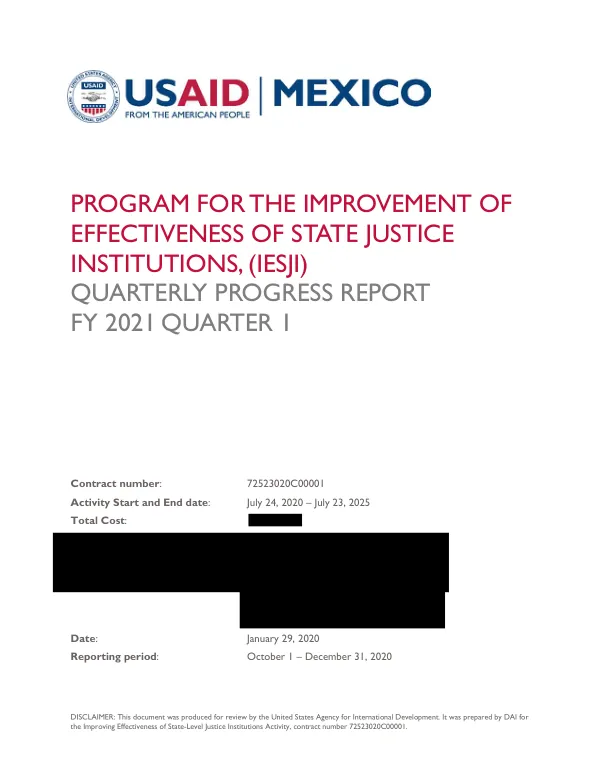
Program for the Improvement of Effectiveness of State Justice Institutions, IESJI Quarterly Progress Report FY21 Q1
Sign inDAI
Program for the Improvement of Effectiveness of State Justice Institutions, IESJI Quarterly Progress Report FY21 Q1
The Program for the Improvement of Effectiveness of State Justice Institutions, IESJI, aims to increase the effectiveness of the Mexican criminal justice system at the state level.
2021 · 14 pages
Sign in to readA free account is required to download.
Abstract
The activity's purpose is to reduce impunity, increase accountability, and improve citizen confidence in the justice sector. IESJI will strengthen institutional functions and capacity of prosecutors, judges, and other actors to prosecute high-priority crimes and reduce impunity. The activity's objectives are to: 1. Individual justice sector institutions use data and analysis to prioritize and fully prosecute higher, serious criminal cases. 2. Justice sector institutions collaborate on policy, resource allocations, and resource allocations to improve prosecutions and reduce impunity. 3. Results of institutional capacity, collaboration, and reform are sustainable over time through partnerships among key local stakeholders. IESJI conducted a rigorous selection process to identify target states, considering both political and viability elements. The activity will deploy interventions directly in eight states and indirectly in up to 14 states. The project received verbal concurrence on the selection process, with formal approval expected in the next quarter. The COVID-19 pandemic has elevated the importance of capitalizing on prior experience and leveraging prior experience within justice institutions. IESJI strategically planned its approach and entry into selected states using virtual communication. The project anticipates that challenges due to COVID-19 will extend into the next quarter, with large backlogs in caseloads expected. IESJI's Institutional Maturity Model (IMM) advanced this quarter and will be implemented in FY 2021 quarter 2 to inform and enrich the implementation strategy. The Monitoring and Evaluation (MEL) Plan was submitted to USAID in October 2020 and included 17 outcome and indicator indicators to inform progress during the life of the activity. The activity's progress report highlights the extensive context analysis conducted as part of the target state selection process and the strategic planning conducted by IESJI to provide USAID with tangible, high-level results in the short term. The project aims to position the project with the United States Government and Mexican counterparts, while setting the basis for sustainable, structural reforms at the state level. IESJI's quarterly progress report covers the period from October 1 to December 31, 2020. The report provides an update on foundational activities, including the extensive context analysis and strategic planning conducted by the activity. The project aims to increase the effectiveness of the Mexican criminal justice system at the state level, reduce impunity, and improve citizen confidence in the justice sector. The activity's progress report highlights the importance of capitalizing on prior experience and leveraging prior experience within justice institutions. IESJI's Institutional Maturity Model (IMM) advanced this quarter and will be implemented in FY 2021 quarter 2 to inform and enrich the implementation strategy. The project aims to position the project with the United States Government and Mexican counterparts, while setting the basis for sustainable, structural reforms at the state level.
Related documents