USAID DEC
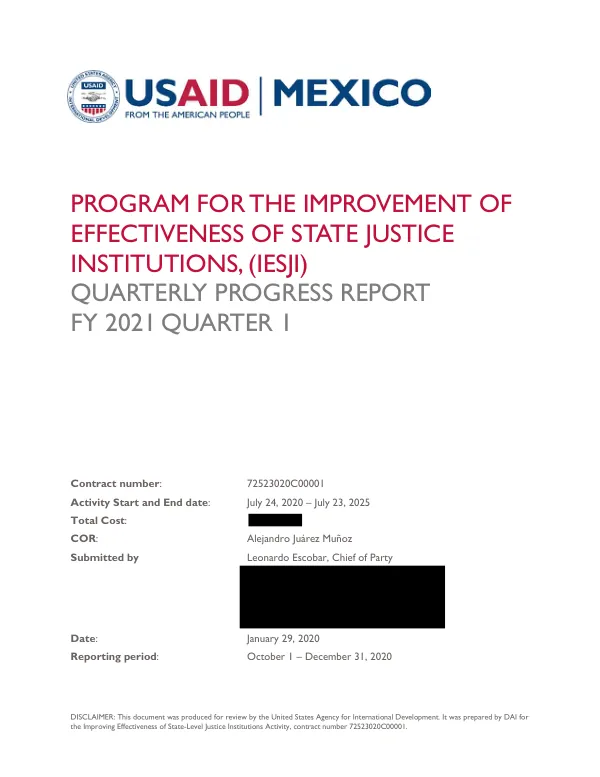
Program for the Improvement of Effectiveness of State Justice Institutions, IESJI Quarterly Progress Report FY21 Q1
Sign inDAI
Program for the Improvement of Effectiveness of State Justice Institutions, IESJI Quarterly Progress Report FY21 Q1
The Program for the Improvement of Effectiveness of State Justice Institutions, IESJI, aims to increase the effectiveness of the Mexican criminal justice system, primarily at the state level, to reduce impunity, increase accountability, and improve citizen confidence in the justice sector.
2021 · 14 pages
Sign in to readA free account is required to download.
Abstract
The activity seeks to strengthen institutional functions and build the capacity of prosecutors, judges, and other state-level actors to improve prosecution of high-priority crimes, reduce impunity, and increase accountability. IESJI conducted a rigorous selection process to identify its target states, considering both political and technical elements to assess the feasibility, viability, and level of willingness on the part of 14 Mexican states to become IESJI's state-level counterparts. Based on the analysis and selection process, IESJI will deploy its interventions directly in eight states: Chihuahua, Coahuila, Hidalgo, Nayarit, Nuevo León, San Luis Potosí, Sonora, and Zacatecas. The project also identified two resource states, Guanajuato and Queretaro, whose practices may inform the improvement of peer institutions in other states. The COVID-19 pandemic has significantly affected IESJI and its intended counterparts, reducing the capacity of justice sector operators to provide effective service delivery. To address this challenge, IESJI strategically planned its approach and entry into selected target states using virtual communication mechanisms, taking advantage of the possibilities for cross-state collaboration and participation in Year 1 activities via virtual means. This process has bolstered IESJI's positioning among stakeholders and ensured prompt rollout of activity implementation despite the limitations presented by pandemic conditions. The project anticipates that challenges related to COVID-19 and its repercussions in terms of institutional efficiency will extend into the next quarter at least. Large backlogs in caseloads are expected for state-level justice systems whose normal operations have been heavily modified and limited due to the pandemic. IESJI identified multiple areas of opportunity to make a compelling case for strategic prioritization in the prosecution of crimes across target states, informing strategic planning and initial efforts to establish working relationships with key counterparts and justice system stakeholders. IESJI's Institutional Maturity Model (IMM) advanced this quarter and will be implemented in FY 2021 quarter 2 to further inform and enrich IESJI's implementation strategy. The model will help to assess the capacity and performance of justice institutions in the target states, providing a framework for IESJI to tailor its interventions to the specific needs of each state. The activity also closely monitored external variables that directly affect IESJI's operational context, including the Mexican election cycles. The upcoming 2021 federal and state-level elections were closely analyzed as part of the target state selection process, which involved an assessment of conditions in 14 Mexican states. The analysis considered the potential impact of the elections on the justice sector and the need for IESJI to adapt its approach to ensure effective implementation of its interventions. IESJI's quarterly progress report covers the period from October 1 to December 31, 2020. During this period, the activity continued to advance in operational and technical startup, meeting remaining milestones related to establishing operations, onboarding staff and subcontractors, completing contractual deliverables, selecting target and resource states, and grounding strategic planning for Year 1 in detailed activity implementation plans. The report highlights the activity's progress in establishing a strong foundation for its interventions, including the selection of target states, the development of its Institutional Maturity Model, and the establishment of working relationships with key counterparts and justice system stakeholders.
Related documents