USAID DEC
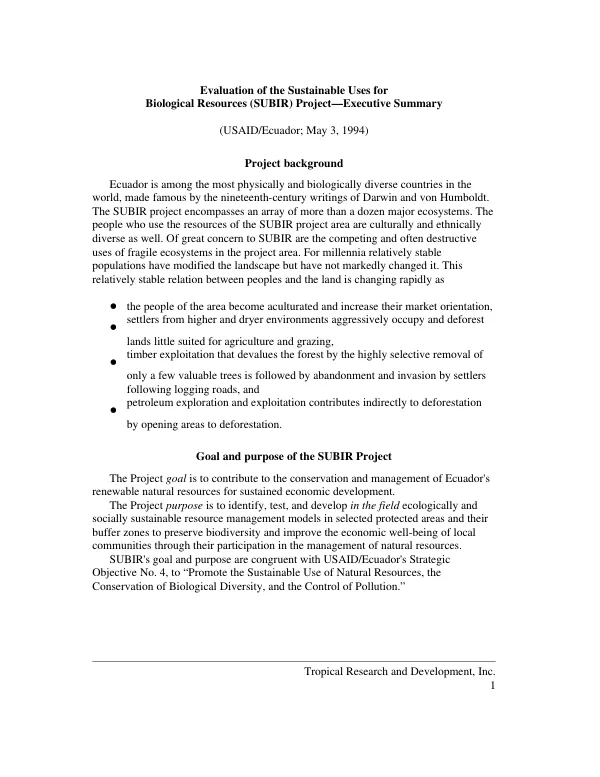
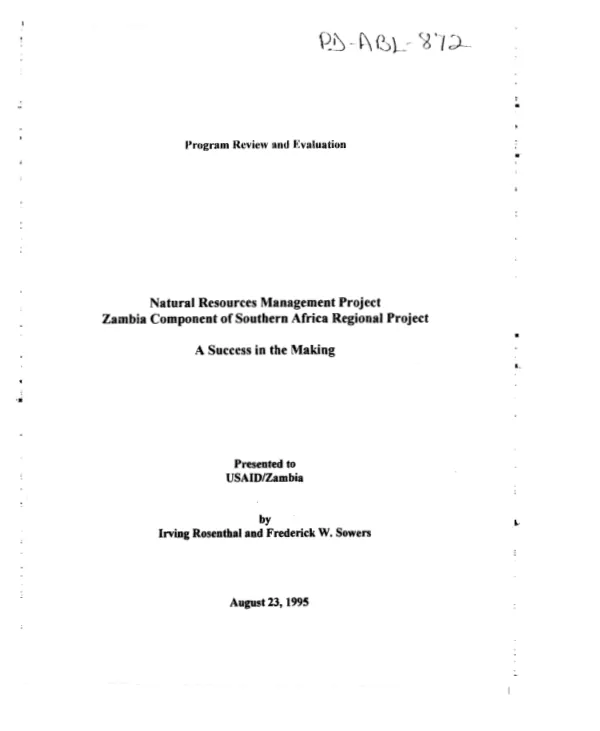
Program review and evaluation : natural resources management project, Zambia component of southern Africa regional project -- a success in the making
Sign inUSAID. MISSION TO ZAMBIA
Program review and evaluation : natural resources management project, Zambia component of southern Africa regional project -- a success in the making
Final evaluation of the Zambia subproject (8/89-8/95) of the regional Natural Resources Management (NRM) Project.
Rosenthal, Irving|Sowers, Frederick W. · 1995
Sign in to readA free account is required to download.
Abstract
The purpose of the subproject was to support Zambia's Administrative Management Design for Game Management Areas (ADMADE) program, aimed at helping local communities to participate in and benefit from wildlife conservation efforts in the country's national parks. ADMADE, a wildlife-oriented form of community-based NRM (CBNRM), is a success in the making, having already achieved a degree of sustainability. The philosophy it embodies is arguably the most significant hope for improving the well-being of Zambia's rural areas by devolving to local populations the proprietary rights to rural resources. The regular and village scouts are the heroes of the program, carrying out their wildlife management activities under great hardships. Recent efforts have focused on (1) improving governance through devolution and administration through transparency; (2) capturing the strength of the private sector through partnerships with the public sector and with local communities; (3) establishing a policy and legal framework that supports equitable distribution of benefits; and (4) institutional restructuring to efficiently enhance linkages between conservation and development. At the policy level, support for the hunting industry may not only yield financial benefits to Zambia, but may also be one of the country's major sources of foreign exchange and government budgetary resources; new revenues will give local people economic alternatives to the consumptive use of wildlife. Additionally, the concept of CBNRM is understood by most people "on the ground", especially by those most affected. A dynamic tension exists between alternative uses of land and resources which, if kept in the open and managed well, can lead to better decisions on the use of these resources. Many of the management issues which were reported to be so troubling 14 months ago, including the operation of the Wildlife Conservation Revolving Fund, are on the mend. Improvements have also been made in such areas as computerizing license fees, systems for monitoring animals, and increasing the number of trained scouts. The Nyamaluma Research and Training Center has been transformed under ADMADE and has established itself as the principal mechanism for translating NPWS' commitment to wildlife co-management into concrete, field-level programs. The Center has broadened its curriculum and added staff to improve its training to a wider cross-section of communities in Game Management Areas (GMAs). Additionally, the Center's ongoing research and monitoring of wildlife conservation activities provides a key to quantifying program progress. Less positively, however, the National Parks and Wildlife Service (NPWS) lacks the institutional, technical, and research management capacity needed to administer ADMADE effectively, and the World Wildlife Fund (WWF), while providing a useful financial and secretariat support mechanism for the project, has not provided the overall technical leadership it requires (though it is unclear whether USAID expected WWF to exercise such leadership). WWF has also failed to complete two of the four components of its present cooperative agreement (new wildlife legislation and development of a GMA information base). Various recommendations are made, and several scenarios for continued USAID involvement are offered. The recommended option is a one-year extension leading into a follow-on project.
Related documents
Documents in this collection
![End of program evaluation report (Nov 1999-Oct 2002) : cooperative agreement between USAID and WWF [World Wildlife Fund] Indonesia no. 497-A-00-00-00002-00 -- the Outer Islands bioregional program : integrated protected area management and spatial planning in Kalimantan and Papua[, Indonesia]](https://covers.devme.ai/gen/5324.webp) 2002
2002USAID DEC
End of program evaluation report (Nov 1999-Oct 2002) : cooperative agreement between USAID and WWF [World Wildlife Fund] Indonesia no. 497-A-00-00-00002-00 -- the Outer Islands bioregional program : integrated protected area management and spatial planning in Kalimantan and Papua[, Indonesia]
Open record![Sri Lanka : final evaluation of the shared control of natural resources [SCOR] sub-project -- final report](https://covers.devme.ai/gen/5940.webp)
USAID DEC
![End of program evaluation report (Nov 1999-Oct 2002) : cooperative agreement between USAID and WWF [World Wildlife Fund] Indonesia no. 497-A-00-00-00002-00 -- the Outer Islands bioregional program : integrated protected area management and spatial planning in Kalimantan and Papua[, Indonesia]](https://covers.devme.ai/gen/58040.webp)