USAID DEC
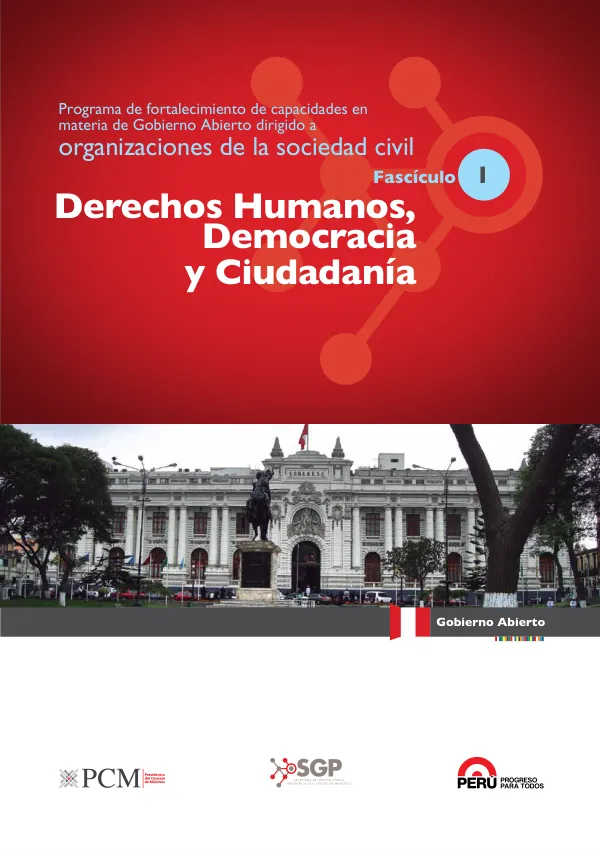
Programa de fortalecimiento de capacidades en materia de Gobierno Abierto dirigido a organizaciones de la sociedad civil
Sign inUSAID
Programa de fortalecimiento de capacidades en materia de Gobierno Abierto dirigido a organizaciones de la sociedad civil
The concept of derechos humanos, or human rights, is a fundamental aspect of modern societies.
2014 · 32 pages
Sign in to readA free account is required to download.
Abstract
It is widely accepted that all individuals have inherent rights and freedoms that must be respected and protected. These rights are considered universal and inalienable, meaning they belong to every human being regardless of their nationality, ethnicity, or any other characteristic. The characteristics of derechos humanos include their indivisibility, interdependence, and universality. They are indivisible because they are all interconnected and cannot be separated from one another. For example, the right to life is closely linked to the right to freedom from torture and the right to a fair trial. They are interdependent because the realization of one right often depends on the realization of others. For instance, the right to education is closely linked to the right to health and the right to a decent standard of living. Finally, derechos humanos are universal because they apply to all individuals, regardless of their nationality, ethnicity, or any other characteristic. Derechos humanos can be classified into several categories, including civil and political rights, economic, social, and cultural rights, and collective rights. Civil and political rights include the right to life, liberty, and security of person, as well as the right to freedom of expression, assembly, and association. Economic, social, and cultural rights include the right to work, education, and healthcare, as well as the right to an adequate standard of living. Collective rights include the rights of indigenous peoples, women, and children. In the context of the Peruvian government's efforts to promote derechos humanos, the country has ratified several international human rights treaties, including the Universal Declaration of Human Rights, the American Convention on Human Rights, and the Convention on the Rights of the Child. The Peruvian government has also established several institutions and mechanisms to promote and protect derechos humanos, including the National Human Rights Council and the Office of the Ombudsman. The promotion and protection of derechos humanos are essential for building a more just and equitable society. They provide a framework for ensuring that all individuals are treated with dignity and respect, and that their rights and freedoms are protected. In the context of the Peruvian government's efforts to promote Gobierno Abierto, the protection of derechos humanos is a critical component of the country's commitment to transparency, accountability, and citizen participation. The Peruvian government's commitment to derechos humanos is reflected in several key policies and laws, including the Ley de Transparencia y Acceso a la Información Pública, the Ley de Protección de Datos Personales, and the Ley de los Derechos de Participación y Control Ciudadanos. These laws provide a framework for ensuring that the government is transparent and accountable, and that citizens have access to information and the ability to participate in decision-making processes. In conclusion, derechos humanos are a fundamental aspect of modern societies, and their promotion and protection are essential for building a more just and equitable society. The Peruvian government's commitment to derechos humanos is reflected in its policies and laws, and its efforts to promote Gobierno Abierto are an important step towards ensuring that the country's citizens have access to information, participate in decision-making processes, and are treated with dignity and respect. The Peruvian government's efforts to promote Gobierno Abierto are also reflected in its commitment to transparency and accountability. The government has established several institutions and mechanisms to promote transparency, including the Portal de Transparencia Estándar and the Comisión Multisectorial de seguimiento de la implementación del Plan de Acción de Gobierno Abierto. These institutions and mechanisms provide a framework for ensuring that the government is transparent and accountable, and that citizens have access to information and the ability to participate in decision-making processes. The promotion of Gobierno Abierto is also closely linked to the concept of ciudadanía, or citizenship. Ciudadanía refers to the rights and responsibilities of citizens, and the ways in which citizens participate in decision-making processes and hold their government accountable. In the context of the Peruvian government's efforts to promote Gobierno Abierto, ciudadanía is a critical component of the country's commitment to transparency, accountability, and citizen participation. In conclusion, the promotion of Gobierno Abierto and ciudadanía are critical components of the Peruvian government's efforts to build a more just and equitable society. The government's commitment to transparency, accountability, and citizen participation is reflected in its policies and laws, and its efforts to promote Gobierno Abierto and ciudadanía are an important step towards ensuring that the country's citizens have access to information, participate in decision-making processes, and are treated with dignity
Related documents