DEVTECH SYSTEMS, INC.
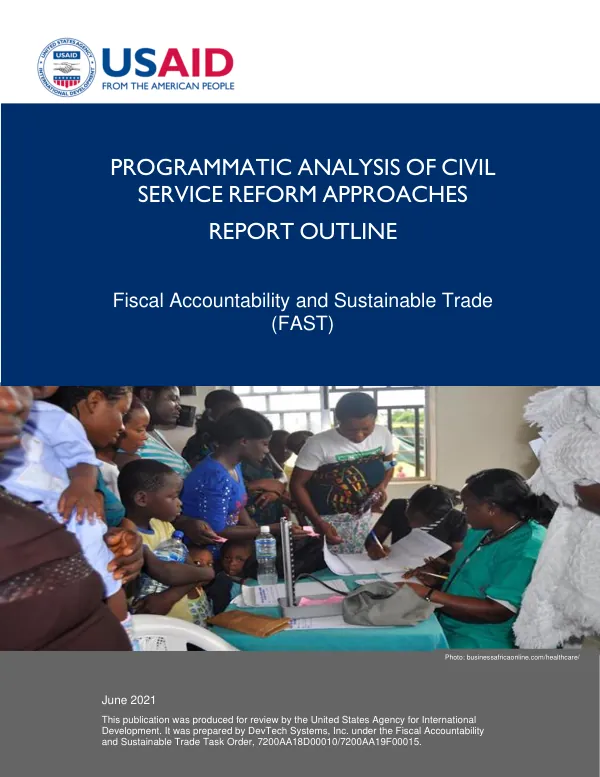
Programmatic Analysis of Civil Service Reform Approaches
The Fiscal Accountability and Sustainable Trade (FAST) task order supports rapid, sustainable, and equitable economic growth in USAID-assisted countries by enabling USAID to bring a systems approach to addressing Public Financial Management (PFM), trade capacity building (TCB), macroeconomic planning and policies, and other economic governance issues.
2021 · 14 pages
Sign in to readA free account is required to download.
Abstract
The task order aims to improve host-country capacity to mobilize revenue and provide public services, host-country policy climate for investment, host-country ability to recover from and mitigate the impact of conflict, natural disasters, or fiscal crises, and host-country institutional capacity to identify, design, advocate, and implement better economic policies. The "Programmatic Analysis of Civil Service Reform Approaches" task under FAST draws from real-world economic and political experiences of countries to inform USAID of effective approaches that improve the performance, accountability, and cost-effective management of the public sector. The analysis will provide USAID with a set of practical options that its staff can consider in their efforts to assist host countries in improving their public sector operations as an element of the broader aim of promoting sustainable and equitable economic growth. The traditional model of civil service management was controlled by political leadership, characterized by hierarchical and bureaucratic structures, permanent, non-partisan, and anonymous staff, an ethos of serving the public interest based on formal structures and procedures, and administering but not contributing to policy formulation. However, this model required adjustments to take into account expanded public services, technology advancements, and growing demand for results. Over the past three decades, civil services have shifted towards improving service delivery by strengthening the effectiveness and performance of government while ensuring that structures and operations are flexible, affordable, and sustainable. The key tenets associated with this shift include political and technical leadership and commitment, adequate governance arrangements, focus on performance management, well-designed programs, appropriate funding arrangements, policy dialogue with stakeholders, flexibility, and continuous learning and innovation. These principles have helped in shaping reform efforts to both reduce pressure on public budgets and provide for the politically demanded level of services in an efficient and transparent manner. Implementation issues in civil service reform in developing countries are often hampered by several factors, including the ability of an administration to pass legal amendments, the degree that the economy is structured in a centralized or decentralized manner, the cultural divide in the country, the potential for the private sector to participate in traditionally public service provision, and the impact of isomorphic mimicry. The analysis will look at the relative importance of these cross-cutting issues across the reform approaches based on country experience and how to best address them. The Fiscal Accountability and Sustainable Trade (FAST) task order aims to support rapid, sustainable, and equitable economic growth in USAID-assisted countries by addressing Public Financial Management (PFM), trade capacity building (TCB), macroeconomic planning and policies, and other economic governance issues. The task order will provide USAID with a set of practical options that its staff can consider in their efforts to assist host countries in improving their public sector operations. The traditional model of civil service management has evolved over time to take into account expanded public services, technology advancements, and growing demand for results. The key tenets associated with this shift include political and technical leadership and commitment, adequate governance arrangements, focus on performance management, well-designed programs, appropriate funding arrangements, policy dialogue with stakeholders, flexibility, and continuous learning and innovation. The analysis will draw mainly from real-world experiences in implementing successful civil service reforms under varying political systems and constraints, while also reflecting upon promising, yet untested, approaches identified by academia or other interest groups. The research will provide a historical perspective on civil service reform efforts, starting from early 19th century, covering reforms in both developed and developing countries.
Related documents