USAID DEC
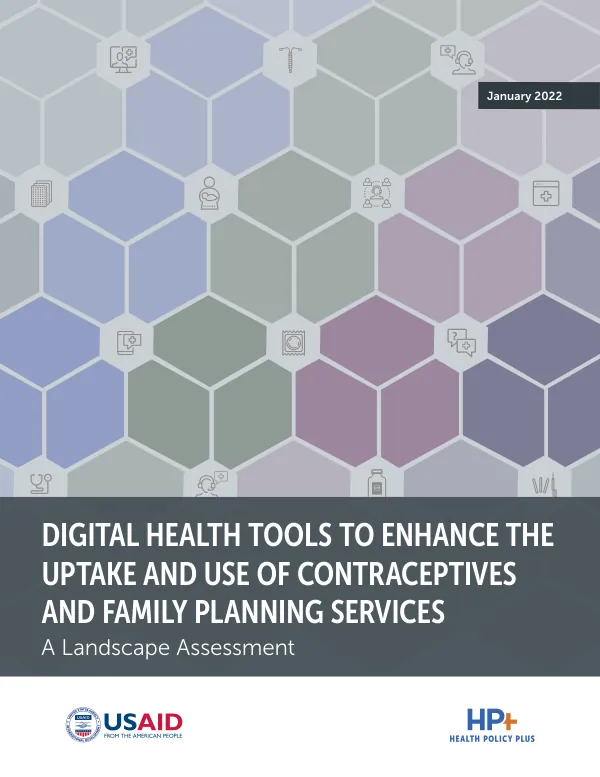
Digital Health Tools to Enhance the Uptake and Use of Contraceptives and Family Planning Services: A Landscape Assessment
Sign inAVENIR HEALTH
Digital Health Tools to Enhance the Uptake and Use of Contraceptives and Family Planning Services: A Landscape Assessment
The use of digital tools for health has expanded rapidly over the last decade.
2021 · 30 pages
Sign in to readA free account is required to download.
Abstract
From personal health tracking to referral coordination to data collection and analysis for management and monitoring, digital tools support a growing array of health system functions and users. Yet, by 2015, out of nearly 100,000 digital health tools created, less than 7 percent were estimated to be linked to family planning, sexual and reproductive health, and pregnancy. Among digital health tools aimed at individuals using or seeking family planning commodities or services, most tools initially sought to improve users' knowledge of family planning methods and services; recently, new digital tools aim to modify users' or potential users' behaviors by integrating features related to service provision. Digital health tools can increase the effectiveness of family planning service delivery and campaigns, and they have the potential to address gender barriers that restrict family planning access and use among hard-to-reach populations. Such barriers may include cultural or social norms that restrict women's mobility or ability to access services, young women's fear of stigma or disapproval for using family planning, gender norms around masculinity that limit men's health-seeking behaviors for family planning or their support for partners' family planning use, and the view that health centers are a part of women's space and less that of men, among others. At the same time, there is well-documented evidence of a "digital divide" in access to and use of digital tools among men and women. Social and cultural practices and beliefs surrounding who should access technology and for what purposes, who controls household finances, and who makes decisions regarding health and family planning, among other areas, are all relevant when it comes to designing tools that can positively impact gender and power dynamics, as well as generate demand for family planning. The ability of digital health tools to connect with hard-to-reach populations, especially those particularly affected by gender-related barriers to family planning, remains unclear. On the surface, the potential of digital health tools can seem obvious: they can reach these groups through telehealth or tele-counseling, especially during the COVID-19 pandemic; they allow for tailored and targeted information and education, including messages that challenge unequal gender norms; they can use text or audio messages to share links to health community centers, pharmacies, or healthcare providers; they can be launched through social media and other digital channels that potential users access and trust; and they can be a very cost-effective way to collect high-frequency data. Whether this potential can be realized warrants further consideration. Within this context, the family planning community is interested in assessing the potential of digital health tools to sustainably increase the use of family planning services. Sustainability here has two meanings. First, it means the capacity to improve the uptake and continued use of family planning services by effectively linking users to services and commodities. Increasingly, digital tools for health have begun to incorporate features that directly connect interested users to providers or health commodities, either virtually or in person, to encourage uptake. Understanding which types of features are most effective in catalyzing these service delivery connections among various populations is therefore important in generating sustainable family planning use. Second, digital interventions can incorporate mechanisms that would allow potential users to pay (either fully or partially) for family planning goods or services, either before or after the service is provided, or allow the provider to be reimbursed for a service provided. This could be particularly beneficial for women who may be afraid of accessing family planning services due to stigma, as these payment mechanisms could allow them to purchase services without having to physically visit a facility.
Related documents