USAID DEC
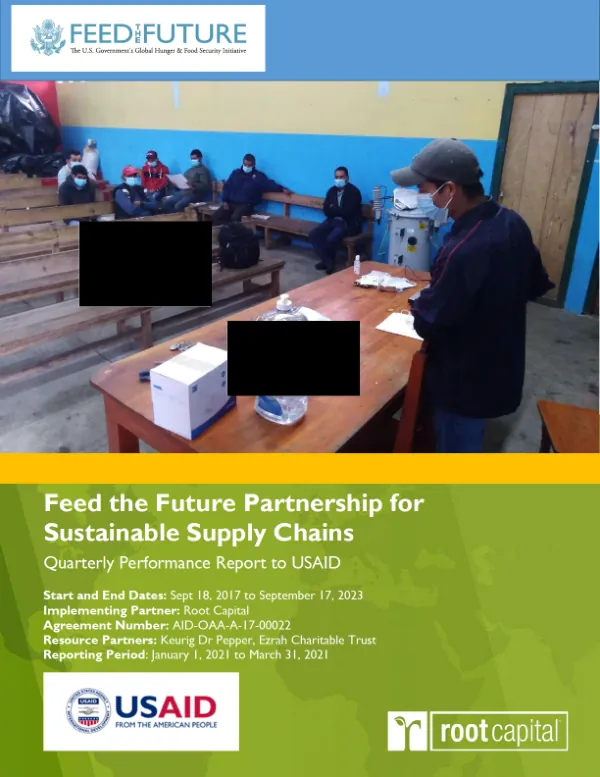
Progress Report: COVID-19 Resilience and Debt Relief Support for Agri-SGBs
The agricultural development initiative in Honduras began with Root Capital's regional advisory team conducting Financial Fundamentals assessments with agri-SGBs participating in BMA services.
2021 · 16 pages
Sign in to readA free account is required to download.
Abstract
In October, the team led capacity building sessions with advisors to strengthen gender inclusion across advisory services. The sessions aimed to provide conceptual and methodological elements, as well as participatory techniques, for advisors leading training engagements. Agri-SGBs maintained active operations with the implementation of required biosafety measures. To minimize the risk of infection, clients adapted new ways of working through part-time and remote work. However, management and coordination continued to be a challenge without significantly affecting production. Uncertainty persisted regarding possible outbreaks and government-mandated protocols that could impact production volumes and sales. In Honduras, Root Capital worked with four coffee SGBs, focusing on financial literacy, financial analysis, and internal controls. Financial literacy services were provided to agri-SGB staff with governance, managerial, or middle management functions to strengthen their knowledge, skills, and practices in interpreting financial statements for financial decision-making. Financial analysis involved strengthening capacity to perform calculations of financial indicators to evaluate economic and financial performance and detect difficulties. In Ghana, approximately 20% of advisory engagements were held in-person, as advisors and clients favored virtual training. This was a great accomplishment for Root Capital's regional advisory team, as many clients had been hesitant to engage in virtual advisory services since the COVID-19 pandemic. Throughout 2021, Root Capital continued to develop the virtual training skills of advisors, building upon e-learning capacity while safeguarding the quality of tailored services. In Indonesia, advisory services reached one coffee SGB and focused on accounting and taxation. Clients preferred in-person engagements, but logistical challenges persisted due to COVID-19 restrictions, including air travel restrictions and requirements for negative polymerase chain reaction (PCR) tests. Despite these challenges, clients showed interest in Digital Business Intelligence services, especially to help with new standards. Root Capital launched COVID-19 Resilience Grants to meet agri-SGBs' urgent cash flow and crisis-related needs in the wake of the pandemic and natural disasters. The project component was completed in August 2021, and $173,920 was disbursed to 20 coffee enterprises. The grants supported projects that benefited over 6,000 coffee farmers, including over 1,700 women. Each project focused on one or more of the following themes: preventing the spread of COVID-19, maintaining business operations, providing social protection, promoting food security, and supporting community health and well-being. The most in-demand project focus was "Maintaining Business Operations," with 14 of the 20 grantees applying their grant funds towards this use. "Preventing the Spread of COVID-19" was the second most common priority, with nine of the 20 grantees choosing this project area. All projects included a gender-inclusive component to ensure that women had the resources and support they needed to withstand the COVID-19 crisis. Root Capital continues to move forward with debt relief for clients in various regions. In one case, a partial settlement agreement was approved, including an exemption of accumulated interest of ~$25K and a capital payment of $220K. In another case, a settlement plan was approved for an outstanding loan facility and grant-funded debt relief for a coffee SGB client in Uganda. The client was approved for a facility of $300,000 and was able to revolve the line of credit to $253,500 in 2020 before it matured in December 2020.