USAID. MISSION TO INDIA
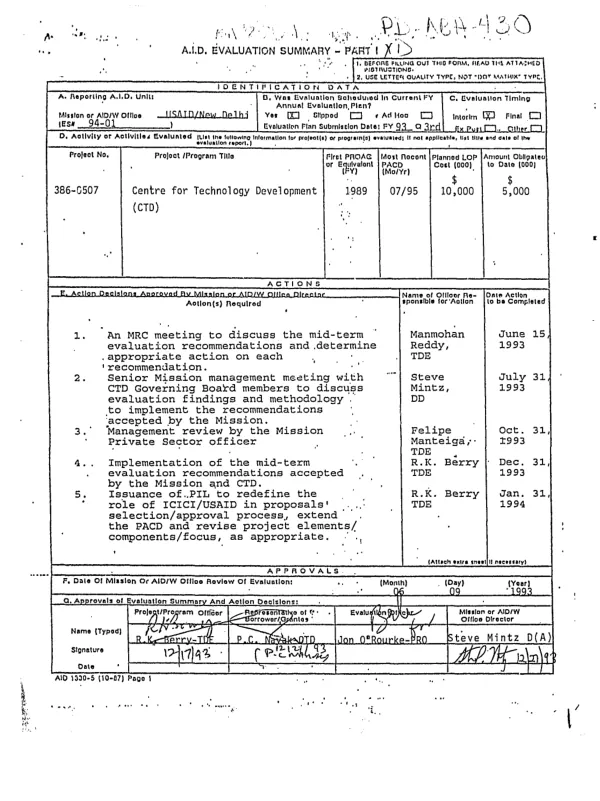
Project activity completion report : Center for Technology Development (CTD)
PACR of a project (1989-98) to establish the Center for Technology Development (CTD) as a private organization for stimulating technology development and commercialization in the Karnataka region of India.
Sign in to readA free account is required to download.
Abstract
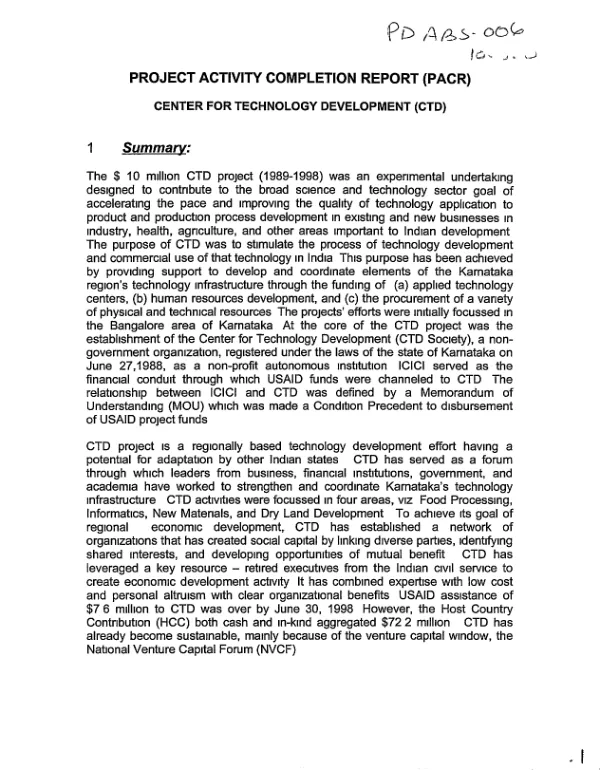
The project achieved its purpose. The CTD has been legally established as a non-profit autonomous institution and has served as a forum through which leaders from business, financial institutions, government, and academia have worked to strengthen and coordinate Karnataka's technology infrastructure. CTD activities were focused in four areas: food processing, informatics, new materials, and dry land development. To achieve its goal of regional economic development, CTD has established a network of organizations that links diverse parties, identifies shared interests, and develops opportunities of mutual benefit. CTD has leveraged a key resource -- retired executives from the Indian civil service -- to create economic development activity, combining expertise with low cost and personal altruism with clear organizational benefits. CTD's goal is to commercialize laboratory-level scientific knowledge into market-driven goods and services for the global marketplace. To this end, it concentrates on commercializing technology after the basic research is over, i.e., on applied research. To promote industry-institute interaction, CTD promoted two non-profit companies under Section 25 of the Indian Companies Act for the commercialization of technologies developed at leading scientific institutions. One such company, Agricultural Technologies and Services Private Limited (Agritech) has commercialized and marketed agricultural, horticultural, and allied technologies developed by various research and development (R&D) organizations. CTD has a Governing Board of representatives from industry, R&D institutions, academia, the Government of Karnataka, and financial institutions, as well as executive and finance committees. CTD does innovative co-financing with other financial institutions, especially for venture capital to accelerate the commercial introduction of the new technologies. This venture capital window, the National Venture Capital Forum (NVCF), is the main reason why the CTD has already become sustainable. CTD's replicability in the region, a key project objective, is evident from its establishment of the Kumaon Development Center (KDC) as an independent society for the development of the Kumaon Division of Uttar Pradesh. Key lessons learned include the following: (1) Regional development is a process, not a project. (2) Concentrated effort in a few focused thrust areas yields quick results. (3) Leveraging of funds by coordinating with multiple financing agencies is essential.
Related documents