USAID DEC
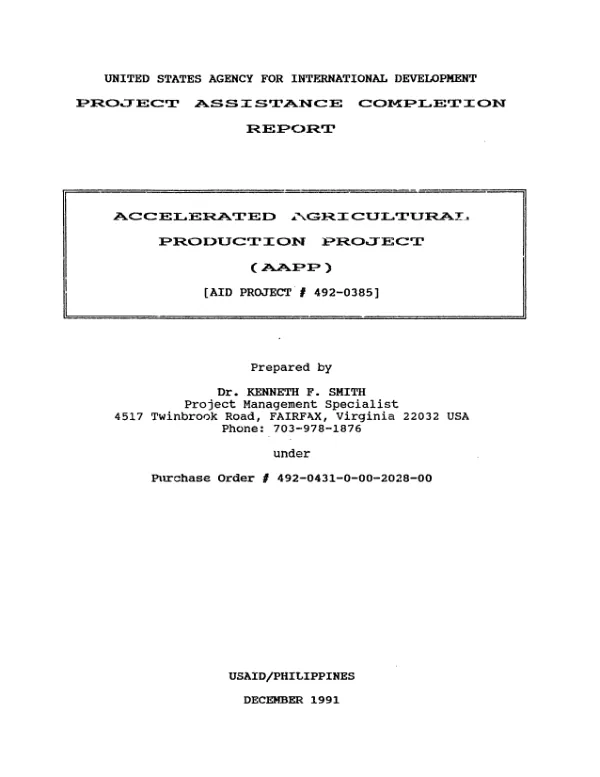
Project assistance completion report : accelerated agricultural production project (AAPP)
Sign inUSAID. MISSION TO PHILIPPINES
Project assistance completion report : accelerated agricultural production project (AAPP)
PACR of a project (8/86-12/91) to increase agricultural production in the Philippines.
Smith, Kenneth F. · 1991
Sign in to readA free account is required to download.
Abstract
The project was essentially a funding mechanism for subprojects (SPs) to improve support services, agricultural marketing, and policy and program formulation. In all, 12 SPs were implemented: marketing and information services; agricultural statistics; research and outreach; privatization; fertilizer development; economic and policy analysis; grain stabilization; planning and program development; crop diversification; irrigation; market development; and improved management services. The project was a huge success, having numerous and broad impacts. Perhaps most importantly, it helped the Department of Agriculture (DA) to reshape its vision and to gain visibility and respect. The project press office even made major contributions to President Aquino's "State of the Nation" address. Further, the project helped DA shift from a "top down" to a "bottom up," approach, integrate research and extension, strengthen its economic and policy analysis and survey capability, increase administrative efficiency, and forge a new partnership with the private sector. These efforts have equipped the DA to meet the challenges it will face when the new Local Government Code is implemented in 1/92. Also, the success of pilot irrigation activities provided impetus for a World Bank follow-on. The project trained hundreds of thousands of farmers and some 37,000 DA and National Irrigation Authority staff, organized the farmers into productive communities, helped linked them to private businesses with whom they could conclude marketing agreements, and directed the DA toward helping farmers produce and sell profitable crops. The project's successes are all the more remarkable in light of the constraints under which it operated, including GOP funding bottlenecks and USAID's inflexible requirements for U.S. sourcing. Lessons and recommendations include the following. (1) Worthwhile projects can eventually emerge from a learning process design. (2) During the latter part of the project, increasing emphasis was put on linking SPs; the additional effort required was justified by the resulting benefits. (3) A revolving fund credit line for GOP Project Administration should be tested. (4) Consultants should work on-the-job with regular line personnel for extended periods of time: technology is transferred both ways. (5) Because of Murphy's Law, projects always take longer to get started than anticipated. This should be taken into account in project planning. (6) Sourcing requirements for computer hardware and peripherals (not software) should be abandoned.