USAID DEC
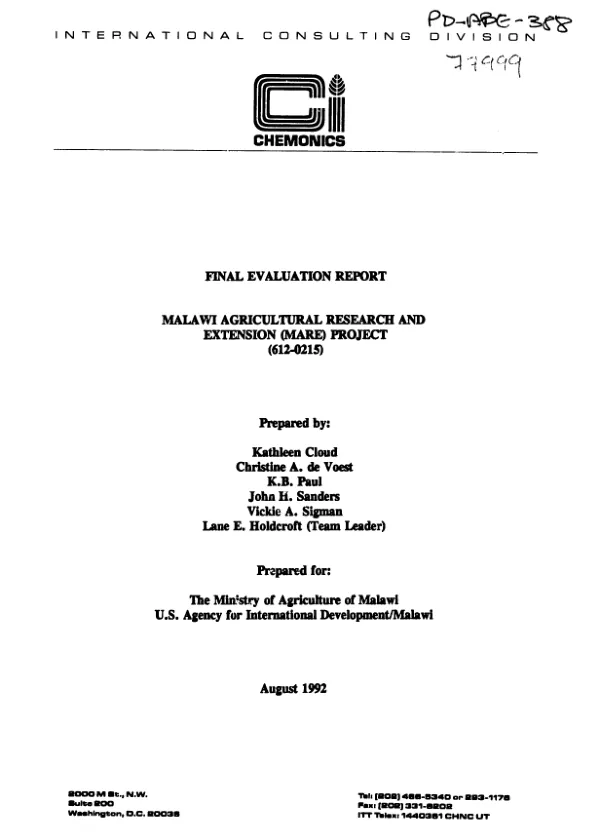
Final evaluation report : Malawi agricultural research and extension (MARE) project (612-0215)
Sign inCHEMONICS INTERNATIONAL, INC.
Final evaluation report : Malawi agricultural research and extension (MARE) project (612-0215)
Final external evaluation of a project (1985-92) to improve the capacity of Malawi's Ministry of Agriculture (MOA) to conduct agricultural research and extension (AR&E) aimed at increasing and diversifying smallholder production.
Holdcroft, Lane E.|Cloud, Kathleen · 1992
Sign in to readA free account is required to download.
Abstract
The project substantially strengthened the AR&E system's agroforestry, horticulture, and economic analysis components, and the project's large training component, which included 48 Ph.D. and M.Sc. programs, had a great effect on the MOA, Project training, complemented by on-farm trials, led to the release of two flint type maize hybrids in 1990, This is a remarkable achievement, which will contribute to major increases in maize production. Nonetheless, the AR&E system has been perturbed by a series of donor interventions and external shocks from which it will need time to recover. Retention of trainees has also been a problem. Specific findings are as follows. (1) The unconventional system of project management, under which a U.S.-based project coordinator and the MOA controller of agricultural services were responsible for overall management -- rather than an onsite chief-of-party -- worked quite well. (2) The adaptive research program focused attention on the need for regionalized recommendations and substantially improved MOA ability to collect and analyze farm-level data, but has not yet been integrated into the overall AR&E system. (3) Despite the project's major investments in infrastructure, training, and laboratory equipment, recurrent costs remains a problem -- the government has failed to provide even modest operating funds for many activities. (4) The project significantly strengthened the MOA's Visual Aids Unit and Extension Aids Branch. (5) The Women's Program had great success in integrating women farmers and professionals into extension, credit, training programs. For example, the amount of credit going to women through farmers groups increased from 8.3% in 1983 to 34.4% in 1991. The Program also implemented a series of income-generation projects and trained both male and female extensionists to work with women farmers. However, women farmers' influence on the research agenda is still nowhere near commensurate with their massive contributions to agriculture in Malawi. (6) The objective of diversifying smallholder production and income was generally not achieved. Research priorities should be revised to focus on crops with greater drought resistance, such as cassava and sorghum-millet, and substitution of maize by other crops such as sorghum, sweet potato, cassava, and banana should be encouraged. The project was relatively well designed, except for three things: the lack of attention to soil science, an overestimation of the number of new technologies to be extended to smallholders, and its greatly reduced support (compared to the predecessor project) for the maize program, just at the time the program was in a position to start producing new technology. This last lesson has direct implications for the agroforestry and horticulture programs, now that they are able to start producing technology.