USAID DEC
Project assistance completion report : agricultural development systems project (263-0041)
Sign inUSAID. MISSION TO EGYPT
Project assistance completion report : agricultural development systems project (263-0041)
Final Mission report on a project (9/77-9/86) to upgrade horticultural research and economic analysis in Egypt's agricultural sector.
1987
Sign in to readA free account is required to download.
Abstract
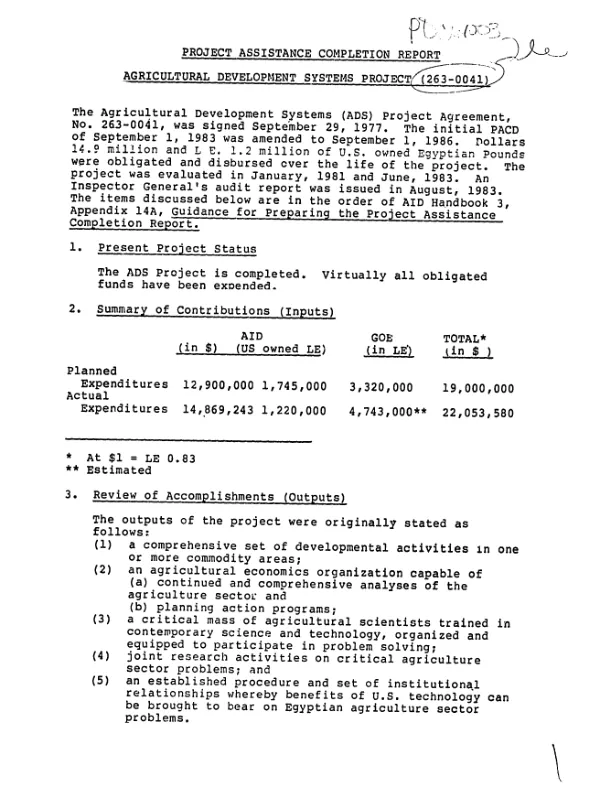
Project targets, as modified by amendment, were largely fulfilled. Outputs include: a horticultural laboratory with tissue culture and greenhouse facilities, located at the University of Cairo; project-generated technologies and extension reports; various improved horticultural crops and increased production; baseline studies for economic policy formulation; extensive training (six Ph.D. degrees, 12 postdoctoral assignments, and short-term training for 260 persons); 10 economic policy workshops; and support funding for 450 Egyptian researchers. Relationships were facilitated between the Ministry of Agriculture (MOA) and academic researchers, both Egyptian and American, where before there had been little contact. The horticultural laboratory, the result of extensive collaboration between Egyptian institutions and the University of California, produced a high-yielding tomato variety which has been extensively adopted and, it is estimated, has increased Egyptian farm incomes by an amount as great as the total U.S. contribution to the project. The sustainability of these achievements is, however, seriously in doubt, for they were generated in an environment that basically stood outside of Government of Egypt (GOE) institutions such as the MOA, the local university system, and the Agricultural Research Center. Although sustainability was identified as a problem as early as 1983, a strategy for institutionalizing project activities was never developed. In fact, since the PACD the horticultural laboratory has been underfunded by the GOE, while the agricultural economics component, which generated no facilities, has dissolved. Although it is not known exactly why sustainability issues were neglected, it may be that the project was intentionally designed to circumvent GOE institutions so that it would have the financial flexibility to more quickly generate research. And this is the project's major lesson - while circumvention of host government institutions may produce useful results, it cannot produce institution building. Additionally, project objectives, expectations, and management roles should be clearly understood by all parties from the outset.
Related documents