RONCO CONSULTING CORP.
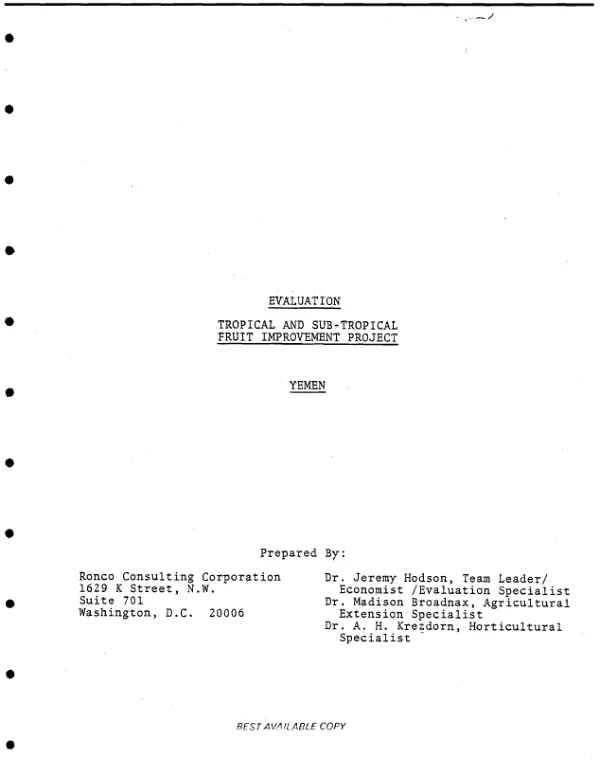
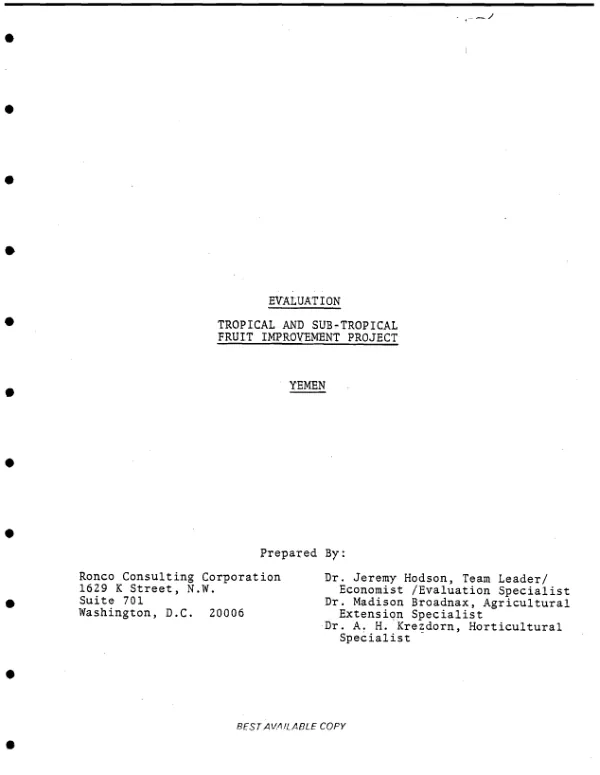
Evaluation; tropical and sub-tropical fruit improvement project
Evaluates project to develop an institutional base for future production of horticultural crops (i.e., fruits and nuts) in Yemen.
Hodson, Jeremy|Broadnax, Madison|Krezdorn, A. H. · 1981
Sign in to readA free account is required to download.
Abstract
Special evaluation covers the period 7/77-7/81 and is based on site visits, document review, and interviews with project personnel. The project has been a disappointment and has lost its credibility in the view of the Yemen Arab Republic Government (YARG). A.I.D., having received no bids for implementation, sought out a contractor, Tuskeegee University (TU), which had limited qualifications and did not begin field activities until early 1979. Moreover, A.I.D. fostered discontinuity in project management. USAID/Y, for its part, authorized expenditures in a manner which inhibited planning, did not mobilize or coordinate YARG contributions, was slow and inefficient in completing the research stations, and did not work well with TU. As a result, few project outputs were achieved. Although nurseries were assisted and growing sites and research stations were established in Bir al Shaif and Jarouba, the first station will likely be abandoned and relocated and the other has inadequate facilities. Further, no YARG Ministry of Agriculture personnel were trained; no imported varieties of trees have fruited; no yield data on local varieties have been obtained; no research was initiated on improved cultural practices; and baseline and projection analyses of promising horticultural crops were indefinitely postponed. To redesign the project for a proposed follow-on phase, it is recommended to: (1) build on project achievements, however limited; (2) adapt to the fact that top TU faculty are unlikely to accept 2-year assignments in Yemen; (3) upgrade TU staffing; (4) develop a balanced research/dissemination program with improved research techniques and development of propagation nurseries; (5) promote greater YARG involvement; (6) transfer project management to TU; (7) coordinate research with horticultural research elsewhere; and (8) renew efforts to initiate in-country and overseas training.
Related documents