USAID. MISSION TO JAMAICA
Project assistance completion report : agricultural planning project (532-0061)
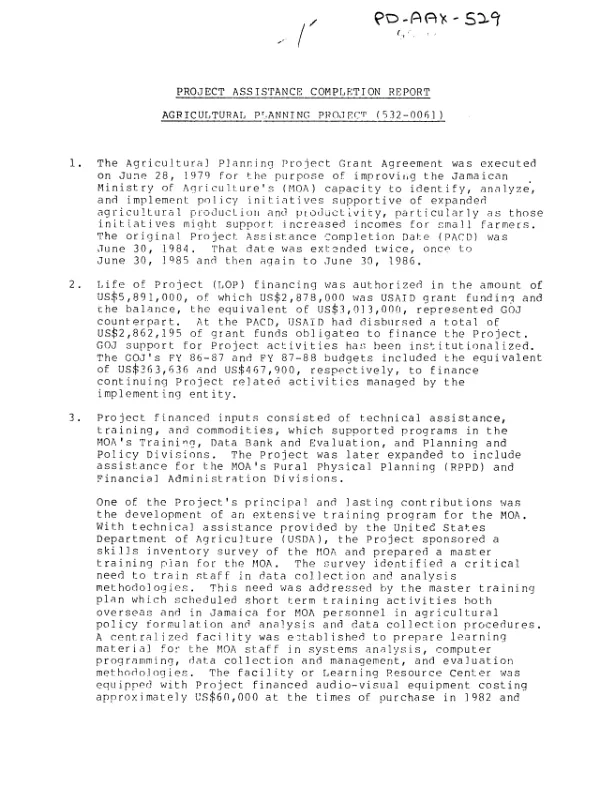
Project Assistance Completion Report on a project (6/79-6/86) to improve the planning capabilities of the Jamaican Ministry of Agriculture (MOA).
Sign in to readA free account is required to download.
Abstract
The project's principal contribution was the development of an extensive training program for the MOA. Short-term training was provided overseas and in-country in agricultural policy formulation and analysis and data collection procedures. A Learning Resource Center was established to prepare educational materials in systems analysis, computer programming, data collection and management, and evaluation methodologies. Installation of a mainframe computer for the MOA's Data Bank and Evaluation Unit was another major project contribution. One of the many uses to which the computer was put was analysis of data from a food survey consumption survey, which benefited USAIS/J's food aid planning as well as the MOA. The computer, however, functions at only a fraction of its potential capacity, due in large part to inadequate levels of skilled personnel and support. The project also prepared a series of policy planning and analytical reports, covering a wide range of activities; these reports provided background for a Five-Year Plan. The Plan, however, while a good historical review, did not thoroughly analyze the constraints facing the agricultural sector. Finally, the project financed installation of a Comprehensive Resource Inventory and Evaluation System (CRIES) comprising land use, soil, and crops databases. The land use database was updated over the period 1983-85, but unfortunately the MOA did not achieve full benefit from the system due to inadequate access to suitable satellite imagery. The TA contractor for the non-CRIES activities did enhance the MOA's data collection abilities, but was less successful in institutionalizing policy analysis skills. In general, this was because the TA team members, lacking previous development project experience, tended to function as MOA staff and failed to recognize that surveys, computers, etc., are ultimately only tools to be used in support of policy formulation. On the Jamaican side, the project suffered from extensive staff turnover, especially for more skilled personnel who could not be retained on their MOA salaries. Overall, this project, rather than preparing a long-term blueprint for sector development with detailed quantitative targets, should have devoted its limited resources to programming public investment and improving the system of prices, incentives, and performances of markets. Future activities to strengthen public agencies' planning capacities should keep in mind that these agencies need to be able to respond quickly to changing events. This requires a much improved information base and some centralized responsibility for policy coordination.