DATEX, INC.
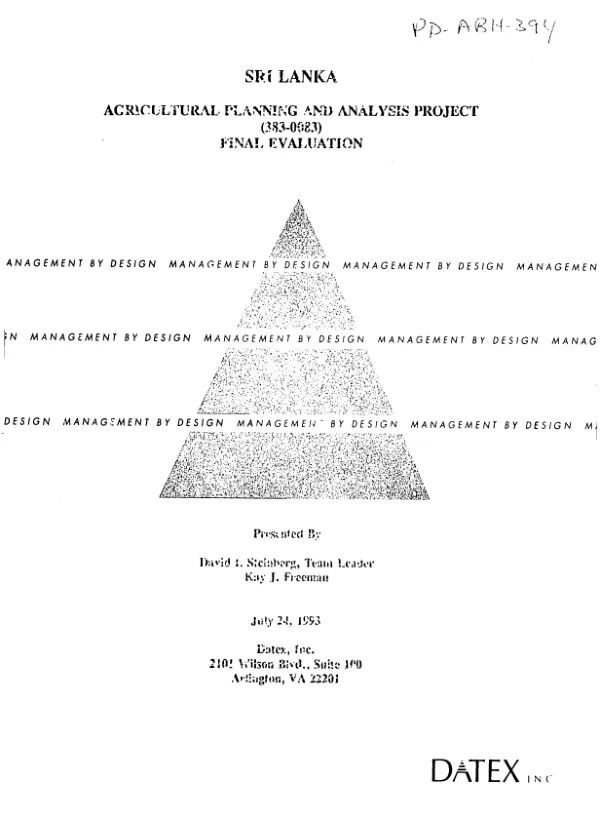
Sri Lanka agricultural planning and analysis project (383-0083) : final evaluation
Final evaluation of a project to enhance agricultural planning and policy analysis in Sri Lanka.
Steinberg, David I.; Freeman, Kay J. · 1993
Sign in to readA free account is required to download.
Abstract
Evaluation covers the period 8/86-8/93, against a 12/93 PACD. The project was an important, successful effort. It responded to Sri Lankan needs, and was appropriately modified to meet changing provincial roles. Although not originally designed to directly affect policy reform (but rather to create its intellectual and administrative infrastructure), it had a far greater positive impact than could have been expected. The provision of long and short-term TA was combined with training and equipment in a judicious and supportive manner. The TA advisor was eminently successful, playing critical roles in the management of policy and research papers. Training was the most important aspect of the project, although language testing issues clouded the choice of some candidates. Procurement was probably the most delayed and troublesome aspect of project administration. A functioning agricultural planning system is in effect; and a mid-term national agricultural strategy will be completed by 12/93. The technical and analytical capabilities of the planning units have been strengthened, including the provincial units, whose outlooks have been broadened and whose staff capacities have been enhanced. Much closer links now exist between the National Planning Division and the provinces, which are the base for the new agricultural strategy. Legislators and policy makers increasingly seem to have turned to these groups for policy advice and options. Sri Lankan officials indicated that they were able to present sound, prioritized policy alternatives to the cabinet on short notice because of the project, and that its overall impact was positive. This type of project can speed the reform process when the direction has been determined, provide analytical data on which reforms my be justified, and train those who prepare policy options. But it cannot change policies that the state is unprepared to alter. The policy successes were a product of proper timing, the correct choice of policy issues, excellent TA, and donor policy coordination. The project should be terminated as scheduled; however, the project should first fund studies and seminars for the new agricultural development strategy to be developed after PACD. Lessons learned are as follows. (1) TA is a highly personalized activity, and advisors should have disciplinary competence, country experience, and cross-cultural sensitivity. (2) Host-country contracts create administrative headaches, but may provide the basis for host-country relationships that are more effective. (3) Agricultural and rural sector projects should be considered within the broad political economy. (4) Policy reforms will take place when governments perceive them to be in their interests; donors must be prepared administratively and conceptually to respond quickly. (5) It is usually impossible to pinpoint the genesis of policy change and assign credit to any one donor. (6) Training is an important investment in long-term sustainable policy and developmental change. (7) Project modifications, training, and commodity procurement, because of the increasing complexity of USAID and U.S. Government regulations, are becoming more difficult and require intensive staff effort in order to be successful. (Author abstract)
Related documents
Documents in this collection
 1993
1993USAID DEC
Sri Lanka agricultural planning and analysis project (383-0083) : final evaluation
Open record 1987
1987USAID DEC