USAID DEC
Project assistance completion report : agricultural research and extension project (AREP)
Sign inUSAID. BUR. FOR LATIN AMERICA AND THE CARIBBEAN. REGIONAL DEVELOPMENT OFC. CARIBBEAN
Project assistance completion report : agricultural research and extension project (AREP)
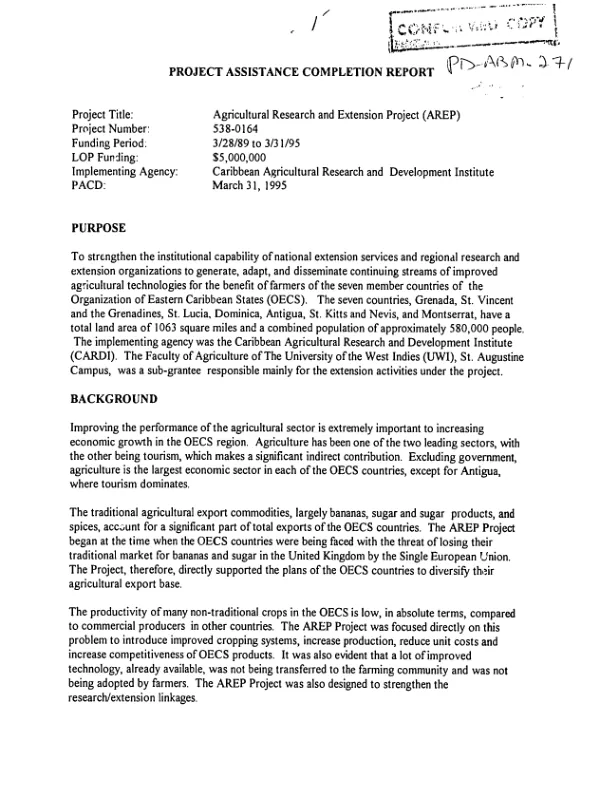
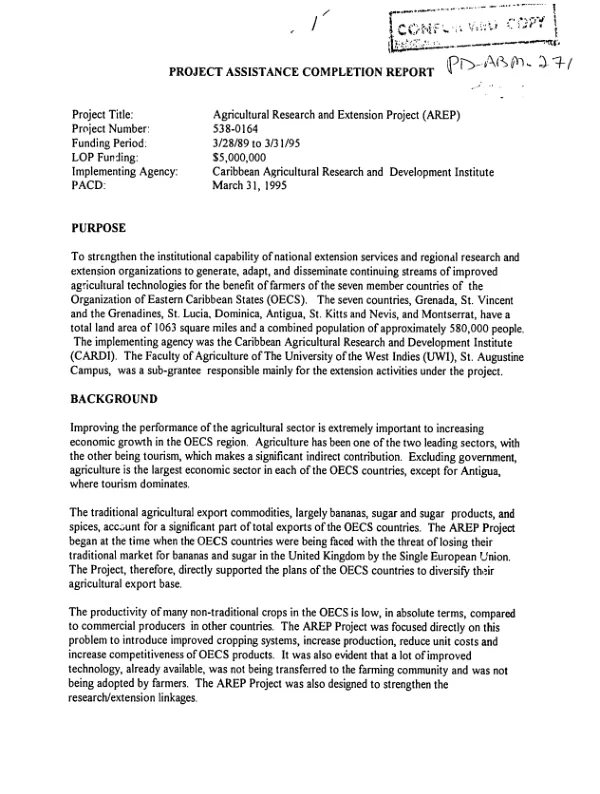
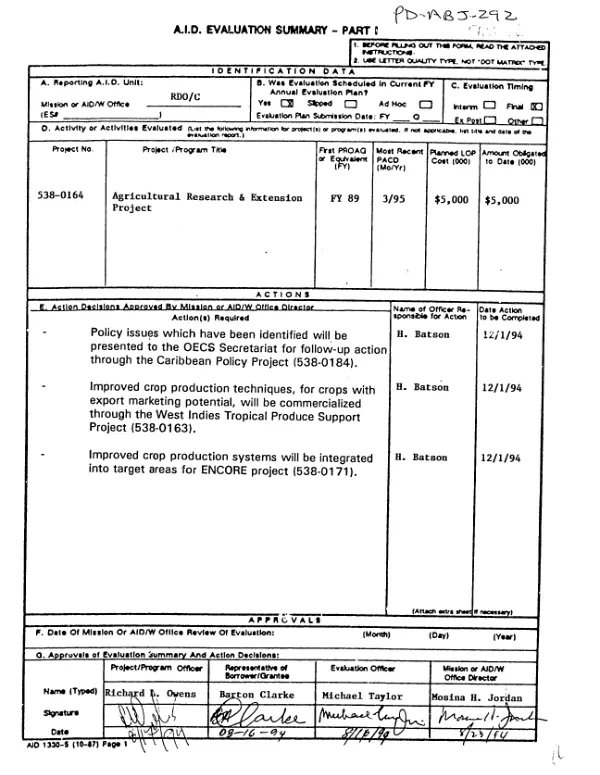
PACR of a project (3/89-3/95) to strengthen national agricultural research and extension services in the seven member countries of the Organization of Eastern Caribbean States (OECS).
1995
Sign in to readA free account is required to download.
Abstract
Major accomplishments include the following. The project: (1) developed and disseminated technologies for improved production of eddoe, ginger, plantain, pineapple, yam, onion, hot pepper, papaya, dasheen, and passion fruit (limited work was done on breadfruit and sapodilla); (2) addressed more than 100 technological constraints in such areas as varieties, planting density, fertilizer, irrigation, postharvest handling, pest and disease management, weed control, and horticultural practices such as pruning, mulching, flower initiation, trellising, and land preparation; (3) conducted more than 450 validations/demonstrations of alternative technologies and production systems; (4) developed a "task force" approach as a mechanism for commercializing commodities in OECS states; (5) delivered training via demonstrations, lectures, field days, seminars, etc. to farmers, extension officers, and marketing agents, totaling 4,654 people; (6) supported regional workshops for 389 persons; (7) established or strengthened linkages between CARDI (Caribbean Agricultural Research Development Institute, the implementing agency) and ministries of agriculture, universities, and other agricultural R&D organizations; (8) produced 117 publications (reports, factsheets, manuals, farmers" guides, conference papers, etc.); and (9) conducted 58 institutional strengthening activities for CARDI. Assessments showed that the adoption rate among the 1,918 farmers exposed to new technology was 47%; among these farmers, it was estimated that 53% of the technologies to which they were exposed were being put to use. Average cost of production per kg of the crops assessed fell 35%-75%, and productivity of onion and ginger cropping increased. The system of transferring technologies has been institutionalized in CARDI, the University of the West Indies, and the national agricultural extension services. Lessons learned include the following. (1) Technology generation and transfer must consider end-user requirements for profitability, marketing constraints, and government support policies. (2) Front line extension officers need continuing training and support in economic and business- related technical and analytical skills in order to provide practical services to farmers. (3) The joint focus planning and task force approach should be further documented in training manuals and transferred to national extension systems. (4) Farmers need help in organizing production to take advantage of growing agro-tourist and export markets.
Related documents
Documents in this collection
 1995
1995USAID DEC
Project assistance completion report : agricultural research and extension project (AREP)
Open record![CARDI [Caribbean Agricultural Research and Development Institute]/UWI [University of West Indies] agricultural research and extension project : AID grant no. 538-0164 -- final evaluation report](https://covers.devme.ai/gen/7430.webp) 1994
1994USAID DEC
![CARDI [Caribbean Agricultural Research and Development Institute]/UWI [University of West Indies] agricultural research and extension project : AID grant no. 538-0164 -- final evaluation report](https://covers.devme.ai/gen/36262.webp)