USAID. BUR. FOR LATIN AMERICA AND THE CARIBBEAN. REGIONAL DEVELOPMENT OFC. CARIBBEAN
Agricultural research and extension project
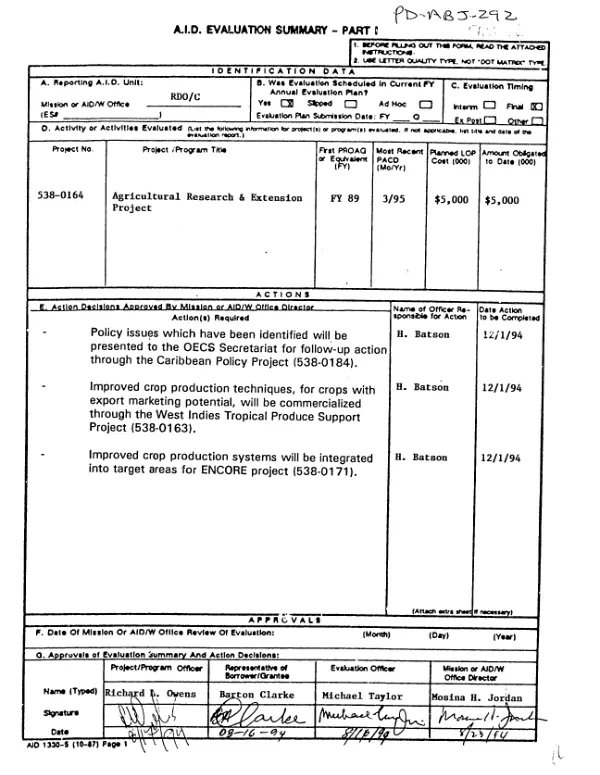
Summarizes attached final evaluation (XD-ABJ-292-A) of a project (3/89-7/94) to strengthen the capability of national and regional entities in the Eastern Caribbean to develop and disseminate improved agricultural technologies.
1994
Sign in to readA free account is required to download.
Abstract
The project made satisfactory progress towards stated goals and outputs. The Caribbean Agricultural Research and Development Institute (CARDI) developed a large number of improved technologies for 13 crops, most of which have been transferred to farmers, especially larger farmers and commercial small farmers, with the assistance of national extension officers. The full extent of the transfer is not clear, however, since mechanisms for estimating the project"s impact on income and employment were not developed. The Farm and Home Management Program (FHM) was developed to help address this issue, but has not been widely accepted by farmers, especially by small farmers. Even adequate baseline data are still lacking, although efforts are being made in this direction. On the positive side, the FHM has created an awareness of the importance of improved technologies and the need for farmer-friendly communications materials among extension officers. One of the project"s weak points was lack of farmer participation in research and extension planning, despite the strong CARDI-farmer linkage established through on-farm validation trials. Unfortunately, the assumption that a strong extension service had been developed by previous projects proved false. Extension was ineffective and continues to suffer from personnel mobility problems and irregular government support, although numerous extension support activities were effectively continued under the project, e.g., the Diploma program at the University of the West Indies, the annual Excellence in Extension awards, in-service training courses, and the creation of five Island professional agricultural extension associations. A tremendous potential exists for farmers to supply food to the growing tourist industry. While this potential has not been generally realized, successful examples do exist, such as the Nevis Growers Association"s supply of commodities to the Four Seasons Hotel, the St. Vincent root crop program, and the St. Kitts/Nevis onion export program (livestock and meat production were outside the project"s scope). These successes were due to the project"s joint focus planning and task force approaches, which focused multi-agency resources on a clear objective, addressed market constraints, and obtained government policy support. Action decisions are to incorporate policy issues in the Caribbean Policy Project (5380184), support improved crop production techniques for crops with export potential through the West Indies Tropical Produce Support Project (-0163), and integrate improved crop production systems into target areas of the ENCORE project (-0171). Lessons learned are as follows. (1) Technology generation and transfer must consider end-user requirements for profitability, marketing constraints, and government support policies. (2) Front line extension officers need continuing training and support in economic and business-related technical and analytical skills. (3) The joint focus planning and task force approach should be further documented in training manuals and transferred to national extension systems. (4) Farmers need help in organizing production to take advantage of growing agro-tourist and export markets.
Related documents
Documents in this collection
![CARDI [Caribbean Agricultural Research and Development Institute]/UWI [University of West Indies] agricultural research and extension project : AID grant no. 538-0164 -- final evaluation report](https://covers.devme.ai/gen/7430.webp) 1994
1994USAID DEC
CARDI [Caribbean Agricultural Research and Development Institute]/UWI [University of West Indies] agricultural research and extension project : AID grant no. 538-0164 -- final evaluation report
Open record 1995
1995USAID DEC
![CARDI [Caribbean Agricultural Research and Development Institute]/UWI [University of West Indies] agricultural research and extension project : AID grant no. 538-0164 -- final evaluation report](https://covers.devme.ai/gen/36262.webp)