USAID DEC
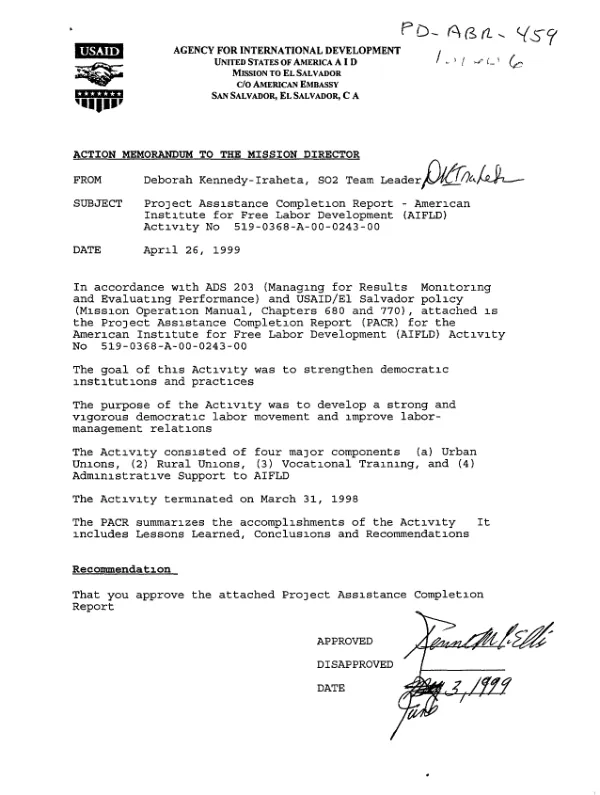
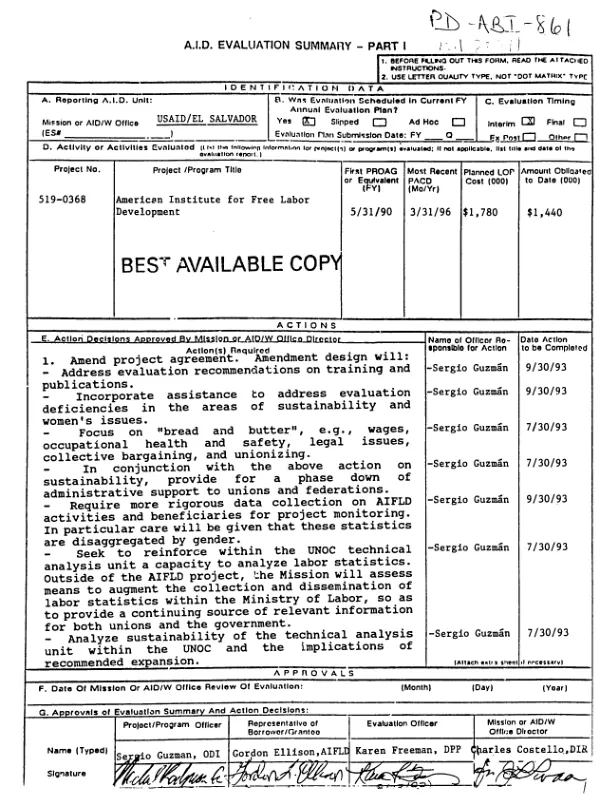
Project assistance completion report : American Institute for Free Labor Development (AIFLD) -- activity no. 519-0368-A-00-0243-00
Sign inUSAID. MISSION TO EL SALVADOR
Project assistance completion report : American Institute for Free Labor Development (AIFLD) -- activity no. 519-0368-A-00-0243-00
PACR of a project (5/90-3/98) to promote democratic labor unions in El Salvador.
1999
Sign in to readA free account is required to download.
Abstract
The American Institute for Free Labor Development (AIFLD) implemented the project. Up to the signing of the peace accords in 1/92, AIFLD technical and administrative assistance helped create and maintain labor and rural cooperative organizations that were independent of the political left. During this period, AIFLD was successful in maintaining a network of independent organizations, under the umbrella of the Union Nacional Obrero Campesino (UNOC). In the immediate postwar period, emphasis shifted to creating an enabling environment for collective bargaining by independent unions. The focus of these activities was a series of tripartite political negotiations that ultimately led to the reform of the existing labor code in 1994. Unfortunately, once the code was enacted, the Salvadoran economy entered a period of rapid transition characterized by the growth of the export assembly (maquiladora) industries and the contraction of the public sector. The focus of AIFLD"s support for the Democratic Workers Center (CTD -- successor to UNOC) shifted, accordingly, to defense of the rights of maquiladora workers and assistance to public sector unions that were attempting to redefine their roles in the face of privatization. During this period AIFLD helped the CTD form a number of new federations and continued to provide legal assistance for maquila workers fired as a result of union organizing campaigns. These efforts have been continued with the Confederacion Nacional de Trabajadores Salvadorenos (CNTS) and broadened to include other unions working in the export processing zones. At the same time, AIFLD provided basic trade union education to maquila workers and sought to educate the labor movement about new tactics, such as codes of conduct and independent monitoring, that began to appear at this time. In the first quarter of 1998, the Solidarity Center organized a conference on independent monitoring and codes of conduct. AIFLD and the Solidarity Center also developed a database on the maquila industry for use in worker education projects. With respect to privatization, AIFLD supported an initiative to create a worker-managed Pension Fund Administrator under the new pension law, and assisted workers in the telecommunications sector who were seeking a negotiated outcome for the privatization process in their industry. TA to rural organizations, which had been the largest components of AIFLD assistance before and during the war, declined thereafter. The village bank program, which benefitted 3,200 campesinos in 1994 alone, became self-sufficient using proceeds from prior loans. The mobile clinic program provided medical training and assistance to 1,900 agricultural workers through 47 health training courses before it was discontinued. AIFLD also supported a pesticide management training project and a program to support agricultural exports. Even after these programs were discontinued, AIFLD continued an extensive program of training for both urban and rural worker organizations, especially in the areas relating to land reform. Throughout the period of the agreement, AIFLD undertook a number of initiatives to promote labor-management cooperation. The most significant endeavor in this area was the Fundacion Obrero Empresarial Salvadorena (FOES), a joint labor- management foundation established under the AIFLD Cooperative Agreement to promote labor-management dialogue and provide institutional support to rural and urban worker organizations. In addition, AIFLD supported training programs on industrial relations with the Federal Mediation and Conciliation Service (FMCS). In the area of vocational education, from 1988 to 1996 AIFLD supported the Instituto Obrero-Empresarial de la Construccion (IOPIC), a training institution for the construction trades established by the International Masonry Institute/International Union of Bricklayers. During the period of the agreement, IOPIC graduated 2,000 skilled carpenters, bricklayers, painters, plumbers, and electricians, most of whom found well-paying employment in the unionized construction sector. The key lesson learned is that it is far more difficult to create a democratic labor culture than it is to sustain independent unions as political actors. (Author abstract, modified)
Related documents
![Microenterprise innovation program : cooperative agreement no. 940-0406-A-00-5246 [with Catholic Relief Services] -- close-out report](https://covers.devme.ai/gen/5658.webp)