USAID. MISSION TO EL SALVADOR
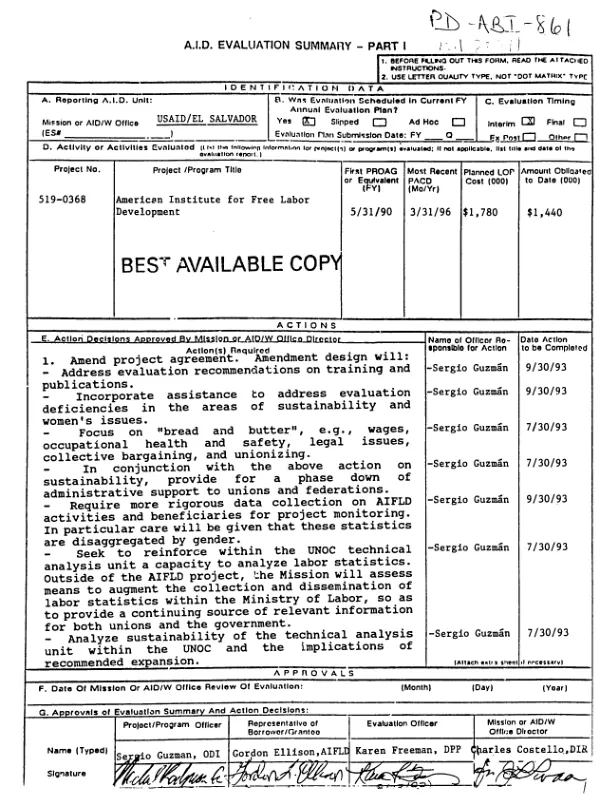
American Institute for Free Labor Development
Summarizes interim evaluation of a grant to the American Institute for Free Labor Development (AIFLD), to strengthen democratic labor unions in El Salvador by strengthening the National Union of workers and Peasants (UNOC) and other democratic unions.
1993
Sign in to readA free account is required to download.
Abstract
The evaluation assumes a 2-year project extension. In the past, AIFLD saw both radical anti-unionists and radical non-democratic unionists as equal threats to the development of a pluralistic society in which democratic unions played an important role. However, since the end of the civil war, the leftist threat to democratic trade unionism has diminished. Collective bargaining agreements should now be the first priority. Inter-organizational political differences appear to be the principal barrier to centralized union-cooperative training. Cooperative administration courses have played an important role in helping cooperatives to become viable agribusiness operations. The prospects for self-sufficiency are improving, as AIFLD"s client union federations are being weaned from project administrative support, and rural cooperative organizations are using village banks and agribusiness initiatives to attain self-sufficiency. UNOC"s credibility within the democratic labor movement, its policy formulation, and its presentation of democratic labor"s positions on national issues were strengthened through the project. The key was the technical team, consisting of an economist and two lawyers, who played a crucial role in strengthening the inter-union organization and the post-civil war labor-government-private sector forum. In the extension period, AIFLD should add three professionals to assist unions with agrarian and worker rights, research the state of collective bargaining contracts and union/federation organization, and collect information leading to productive union organization campaigns. (Author abstract, modified)
Related documents
Documents in this collection
 1999
1999USAID DEC
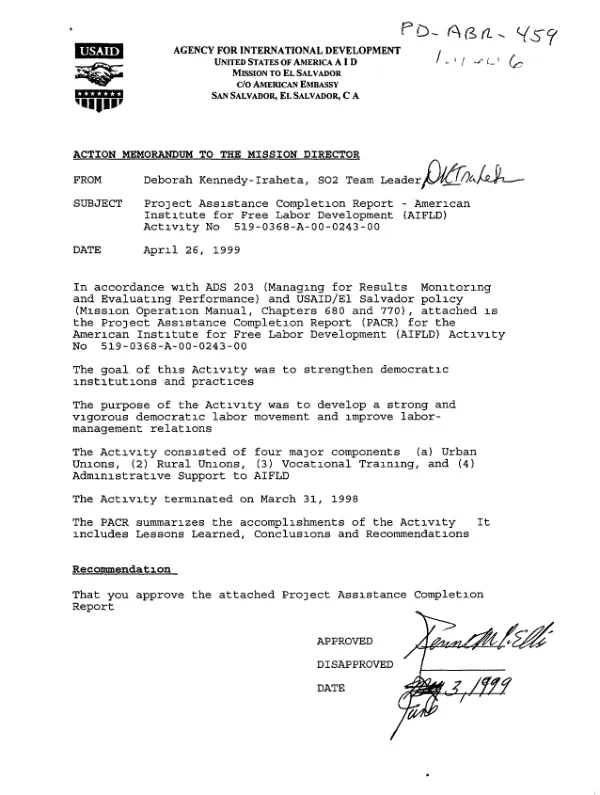
Project assistance completion report : American Institute for Free Labor Development (AIFLD) -- activity no. 519-0368-A-00-0243-00
Open record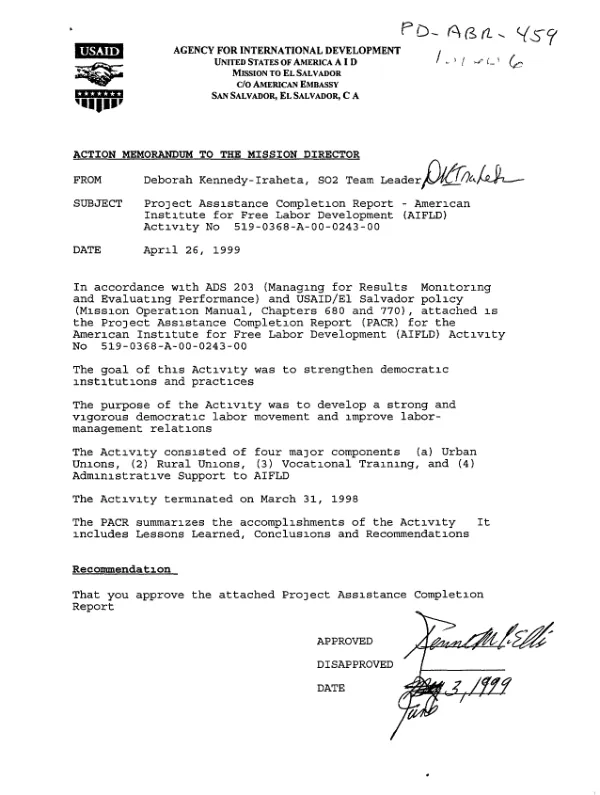 1999
1999USAID DEC