USAID. MISSION TO TOGO
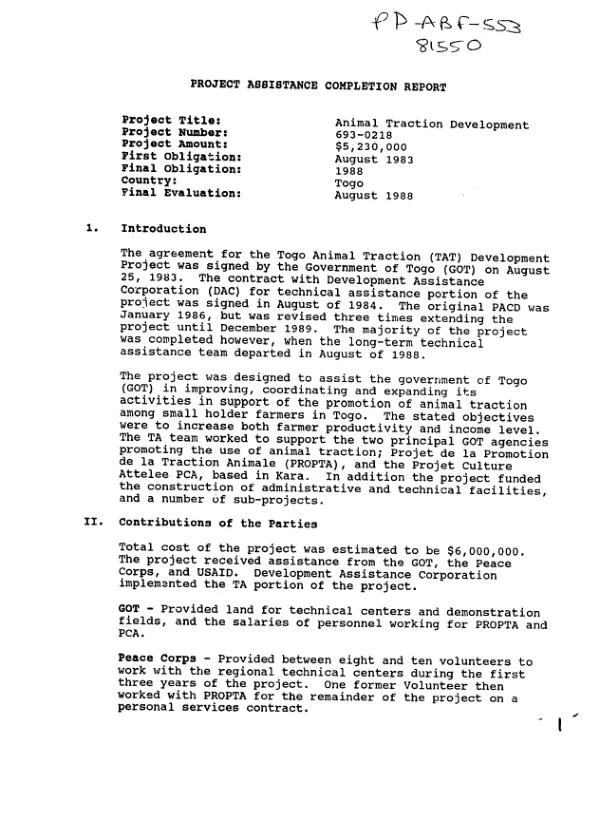
Project assistance completion report : animal traction development
PACR of a project (8/83-8/88) to promote animal traction among small farmers.
1993
Sign in to readA free account is required to download.
Abstract
The project was highly successful. Over 1,700 farmers were trained in the Kara and Savanes regions and 16 of 17 planned technical centers (CATs) have been established and are functional. Project-trained ox-drawn units numbered over 800 and the goal of 806 farmers adopting plow and weed technologies was surpassed. However, the number of farmers receiving credit for the purchase of draft animals through the national system only reached about half the goal of 800 recipients. Animal health services were provided through two annual programs to over 4,000 cattle; a structure has been put in place to continue these services after the PACD. Farmland under cultivation with animal traction increased by approximately 30%. Returns based on net income from crop production rose by almost 40%, although the addition of animal traction costs reduces the number to 13%. The project fell short of its goals to establish adequate animal traction equipment parts supply and repair facilities on the local level. The following lessons were learned. (1) Sufficient attention to the issue of collection procedures is important in the design of credit programs. The credit component initially suffered due to an inadequate system resulting in low repayment rates. (2) Extension activities performed on "model farms" were generally better attended than those held at the CATs. Farmers related better to conditions found in fields similar to their own, rather than the demonstration fields at the centers. (3) Private sector suppliers of animals and equipment should be brought into a project of this nature early on to ensure adequate development of the sector. (4) Efficient procedures for the timely disbursement of project funds are essential to success. (5) The add-on projects were difficult to manage and were unrelated to the project purpose. Upon completion of the project, a 2-year support grant was made to two host government agencies: Project de la Promotion de la Traction Animale (PROPTA) and Projet Culture Attelee (PCA), based in Kara, upon completion of TAT. Evaluation of this support found that PROPTA-supplied animals were far more expensive than those provided by the private sector and that PROPTA had not sold a team in over 3 years due to poor return on the investment; it was recommended therefore that no further support be given to this sector. The MAPS and Agribusiness assessments noted that Togo's agriculture sector is totally bogged down due to highly unfavorable policies and conditions (i.e., mismanaged government input and marketing monopolies, and poor communication and transportation links). (Author abstract)
Related documents