USAID. MISSION TO TOGO
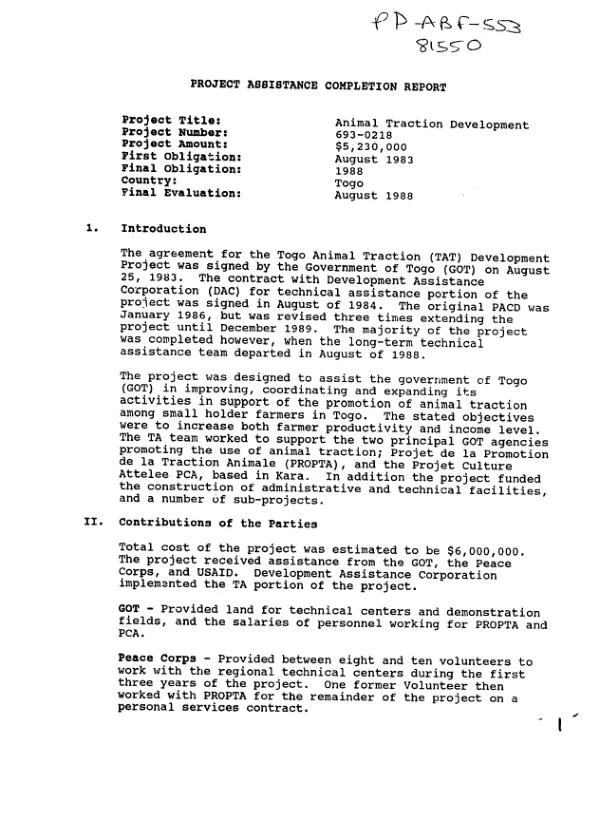
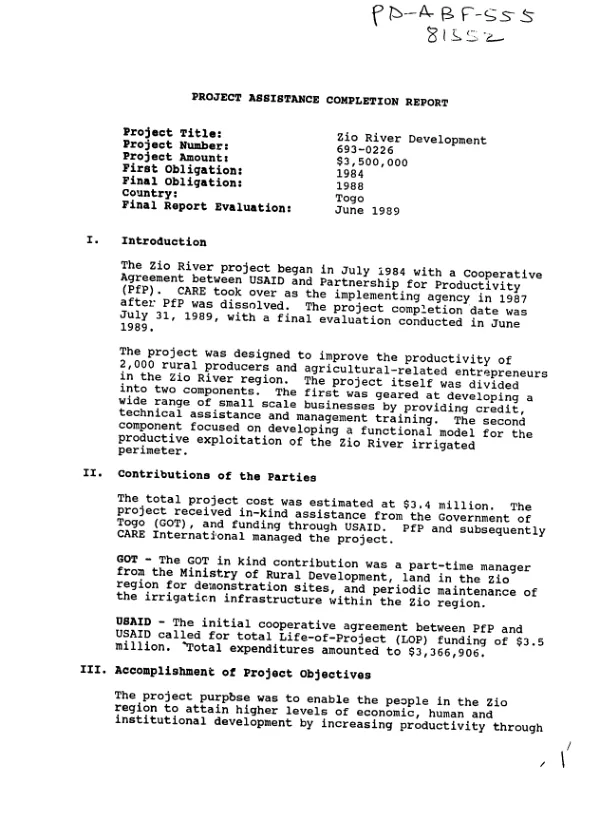
Project assistance completion report : Zio river development
PACR of a project (1984-88) to increase agricultural production in Togo's Zio River region.
1993
Sign in to readA free account is required to download.
Abstract
Specific objectives were to: (1) develop and strengthen local farmer-producer organizations; (2) improve production and marketing techniques; (3) strengthen local agricultural institutions; (4) institutionalize credit education; (5) create or reinforce rural support infrastructure; and (6) improve productivity of the Zio River irrigated perimeter through collaboration with the Regional Office of Rural Development (DRDR). Most of the stated objectives were achieved. Farmer-producer organizations were developed and strengthened through technical, credit, and training support via the project extension service. Production techniques were improved through the introduction and application of specific agricultural technical packages. The rural support infrastructure was strengthened through training local extension agents and through the creation and training of farmer groups. The objective to strengthen local agricultural institutions' capacity to provide agricultural extension services was not met, however, largely because of Government of Togo (GOT) policies. Instead the project created its own multi-purpose extension operation providing services directly to farmers and rural entrepreneurs. Also, collaboration with DRDR aimed at group promotion in the Zio River perimeter was never fully developed because of pronounced differences between the project's and DRDR's approach. The project surpassed four out of five planned outputs. The project significantly exceeded the first target of providing credit and technical assistance to 2,000 individuals. The Zio project assisted 887 individual clients and 1,854 non-clients who attended on-farm demonstrations. Approximately 100 non-clients participated in rural enterprise development training sessions. Management and technical training was conducted with 793 farmers, surpassing the second target of 500 farmers. The project also exceeded the target of 20 producer groups with increased group management skills whose member incomes have been raised because of the organization. Forty-six groups, including a marketing association of rice farmers, were assisted by the end of the project. Training and management assistance far surpassed the target level of 75 clients a year. Approximately 930 agricultural clients, 50 rural enterprise clients, and some 300 non-clients in both sectors received training. The final, unachieved target was a loan recovery rate of 90%. The following lessons were learned: (1) The project design was overly ambitious. The project was to work in three different sectors (rainfed, irrigated agriculture, and rural enterprises), introduce new technologies, provide skills training, and change attitudes and behaviors of rural farmers and entrepreneurs. A more focused, less ambitious design may have been more effective at limiting project interventions and achieving measurable results in the targeted sectors. (2) The type of "cradle to grave" activities performed by the PVOs (Partnership for Productivity and CARE) in this project ultimately served to discourage the GOT from providing assistance to the region. (3) Language used in project design documents to define project objectives and purposes should remain consistent so that the end goals of the project are clear to the implementing agency. A 1992 project update notes the findings of the MAPS and Agribusiness assessments which indicate that Togo's agricultural sector is completely bogged down due to highly unfavorable policies and conditions (i.e., mismanaged government input and marketing monopolies and poor communication and transportation links). Another government policy almost ensures these types of projects never attain sustainability. The GOT no longer provides extension/encadrement services in an area that is "taken over" by a donor or PVO, thereby committing them to remain in perpetuity if the project is to survive. For agriculture to graduate beyond the subsistence level in food crops and break-even level in cash crops, major policy reforms must be achieved. The government must either provide affordable services from the profits it derives from the monopolies or end all interventions and encourage the private sector to take over these functions. In order for the latter to happen major fiscal reforms must also be initiated. (Author abstract)
Related documents