USAID DEC
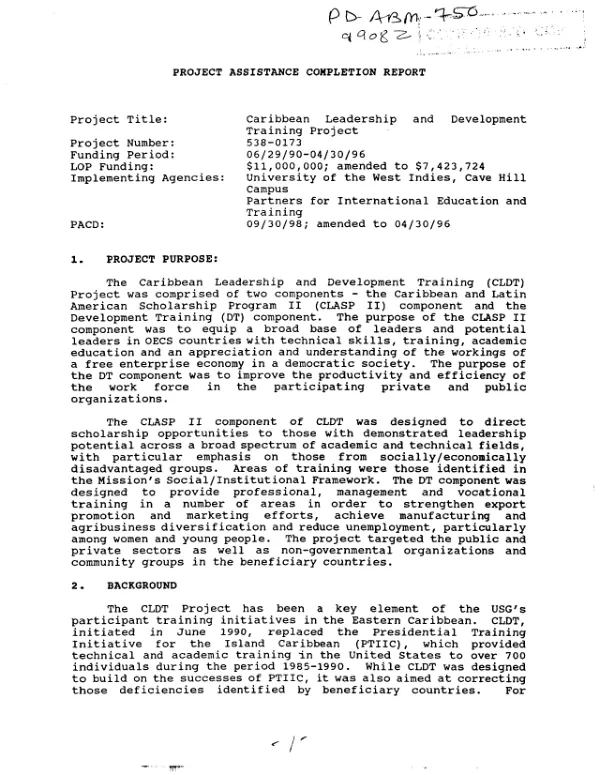
Project assistance completion report : Caribbean leadership and development training project
Sign inUSAID. BUR. FOR LATIN AMERICA AND THE CARIBBEAN. REGIONAL DEVELOPMENT OFC.
Project assistance completion report : Caribbean leadership and development training project
PACR of a project (6/90-4/96) to provide training in areas critical to socioeconomic development to leaders and potential leaders in the Eastern Caribbean.
1996
Sign in to readA free account is required to download.
Abstract
The project consisted of two components: Development Training; and the Caribbean and Latin American scholarship Program II (CLASP II), implemented, respectively, by the University of the West Indies (UWI) and Partners for International Education and Training. The development training component exceeded its numerical targets; 1,758 vs. a target of 800 individuals received in-country and regional training, with an additional 85 scholarships awarded for U.S. short-term technical training. The public sector received 59% of the training, the private sector 36%, and NGOs 5%; males received 51% and females 49%. However, males actually predominated only in short-term regional training, with females receiving 54% of in-country awards, 75% of 1-year long-term awards, and 55% of 2-3 year long-term awards. Long-term trainees totaled 110, with training taking place at all three UWI campuses and 11 other tertiary institutions. Long-term trainees (for whom the program was the end of a long and persistent search for funding) consistently rated the program as excellent to good, and 54% participated in a follow-on activity. Long-term training was provided in the areas of public administration, education, engineering, business administration, community health management, agriculture, hospitality management, and computer science. In terms of sector focus, all of the countries showed interest in agriculture and many showed interest in tourism. In 1992, training was reallocated so that 80% supported two new strategic objectives of the Mission: natural resource management and increased and diversified trade. To encourage sustainability, the project targeted training towards managers, supervisors, teachers, extension officers, and community leaders, and established a public/private project advisory committee (PAC) in each beneficiary country to identify training needs, recommend training sites, and, in several instances, foster coordination among several participating agencies. The CLASP II component received $1 million in funding in 1993, but no additional funds were obligated because this component met with the same unpopularity as its predecessor, the Presidential Training Initiative for the Island Caribbean (PTIIC), which contained very stringent selection criteria and specific targets established by AID/W. CLASP II upgraded the subject knowledge and pedagogical skills of 49 secondary school teachers from Dominica, who were trained at New Mexico State University with follow-on training in Dominica. Dominican authorities have acclaimed this training effort as a total success. The following lessons were learned. (1) In the development training component, the PACs were mechanisms for participative planning, information sharing, and linkages, and significantly improved the speed of information exchanges with collaborating agencies and persons. (2) Short-term trainees were encouraged to identify a tangible and relevant activity which they could plan during their training and implement upon their return. However, only about 50% actually implemented such activities; the main barrier appeared to be lack of support from employers. A stronger follow-on component is needed and should include working with the trainees, their supervisors, and national training officers. (3) Collaboration with donors funding similar training activities proved very cost-effective. Donor coordination in the area of human resources development needs to be strengthened. (4) One way of multiplying impact is through information sharing. Some of the project's conferences, seminars, and training programs produced manuals, discussion papers, or research findings which were beneficial to various audiences and even the general public. In some instances, UWI project staff edited such documents and shared them with university libraries. (5) A number of programs (e.g., small business management) were in two phases, with trainees returning to their jobs in between to apply the skills they had learned. While this may cost a little more than a single-phase program, the trainees found it much more beneficial, since it allowed them time to apply and test plans, receiving confirmation or correction or consolidation in the final training phase.
![Capturing the results of 30 years of AFGRAD [African graduate fellowship project] training : evidence of change in individuals and institutions across Africa -- final evaluation report (formative evaluation volume 2)](https://covers.devme.ai/gen/6698.webp)
![Capturing the results of 30 years of AFGRAD [African graduate fellowship project] training : evidence of change in individuals and institutions across Africa -- final evaluation report (formative evaluation volume 2)](https://covers.devme.ai/gen/83866.webp)