USAID DEC
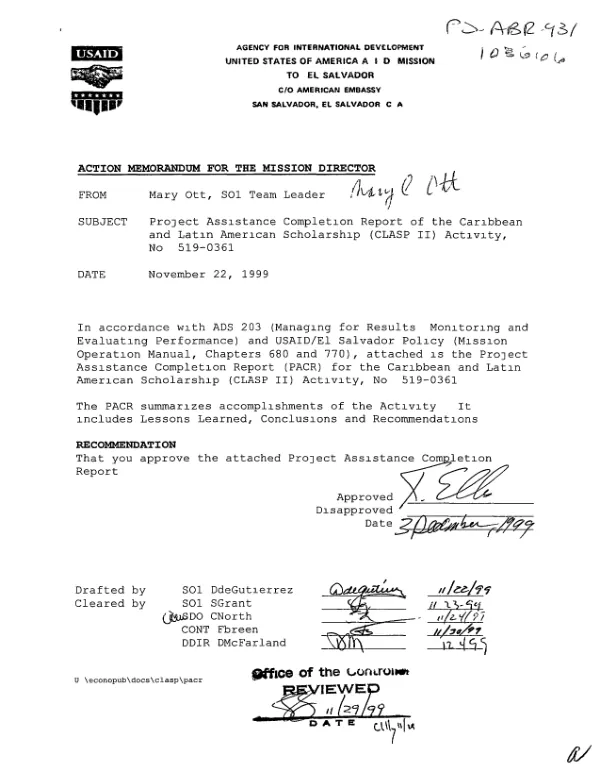
Project assistance completion report : Caribbean and Latin American scholarship (CLASP II) project, activity no. 519-0361
Sign inUSAID. MISSION TO EL SALVADOR
Project assistance completion report : Caribbean and Latin American scholarship (CLASP II) project, activity no. 519-0361
PACR of the CLASP (Caribbean and Latin American Scholarship) II project in El Salvador (7/90-9/98), designed to equip a broad base of Salvadoran leaders with leadership capability, an appreciation of democratic processes in a free market economy, and technical skills and academic training.
1999
Sign in to readA free account is required to download.
Abstract
Over the life of the project, a total of 1,514 Salvadorans, vs. a target of 1,500, received training in the United States in democratic practices and diverse technical and academic fields. CLASP II also funded: short U.S. visits to acquaint support groups for the education, labor leader, and health care reform programs with the contents of the training programs; attendance by four participants to the 1995 Beijing World Conference; and four in-country training events -- a workshop for members of the Board of Directors of the Initiative for the Americas Fund (FIAES), and three high-impact training workshops in preparation for the newly approved Human Capacity Development (HCD) Activity (5190432). The project exceeded targets in all areas -- including targets for women participants and training at Historically Black Colleges and Universities (HBCUs) -- except long-term training. Program management, with the concurrence of USAID/W, decided to limit long-term training, especially academic, based on the expense of such programs, participant tendency to focus on their own benefit rather than on that of their institutions or communities, and stakeholder demand for shorter and more specialized programs geared to specific objectives. In addition, CLASP recruited candidates from a number of special groups, including scholars living or working outside the San Salvador metropolitan area; youth (those under age 30 years) or those working with youth; and those contributing to the national reconstruction program. CLASP II also coordinated specific training programs with Mission strategic objectives in economic growth, democracy, health, environment, and national reconstruction. Lessons were learned in the three areas noted below. Lessons for host country ownership: (1) Involve host country institutions in all stages of the training cycle. (2) Recruit from committed host country institutions that support the application of new skills and knowledge by returning scholars. (3) Enlist the participation of supervisors, decision-makers, and other key stakeholders in training programs. Lessons for program design and management: (1) Establish and adhere to a timetable adequate for each step in the interrelated process of integrated participant training programs. (2) Facilitate communication and cooperation among all stakeholders from pre-departure of scholars through the training provider visit. (3) Sharpen training program objectives with specific measurable outcomes. (4) Develop a critical mass of scholars through repeat programs. (5) Strive for homogeneous training groups. (6) Develop an effective working partnership between the programming agency and the training provider. (7) Select training institutions sensitive to and capable of meeting special needs of scholars from post-war circumstances. Lessons for sustainability of follow-on activities: (1) Decentralize follow-on activities to the regional level in order to enhance scholar networking and participation. (2) Encourage scholar responsibility and shared ownership for undertaking follow-on activities.