USAID DEC
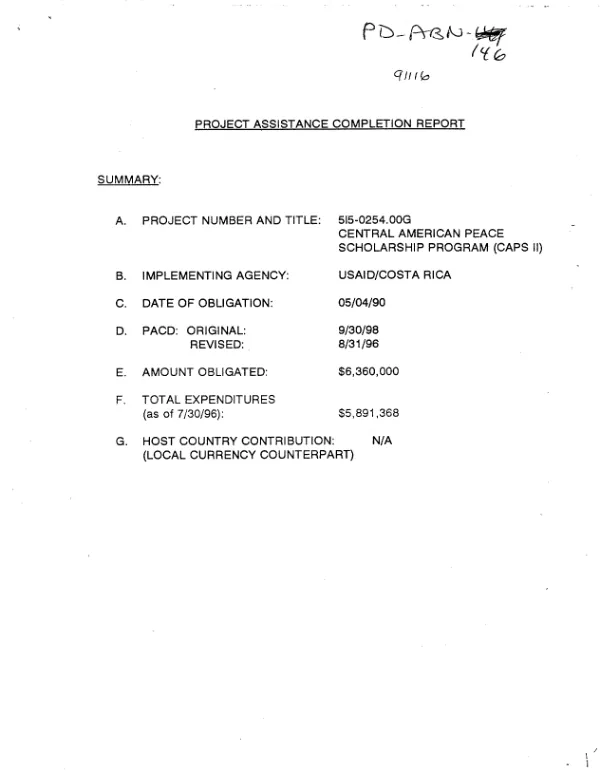
Project assistance completion report : Central American peace scholarship program (CAPS II)
Sign inUSAID. MISSION TO COSTA RICA
Project assistance completion report : Central American peace scholarship program (CAPS II)
PACR of a project (5/90-8/96) to provide U.S.
1996
Sign in to readA free account is required to download.
Abstract
training and exposure to a democratic society to Costa Rican leaders and potential leaders (CAPS II project). The project was well-designed, especially in targeting socially and economically disadvantaged leaders, and successfully implemented. CAPS II focused on the private sector, with special attention to women, minorities, and economically disadvantaged groups. Coverage was over a large geographic area to allow participation of leaders at the national, provincial, and local levels. Under the long-term academic program, 2 undergraduate and 85 graduate students studied in the United States in fields such as engineering, journalism, education, agriculture, business administration, public administration, environmental sciences, and international law. In the long-term technical program, managed by FUNAC (the Foundation of Four-S Clubs) in collaboration with the U.S. National 4-H Council, 60 high school students spent a school year in the United States, living with U.S. families. In the short-term training program, 225 participants, mostly community and school leaders from rural and semi-rural areas, received 4 weeks of U.S. training designed especially to meet their needs. All CAPS II trainees, except for eight who are completing U.S. Masters programs, have returned to Costa Rica and are applying their skills, contributing to the development of their country. Their multiplier effect has been extraordinary. The project gave trainees not only new knowledge and skills, but an increased confidence and sense of responsibility, along with a new open-mindedness about the world. Knowledge of the English language enabled them to get better jobs and obtain promotions. Because of its focus on the socioeconomically disadvantaged and women, CAPS II contributed significantly to USAID/CR's goal to promote active participation in the economy by the disadvantaged. In fact, 51% of all participants were women, versus a 40% target set by USAID/Washington. The following lessons were learned. (1) The key elements in the success of the long-term component were the establishment of a selection committee (composed of representatives of the Mission's technical divisions and Training Office, training experts, returned participants) and the selection criteria established by the Mission. (2) Use of intermediary institutions for the short-term technical component ensured broad participation of the socioeconomically disadvantaged.