USAID. MISSION TO PERU
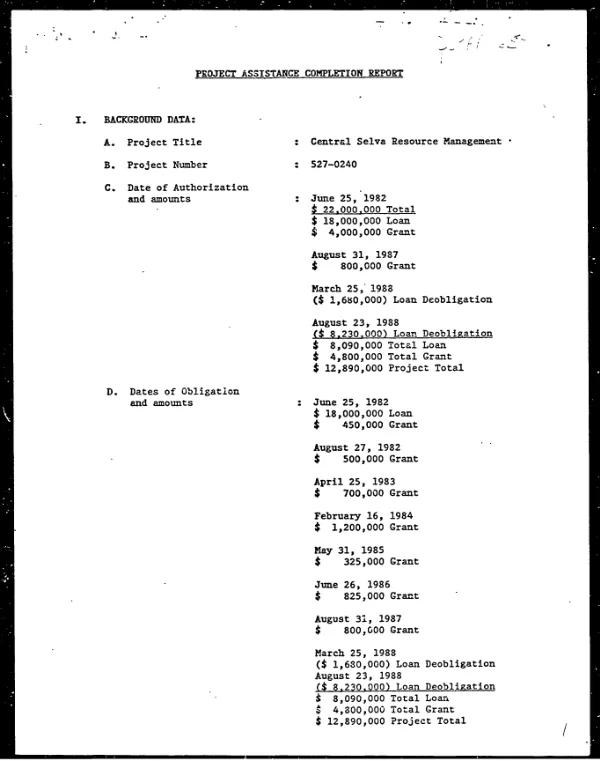
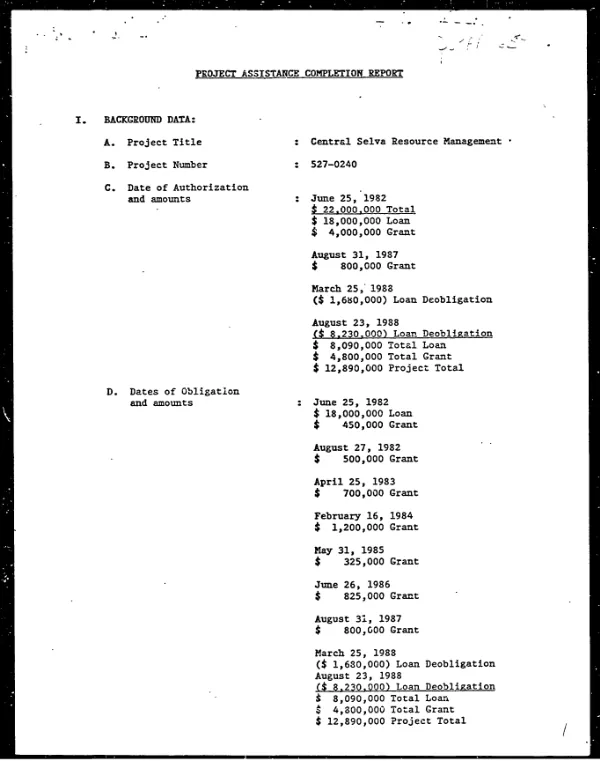
Project assistance completion report : Central Selva resource management
PACR of a project (7/82-9/88) to test and institutionalize a long-range management methodology for Peru's high jungle and its natural resources.
1989
Sign in to readA free account is required to download.
Abstract
The project embodied a vision of sustainable development that was innovative, idealistic, and courageous -- it dared to flout the vested interests of politicians, loggers, and resource predators and to defend the historic rights of native peoples. As a result, development of the Palcazu Valley is underway, using technologies that maximize long-term productivity. More than 200 ha of coffee, cacao, and papaya plantations, as well as a nursery for 460 ha of coffee were established. The Yanesha Forestry Cooperative was formed and is operating a sustained-yield natural forest management and production system based on strip cutting; the cooperative's wood processing complex is producing lumber, preserved posts, and charcoal for export as well as local consumption. The project also: tested 8 agroforestry and agro- silvo-pastoral systems; established 73 tropical hair-sheep modules on improved pastures; and conducted 20 experiments on low-input production systems combining annual/tree crops with grasses and legumes. To improve regional infrastructure, the project provided equipment for a road maintenance center which maintained 114 km or roads and opened logging and local roads. A medical center and four health posts were also established. Midwives and local health promoters were trained, and vaccination campaigns were conducted regularly. A regional development policy support group is operating in the Oficina de Proyectos Especiales of the Instituto Nacional de Desarrollo which provides, among other services, a Geographical Information System containing data from the Palcazu and other high jungle development projects. A major project strength was its concern for appropriate development in relation to land capability. Data gathered by aerial photography made it possible to draw up a rational land use plan, including demarcation of three protection areas: the Yanachaga-Chemillen National Park, the San Matias Protection Forest, and the Yanesha Communal Reserve. Despite these efforts, the project failed to discourage the construction of a highway that passes through the Palcazu Valley and jeopardizes the environmental integrity of the area by opening up to logging and random settlement land which should be devoted to watershed protection. Numerous lessons were learned. (1) Projects of this nature must be based on reliable rainfall records covering a reasonable timespan. (2) Project Papers must be available to host country government technicians in their own language, especially when the projects involve innovative concepts that may be easily misunderstood. (3) Projects should stipulate proper environmental analysis prior to road building, especially when P.L. 480 funds are involved. (4) Agreement among all participating agencies should be ensured concerning land capability evaluation criteria and their application in the field. (5) Credit components should be preceded by a thorough logistic analysis or market study. (6) In-depth study should be carried out before far-reaching changes in farming systems are attempted. (7) Intensive involvement of counterpart personnel is valuable in the initial stages to ensure mutual understanding. (8) There is a need for caution in endorsing politically motivated institutional changes by newly elected governments.
Related documents
Documents in this collection
 1989
1989USAID DEC
Project assistance completion report : Central Selva resource management
Open record![End of program evaluation report (Nov 1999-Oct 2002) : cooperative agreement between USAID and WWF [World Wildlife Fund] Indonesia no. 497-A-00-00-00002-00 -- the Outer Islands bioregional program : integrated protected area management and spatial planning in Kalimantan and Papua[, Indonesia]](https://covers.devme.ai/gen/5324.webp) 2002
2002USAID DEC
![End of program evaluation report (Nov 1999-Oct 2002) : cooperative agreement between USAID and WWF [World Wildlife Fund] Indonesia no. 497-A-00-00-00002-00 -- the Outer Islands bioregional program : integrated protected area management and spatial planning in Kalimantan and Papua[, Indonesia]](https://covers.devme.ai/gen/58040.webp)