USAID. MISSION TO PAKISTAN. OFC. OF THE AID REPRESENTATIVE FOR AFGHANISTAN AFFAIRS
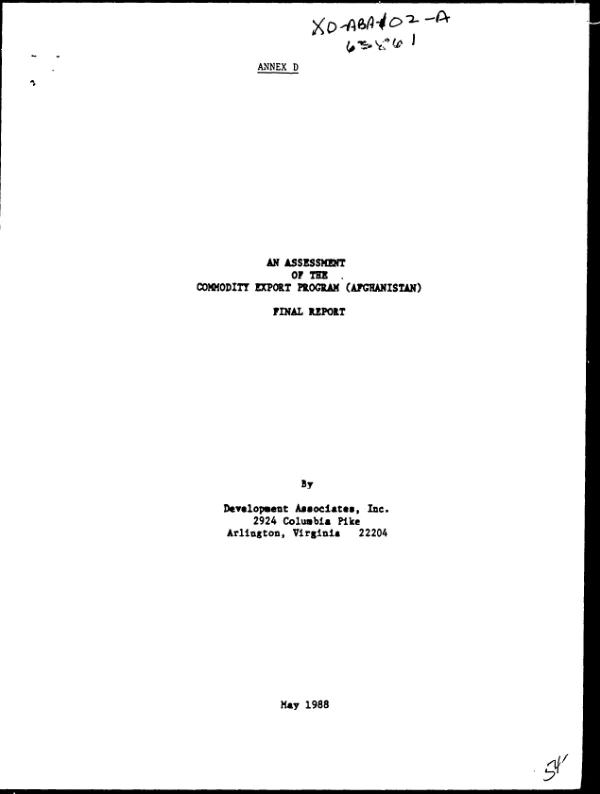
Project assistance completion report : commodity export program (306-0205)
PACR of a Commodity Export Program (CEP) (8/86-6/94) to help meet urgent humanitarian and rehabilitation needs during the civil war in Afghanistan.
1994
Sign in to readA free account is required to download.
Abstract
The report covers three of the four program components: procurement and logistics; mine detection; and transportation and infrastructure. Under the procurement and logistics component, the contractor (initially American Manufacturers Export Group, later RONCO), provided food, clothing, and other relief commodities for distribution under the CEP itself and also provided procurement services for all the other projects in the Afghanistan portfolio -- at the height of the CEP, the contractors supported 23 separate entities. In all, 3,888 purchase contracts worth almost $77 million were processed, including Bailey bridges, automobiles, tractors, trucks, computer systems, medical equipment, pharmaceuticals, fertilizer, wheat seed, fruit trees, mine detection dogs, mules, and farrier equipment. The contractors: operated 17 different warehouses, including 3 inside Afghanistan; handled 128 air and 9 sea shipments under the Defense Department humanitarian aid (McCollum) program; facilitated movement of USAID commodities for international donors, USAID projects, and other relief organizations, using every conceivable mode of transportation, including mules, rafts, and human labor; monitored more than 113,000 MT of commodities and food and more than 223,000 MT of wheat involving 12,000 truck sorties; and assumed responsibility for excess equipment and commodities as other projects were phased out, including the conduct of 14 auctions of equipment. A major success of the program was the establishment of the Mine Detection Dog Center (MDC) at two facilities in Pakistan (Pabbi and Quetta). The program evolved out of the familiarity of an AMEG veterinarian with the use of dogs to detect mines in Thailand, and 14 trained German Shepherds were donated by the Thai government. The MDC has cleared 9,360 sq km, detected and destroyed over 36,000 mines or other unexploded ordnance, and checked over 366,000 suspicious objects. RONCO undertook an extensive program to prepare the MDC to continue as an independent NGO. As of 2/94, the MDC operated with 93 dogs, 277 dog handlers, plus support personnel, and served 10-15 provinces inside Afghanistan at any given time; funding through 1996 has been provided through a USAID grant to the UN Office for Coordination of Humanitarian Assistance. Under the transportation and infrastructure component, the Afghan Construction and Logistics Unit (ACLU) was created in 1988 (when it appeared that a peace settlement was imminent) to supply commodities for returning refugees and to repair transportation infrastructure. However, because (1) repatriation proceeded more slowly than expected, (2) the commercial private sector proved capable of meeting commodity distribution needs, and (3) the transport wing of the ACLU was made up almost entirely of a faction of Afghans who had become strongly anti-American by 1991 and were responsible for several hijackings, the transportation function was ended in Summer 1991 and the ACLU shifted its emphasis to repair and construction of road and bridges inside Afghanistan. Its major accomplishments were to: repair 800 km of roads and repair, construct 33 reinforced concrete bridges, and erect 7 Bailey bridges; survey 14,000 roads and bridges in all 29 provinces of Afghanistan; and train 1,174 ACLU employees in construction techniques and equipment operation. The ACLU was registered as a legal entity and in 3/94 became an independent construction firm, equipped with 455 pieces of construction or maintenance equipment, vehicles worth $12 million, nearly $1 million in spare parts inventory, and a cadre of 80 highly skilled core employees. Lessons learned are as follows. (1) The CEP provided the capability of responding quickly to the ever-changing operational environment inside Afghanistan, and enabled the Mission to response to victims of natural disasters as well as of war. (2) Its flexibility allowed it to serve as an incubator for innovative pilot programs such as the MDC and the ACLU. (3) The advantages of a centralized procurement contractor are substantial, and RONCO generally got high marks for its performance. However, at times other contractors complained that the procurement process was cumbersome or the items procured did not meet their needs. Better modalities for resolving differences between contractors should have been established. (4) When a program is closing out, the logistics contractor should be the last to go. (5) Efforts to make the Afghan institutions formed under the program more sustainable should have been initiated from the beginning of the program through last minute crash courses. Nonetheless, prospects for the sustainability of the MDC and the ACLU are good.
![Amended activity approval memorandum (AAM) [proposed] for the commodity export program (CEP), project no. 306-0205](https://covers.devme.ai/gen/14714.webp)