USAID DEC
Project assistance completion report : drug abuse prevention and control project no. 532-0161
Sign inUSAID. MISSION TO JAMAICA
Project assistance completion report : drug abuse prevention and control project no. 532-0161
PACR of a project (1989-9/94) to improve the capability of the Jamaican public and private sectors to develop and implement drug abuse prevention programs aimed at high-risk target groups, primarily youths between 12-25 years of age.
Sign in to readA free account is required to download.
Abstract
The project was implemented by the National Council on Drug Abuse (NCDA). The project was unsuccessful for several reasons. (1) Instead of targeting high-risk groups, NCDA launched a national program by parish, which paid no attention to the needs of high-risk groups. (2) The goals of the grant agreement appear to have been overly ambitious; NCDA lacked the organizational structure to cope with the infusion of approximately 25 new staff and the demands of creating a new project organization within a short time period. (3) Some of the planned training was either not provided or was inadequate, including management training of NCDA staff and training of community, drug treatment, and rehabilitation workers in counseling and community prevention strategies. In addition, training records were incomplete, and training impacts were not assessed. (4) A financial review in 1992 identified a serious lack of internal controls at the NCDA and its subgrantee, Jamaica Western Partners (JWP). As a result of this financial review, the findings of the 9/92 evaluation, and the fact that counterpart funding figures provided by NCDA were unreliable, USAID stopped making advances to NCDA and JWP; therefore, counterpart contributions also ceased. In 9/93, Hi-Tech International (an 8A firm), and Westover were contracted to administer the remaining funds, and the project made some minor accomplishments; the very small funding levels provided were not sufficient to achieve success in such complex areas as drug abuse prevention and control. Hi-Tech and Westover provided support to two community-based organizations: the Kingston Restoration Co. Teen Center, which provided a drug-free recreational and educational environment for teens; and FORCE -- Mount Zion Community, which facilitated community development of drug abuse prevention programs. The following lessons were learned. (1) Conceptual issues should be clarified during project design to ensure that all parties are working under similar assumptions. (2) Project design should reflect the institutional capabilities of the implementing agencies, and if they are inadequate, appropriate TA should be provided. (3) When a country's research capacity is insufficient, TA to improve research should be provided at the project's outset. Training in evaluation research may also be required to institutionalize capacity in this area. (4) Short-term training has far exceeded the LOP estimated output. However, if the project design includes locally provided training in subject areas in which a local area lacks expertise, the project should improve local capacities through, for example, the provision of peer counseling techniques to a cadre of trainers prior to the implementation of local training.
Related documents
Documents in this collection
USAID DEC
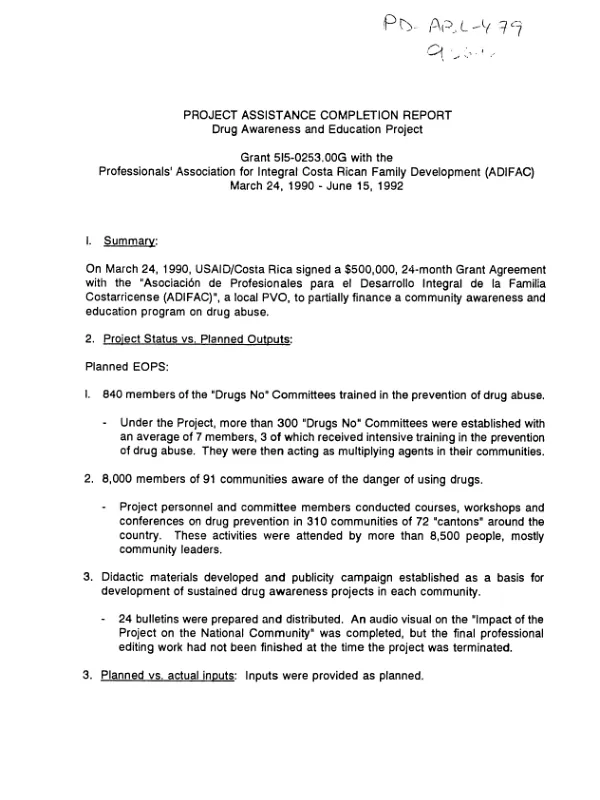
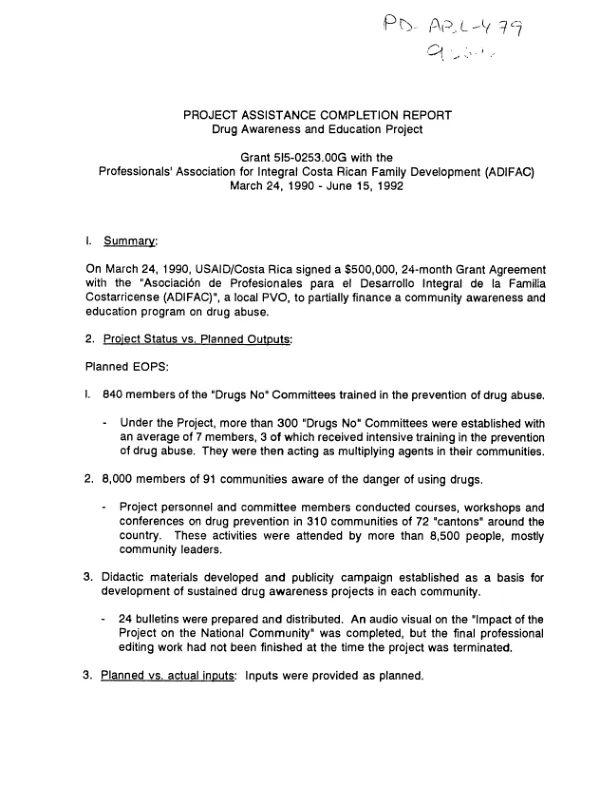
Project assistance completion report : drug awareness and education project -- grant 515-0253.00G with the Professionals' Association for Integral Costa Rican Family Development (ADIFAC), March 24, 1990 - June 15, 1992
Open record 1993
1993USAID DEC