USAID DEC
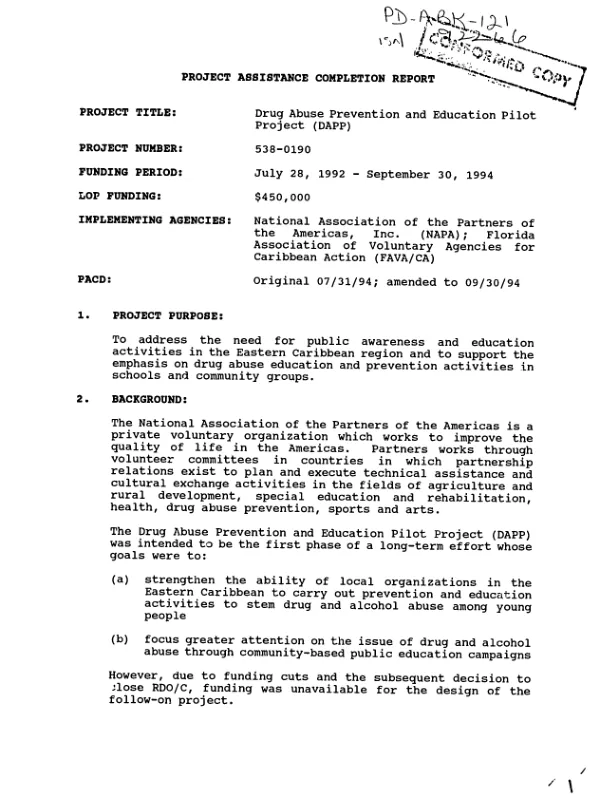
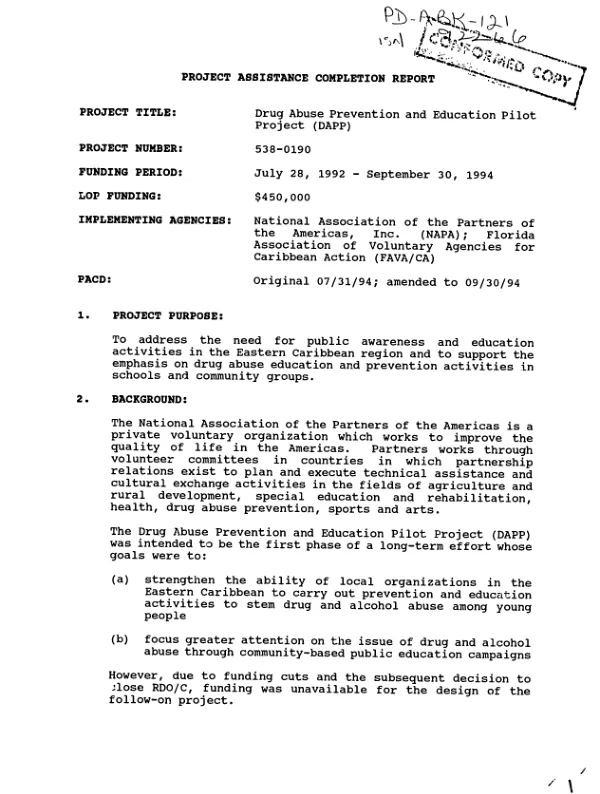
Project assistance completion report : drug abuse prevention and education pilot project (DAPP)
Sign inUSAID. BUR. FOR LATIN AMERICA AND THE CARIBBEAN. REGIONAL DEVELOPMENT OFC. CARIBBEAN
Project assistance completion report : drug abuse prevention and education pilot project (DAPP)
PACR of a pilot project (7/92-9/94) to support community-based drug abuse prevention and education activities in the Eastern Caribbean.
1994
Sign in to readA free account is required to download.
Abstract
The National Association of the Partners of the Americas, Inc. (NAPA) and the Florida Association of Voluntary Agencies for Caribbean Action (FAVA/CA) implemented the project. Through the project, information on drug abuse prevention and education was disseminated widely at the grass roots level, with parents and youth in the target communities participating in workshops and outreach programs. In Grenada and Dominica, the project was particularly successful in augmenting government programs funded by the UN Drug Control Program. Quantitative achievements included: needs assessments in all participating countries; 44 small grants for innovative. community-based drug and alcohol abuse programs; 25 short-term TA missions by NAPA and FAVA/CA volunteers; attendance of 12 persons from the Caribbean at U.S. training programs and conferences; and 5 regional workshops, including 3 training workshops (in peer counseling, community mobilization, and drug abuse prevention through sports), attended by 94 people, and 1 planning and 1 evaluation workshop. The following lessons were learned. (1) Local NAPA partnerships need to be strengthened. The project could have achieved more if it had addressed the institutional weaknesses which constrain the local NAPA partnerships. Despite their good intentions, these strictly volunteer organizations lack the support staff needed to execute development programs of any magnitude. (2) Adequate funds must be provided for project staff (in this case, the regional substance abuse advisor) to travel to participating islands. There also seemed to be a lack of clarity regarding the respective roles of the regional advisor, who was based in Montserrat, and the Washington-based project manager. (3) NAPA and FAVA/CA volunteers provided excellent and cost-effective TA. If the project had had to acquire this TA through other means, the number of TA missions would have been significantly reduced. (4) The project's use of NGOs proved an effective means of reaching people at the grassroots level, especially as many Eastern Caribbean governments do not have the mechanisms in place to mount a sustained drug education program. While the project was intended to be the first phase of a long-term effort, funding cuts and the subsequent decision to close RDO/C precluded a follow-on effort.