USAID. MISSION TO SUDAN
Project assistance completion report : energy planning and management (650-0059)
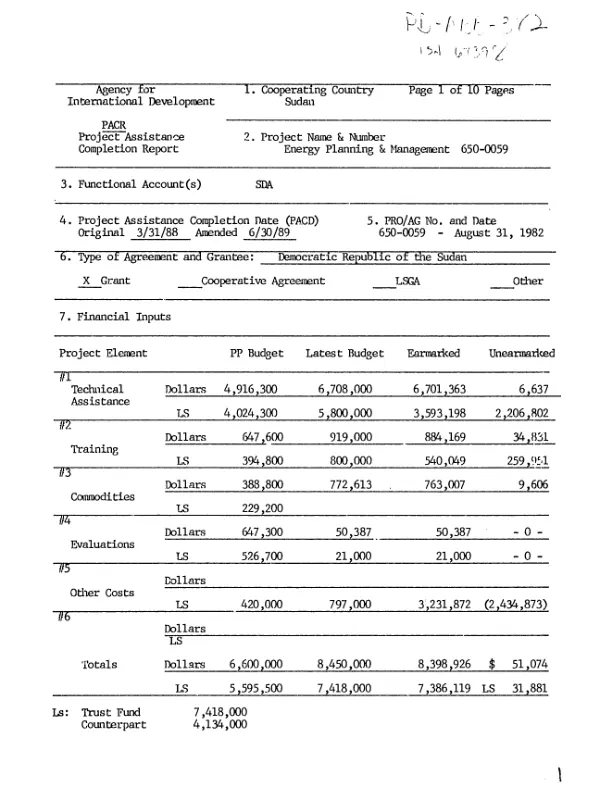
PACR of a project (8/82-6/89) to strengthen three institutions in Sudan's energy sector: National Electricity Corporation (NEC), National Energy Administration (NEA), and the General Petroleum Corporation (GPC).
1990
Sign in to readA free account is required to download.
Abstract
The project was seriously hampered by external factors, including, inter alia, a crippling drought in 1984, which diverted Mission attention away from the project and toward relief efforts; a coup d'etat in 1985; and the forced evacuation of Americans in 1986 for security reasons. Yet even under the most favorable of circumstances, the project could not have transformed the overall situation in the energy sector, and many of its specific objectives were unrealistic. Despite these constraints, the project met many of its objectives, including the major ones identified as concretely feasible by the mid-term evaluation. It helped the Government of Sudan (GOS) address a number of specific and pressing needs, and improved the staff capabilities of both the NEA and the NEC through short-term, on-the-job, and degree training. (Support to the GPC was never funded due to irregularities in GPC's petroleum purchases under a CIP grant.) The NEA has become more task- oriented and is now independently preparing energy studies and serving as a consultant for various GOS and international agencies. The NEC was also strengthened in several areas, and the short-term reliability of its Blue Nile electric power grid increased from 74% to 94%. In monetary terms, project TA led to a tripling of NEC revenues within 3 years, and the benefits to NEA, while more difficult to quantify, were also considerable. A major lesson learned is that even projects with budgets of several millions of dollars and timeframes of several years cannot by themselves entirely build or largely rebuild a counterpart organization.
![Project assistance completion report [: health planning and management, Swaziland]](https://covers.devme.ai/gen/9681.webp)