USAID DEC
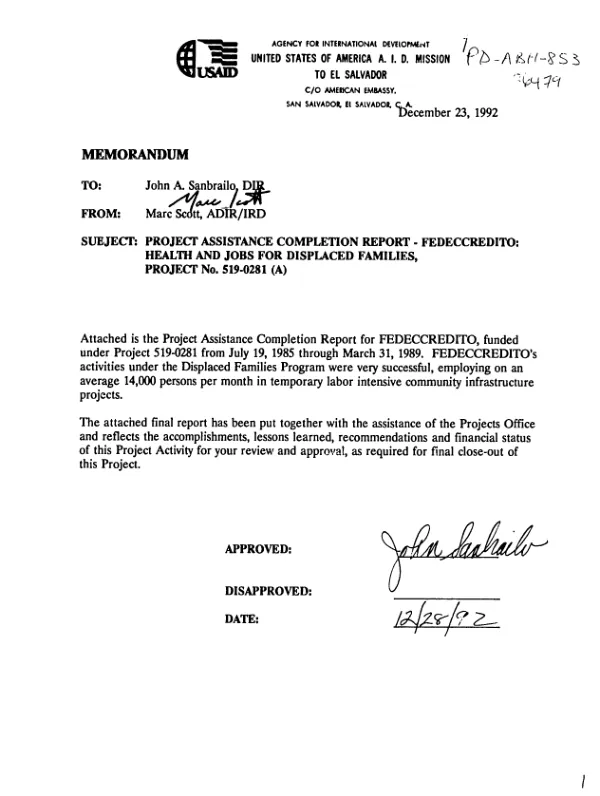
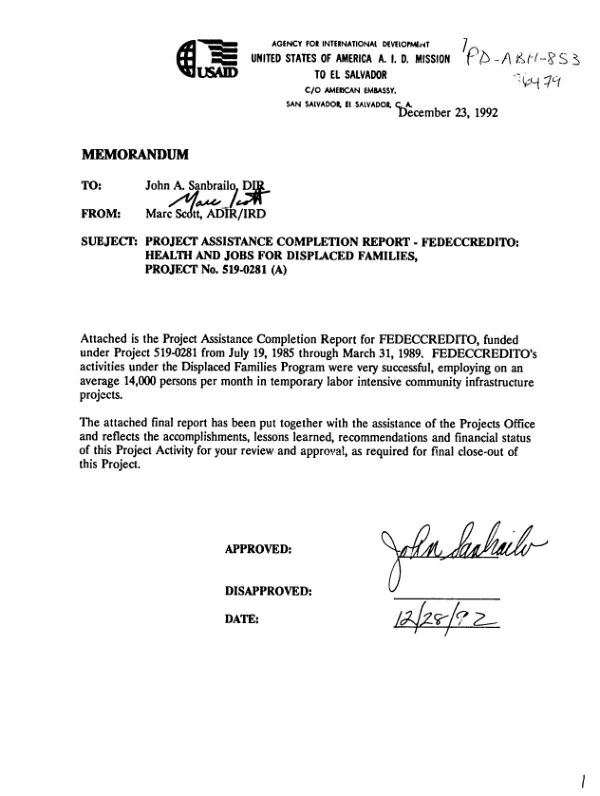
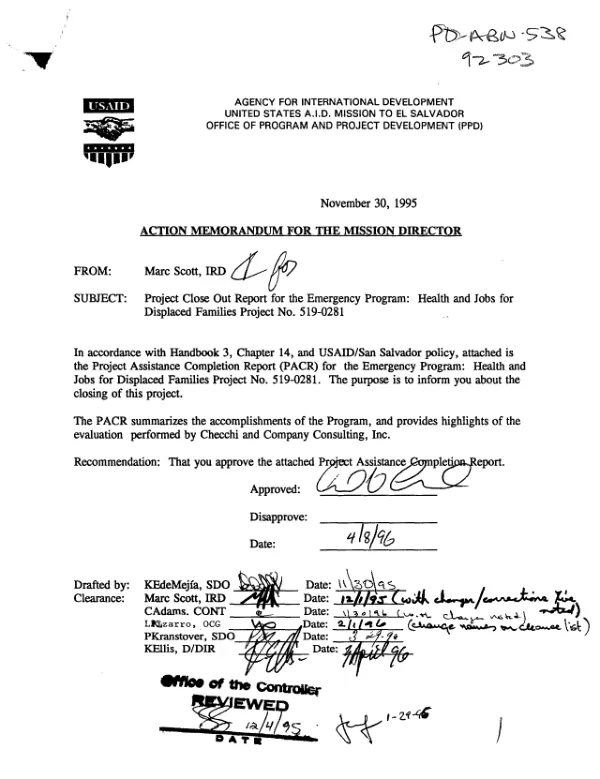
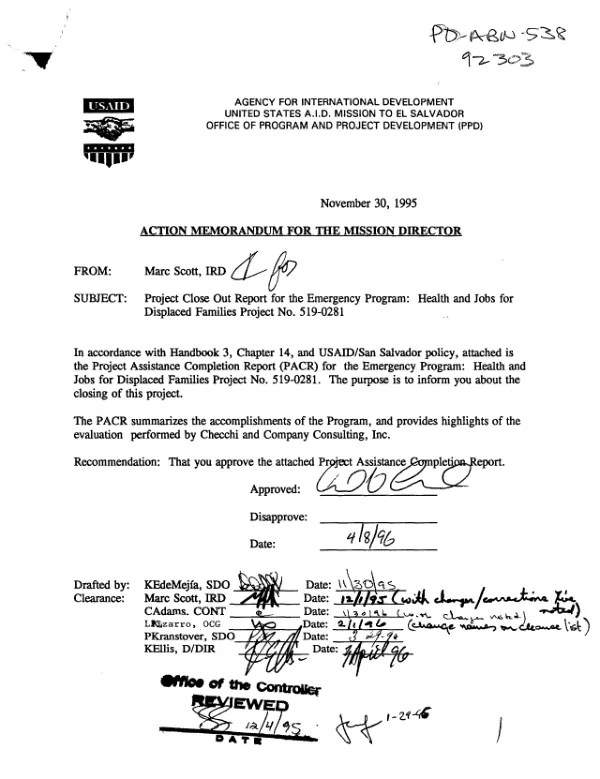
Project assistance completion report : FEDECCREDITO -- health and jobs for displaced families, project no. 519-0281
Sign inUSAID. MISSION TO EL SALVADOR
Project assistance completion report : FEDECCREDITO -- health and jobs for displaced families, project no. 519-0281
PACR of a project component (4/85-3/89) to provide displaced families in El Salvador with employment in community infrastructure projects.
1992
Sign in to readA free account is required to download.
Abstract
The Federacion de Cajas de Credito Rural de El Salvador (FEDECCREDITO) implemented the project. The project met or exceeded all but one of its planned targets. The targeted 10 service agencies are in operation and have provided employment to 14,000 displaced persons/month (vs. a target of 10,000-12,000) in infrastructure projects to improve health conditions (e.g., water and sanitation), community services (e.g., roads, streets), education (schools), and business opportunities (workshops). Environmental improvements were made in the targeted 69 refugee camps, 4,846 employment projects were completed (vs. 3,800 planned), 62 work projects were implemented for returnees (vs. 50 planned), and 116 vocational skills training courses were completed (vs. 95 planned). On the negative side, only 1,897 displaced persons completed the training courses, vs. a target of 2,349. The following lessons were learned. (1) Basic infrastructure projects implemented in municipalities and communities receiving displaced persons generated immediate employment in the 10 target departments (Chalatenango, Cuscatlan, Cabanas, San Vicente, Usulutan, San Miguel, Morazan, La Libertad, La Union, and La Paz). Further, even though approximately 95% of these individuals had prior work experience in agriculture only, they were able, under supervision, to provide effective labor on a variety of construction activities. (2) In El Salvador, infrastructure projects such as enlargement and construction of roads, introduction of potable water, retention walls, etc., are traditionally carried out by men only. Under this project, however, women were given significant employment opportunities, resulting in 20% of the labor being provided by women. (3) To attract an even greater number of women into the labor force, the project should include a specific component to promote female employment among the commercial and productive sectors. (4) The participation of Fiscal Agent auditors provided the project better control over financial management and on-the-job financial management training for accounting staff. (5) Assigning implementation responsibilities to local groups, such as the Cajas de Credito's Board of Directors, expedited implementation and more accurately identified the needs of the beneficiary communities.
Related documents
![Project assistance completion report : cooperative agreement no. 519-A-00-99-00016-00 with CARE International El Salvador, under the project no. 519-0447 : MAREAS (Mitch actividades de rehabilitacion de emergencia en agua y saneamiento) [Hurriance Mitch emergency rehabilitation activities for water and sanitation]](https://covers.devme.ai/gen/26965.webp)
![Project assistance completion report : cooperative agreement no. 519-A-00-99-00016-00 with CARE International El Salvador, under the project no. 519-0447 : MAREAS (Mitch actividades de rehabilitacion de emergencia en agua y saneamiento) [Hurriance Mitch emergency rehabilitation activities for water and sanitation]](https://covers.devme.ai/gen/5684.webp)