USAID DEC
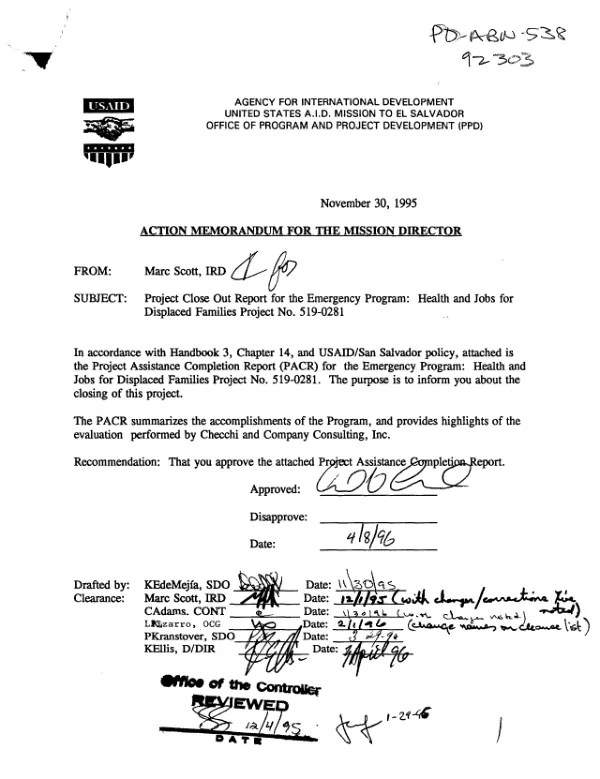
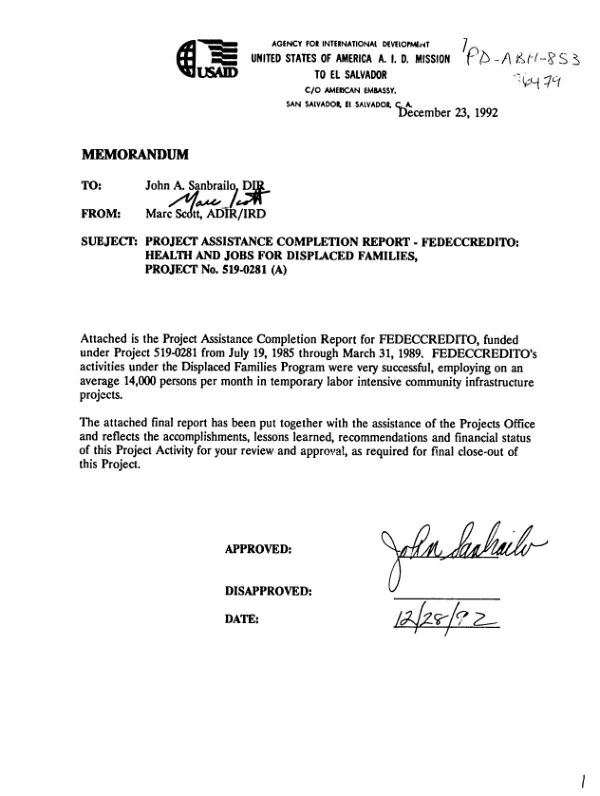
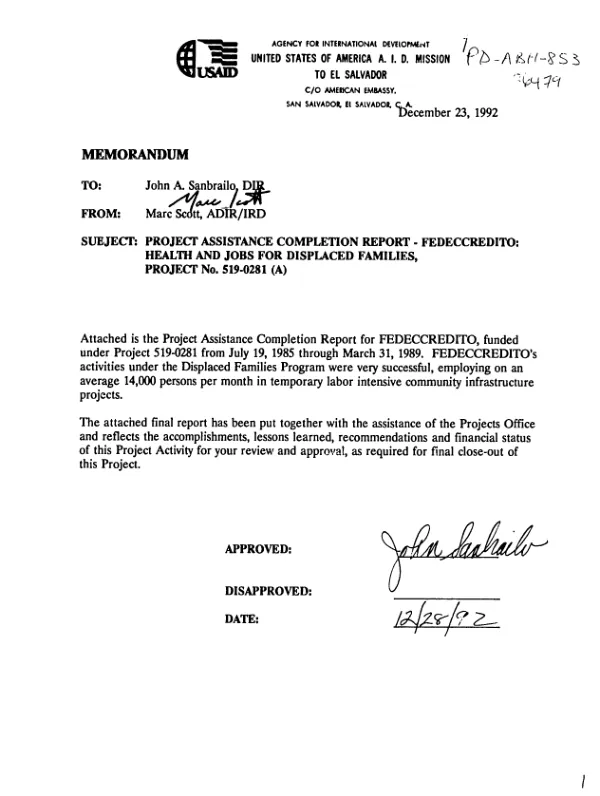
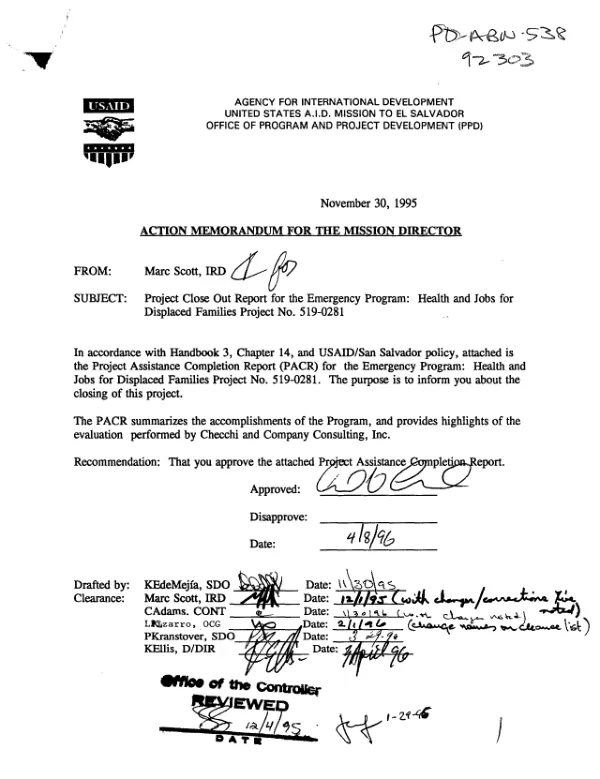
Project assistance completion report -- emergency program : health and jobs for displaced families project no. 519-0281
Sign inUSAID. MISSION TO EL SALVADOR
Project assistance completion report -- emergency program : health and jobs for displaced families project no. 519-0281
PACR of a project (5/82-5/93) to provide income earning opportunities, basic health services, and adequate nutrition for the displaced population in El Salvador as efforts are made toward their relocation.
1996
Sign in to readA free account is required to download.
Abstract
The project met its principal objectives, providing a safety net for many of the displaced when the Government of El Salvador (GOES) could not, helping to settle or relocate in rural areas many who otherwise would have migrated to already over-crowded urban centers, especially San Salvador, and reducing to less than 25,000 the number of displaced who were without reasonable prospects of caring for themselves. At its termination, the project had essentially eliminated the displaced persons problem. While most of the resettled and relocated still live in poverty and a permanent solution for a hard core of displaced has yet to be found, these problems are being dealt with by the National Reconstruction and other ongoing development or welfare programs. Accomplishments made under each of the project"s four components are discussed below. The employment generation component, accounting for a significant portion of project expenditures, provided occasional employment to 150,000-200,000 displaced people through 4,968 work projects, which, according to a USAID/ES data base, installed 28,390 latrines, rehabilitated 1.665 million sq m of cobblestone streets, and completed 316 community potable water initiatives. Under the public health component, CONADES and PVOs vaccinated almost 100,000 displaced mothers and children against disease and tetanus infection; provided mothers with nearly 100,000 oral rehydration therapy (ORT) doses; made 588,000 home visits and 83,000 referrals to Ministry of Health clinics; and trained thousands of the displaced how to deal with community health problems. The food assistance component had three phases: a dole feeding program that peaked at nearly 270,000 beneficiaries in 1984, a supplementary feeding program that expanded the program to over 300,000 between 1984 and 1987, and a food-for-work (FFW) program. Food assistance provided during the period of rapid growth of the displaced population adequately addressed the problem of malnutrition. The shift to FFW, while continuing food distribution to the needy, reduced the number of beneficiaries to around 120,000 because the displaced who had other income sources deselected themselves from the program. Food assistance was phased out in 1992. Under the resettlement and reintegration component, PVOs (primarily World Relief, International Rescue Committee, and Creative Associates International) and CONADES helped 13,218 families reintegrate themselves in the last 8 years of the project. USAID/ES created the Granos Basicos program, which supplied over 27,000 agricultural packages containing enough seeds, fertilizers, and selected pesticides to enable each of 13,000 farmers to plant corn, beans, and sorghum on 1.7 acres. The following lessons were learned: (1) Flexible project design and a rapid response capability are crucial ingredients for an emergency displaced persons program. (2) If the host government is not given enough responsibility for implementing emergency assistance, it may assign lower priority to the program and make less effort to support it. (3) To minimize problems connected with targeting a specific group for assistance, beneficiaries should be graduated from special status as early as possible and in accordance with specific criteria and a deliberate plan. (4) Coordination is needed in order to preclude duplication of efforts. (5) The success of the employment program suggests that a jobs program can help displaced people meet some basic needs and maintain dignity while accomplishing useful community projects. (6) When food distribution moves from pure dole feeding to FFW, specialized TA is likely to be required for implementing institutions, especially when the institutions are inexperienced and have to work in a post-civil war context. (7) In an emergency, it is easy to forget the importance of understanding what is happening to beneficiaries, especially women. Data on this group should be gathered and used. (8) Additional measures may be needed to ensure financial control when large amounts of resources are being channeled through several organizations to large numbers of beneficiaries. (Author abstract, modified)
Related documents