USAID. MISSION TO PAKISTAN
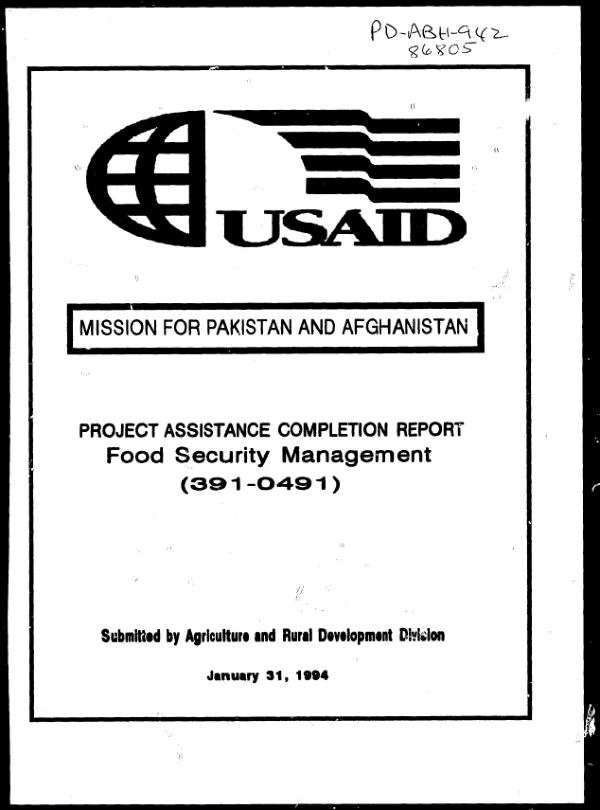
Project assistance completion report : food security management (392-0491)
PACR of a project (8/84-6/91) to improve food security management in Pakistan.
1994
Sign in to readA free account is required to download.
Abstract
The project made significant progress under each of its three components. Under the policy analysis component, an Economic Analysis Network (EAN), comprised of public and private professionals and the Economic Wing of the Ministry of Food, Agriculture, and Cooperatives (MINFA), was established and provided with computer and policy training and computer equipment. The EAN has implemented an ongoing economic and policy analysis program, the most successful part of which has been the production of 26 (many more than planned) major publications. Also under this component, the International Food Policy Research Institute (IFPRI) and Pakistani researchers spurred agricultural policy reform through the completion of far more studies than originally planned. These studies, inter alia, validated the rural development concept and strategies, verified that subsidized institutional credit was not reaching some small farmers, and compared alternative credit pricing scenarios. One study led the Government of Pakistan (GOP) to abolish its wheat rationing system and another scuttled a planned $30 million Asian Development Bank project for new public sector godowns. Under the data collection component, Area Sampling Frame (ASF) methodology was successfully implemented in 7 districts to produce acreage and yield estimates for wheat, cotton, rice, corn, and sugarcane. The Federal Bureau of Statistics's ADC Unit can now independently implement ASF design at the national level. Provincial ADC offices were provided with data processing capabilities and training, both local and foreign. Under the postharvest management component, the Lahore Training Center provided training in grain storage techniques to private millers, and to provincial Food Departments and PASSCO (unidentified acronym); produced and disseminated publications on storage operations; trained operators and managers of storage facilities built by a World Bank project; and produced a major publication which the GOP used to formulate policies governing wheat procurement and storage. The vertebrate pest control subcomponent provided professional pest management training, upgraded the University of Agriculture, Faisalabad's degree program in pest management, disseminated a great variety of educational information, and conducted applied research on preharvest vertebrate pest damage. Further, the project rehabilitated 578,900 tons of wheat storage capacity at one-fourth the cost of constructing a new facility, and facilitated a tripartite agreement between MINFA, provincial Food Departments, and PASSCO (unidentified acronym) on recurring costs for repair and maintenance of godowns, a major achievement. The following lessons were learned. (1) Policy reform projects are generally slow to start, require major adjustments, and require a great deal of time to mature. Project design should permit flexibility for adjustments during implementation. (2) Reliable and timely data are essential for improved policy decision making. (3) Successful economic and policy analysis units must establish linkages with policy makers, as well as working relationships with complementary organizations. (4) Plans for continued training should be built into the project's design. (5) Grain-storage rehabilitation is a feasible alternative to the construction of new facilities.
Related documents
![Project assistance completion report : PFD/GMC [Punjab Food Department/Grain Management Cell] project activities, July - August, 1994](https://covers.devme.ai/gen/7044.webp)