USAID DEC
Project assistance completion report for on-farm water management project (517-0159)
Sign inUSAID. MISSION TO DOMINICAN REPUBLIC
Project assistance completion report for on-farm water management project (517-0159)
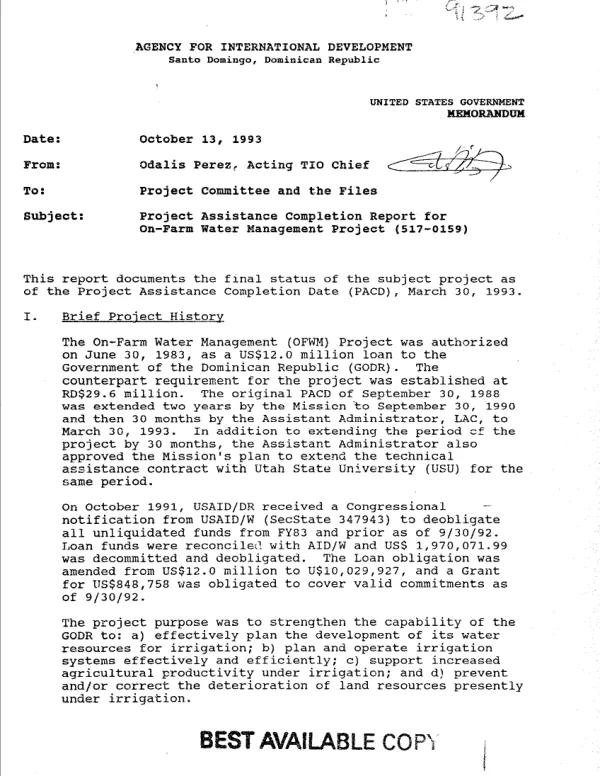
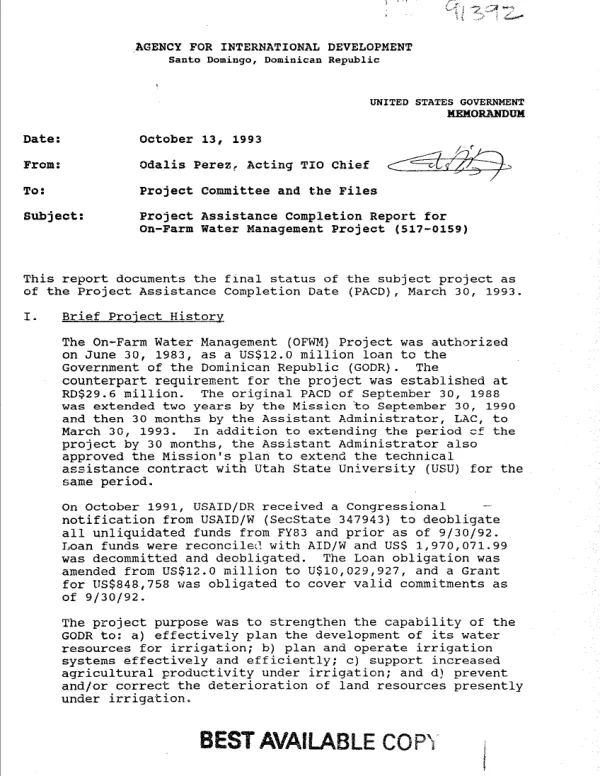
PACR of a project (6/83-3/93) to develop the Government of the Dominican Republic"s (GODR) capacity to support irrigated farming.
1993
Sign in to readA free account is required to download.
Abstract
The project was implemented by the GODR"s National Institute for Hydraulic Resources (INDRHI) and Utah State University. The project was a success, with most goals met or surpassed. Specifically, the project: (1) established 12 water user associations (WUAs); (2) rehabilitated 160 km of irrigation canals (vs. a target of 306 km); (3) reclaimed 400 km of drainage canals (vs. 210); (4) leveled and increased irrigation efficiency on 2,000 ha, (vs. 1,500); (5) improved 2,300 farm ha with new drainage and 1,500 farm ha with irrigation systems, vs. targets of 1,150 and 1,150; and (6) provided 6,500 farmers with training, 75 persons with off-shore training, and 25 persons with degree training, vs. respective targets of 5,000, 40, and 26. An unexpected result was the training of 7,500 farmers outside the project area. Despite the project"s success, the Dominican Republic"s weak agricultural marketing structure and deficient agricultural credit system places the goal of increasing farmer income through increased productivity in irrigated agriculture outside the project"s influence. Farmers, previously reluctant to let canals be dug through their lands, became eager to cooperate with the project when they saw dramatic increases in crop production, water use efficiency, and incomes resulting from improvements in irrigation, drainage, and land structures. The improved physical systems enabled, indeed were essential to, the next step -- encouraging farmers to organize WUAs, under which they became responsible for the operation and maintenance of their own irrigation and drainage systems. The WUAs allowed farmers to participate in the process of democratic decision making, and some served as bases for entrepreneurial ventures. Privatization of control of the irrigation districts through the WUAs within the project area of influence was so successful that INDRHI decided to encourage the formation of WUAs throughout the country, and plans to turn all irrigation districts over to the WUAs. INDRHI"s 1993 budget should cover, after PACD, the turn-over of 29 irrigation systems comprising 26,300 ha to 7,261 farmers organized into WUAs. These activities will be supervised by INDRHI"s new National Center for Training in Irrigation and Drainage at Bani. The following lessons were learned. (1) A top-down approach is not as effective as a bottom-up approach in developing WUAs. (2) Motivation through clear, personal benefits was the key to eliciting farmer cooperation and to motivating farmers to invest their time and money into developing WUAs. Similarly, the GODR"s cooperation and enthusiasm were gained as soon as the project"s progress became evident.
![Project assistance completion report : project USAID no. 519-0303 -- water management-GOES [Gobierno de El Salvador]](https://covers.devme.ai/gen/6459.webp)