USAID DEC
Project assistance completion report : project USAID no. 519-0303 -- water management-GOES [Gobierno de El Salvador]
Sign inUSAID. MISSION TO EL SALVADOR
Project assistance completion report : project USAID no. 519-0303 -- water management-GOES [Gobierno de El Salvador]
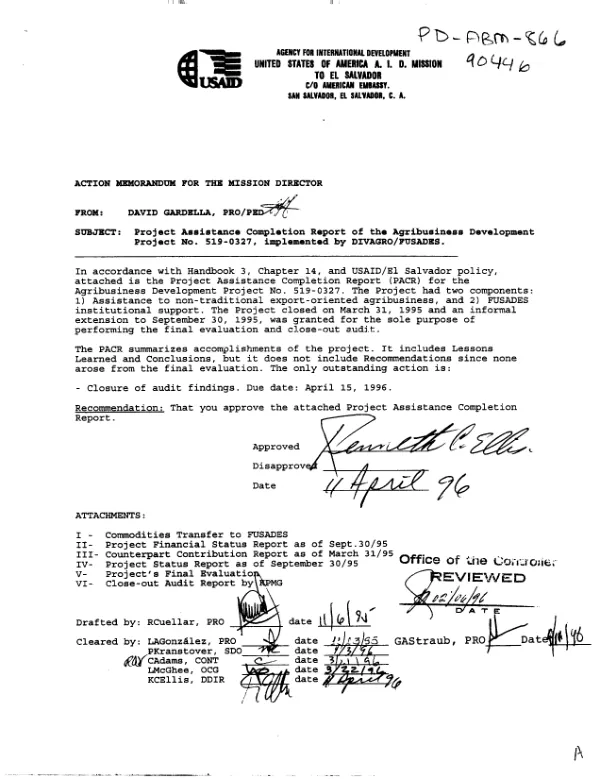
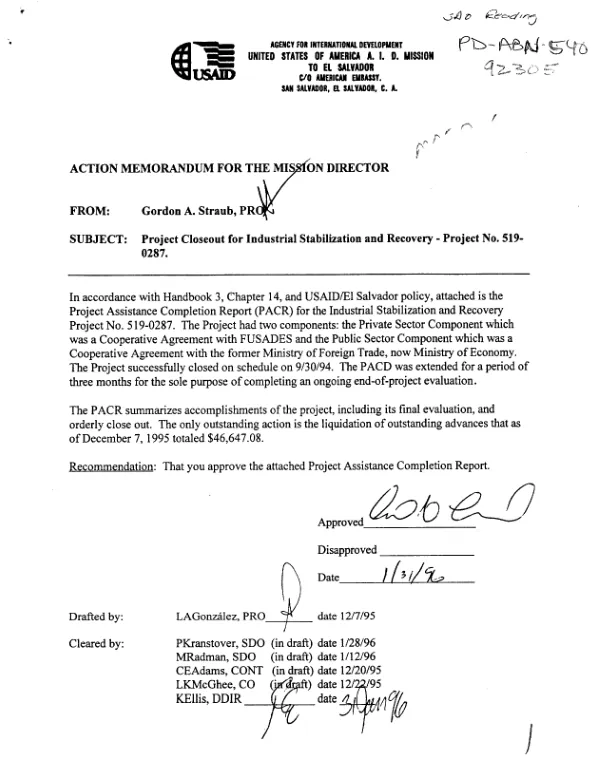
PACR of a project (8/85-9/92) to promote the production of non-traditional agricultural export (NTAE) crops through irrigation development in El Salvador.
1996
Sign in to readA free account is required to download.
![Project assistance completion report : project USAID no. 519-0303 -- water management-GOES [Gobierno de El Salvador]](https://covers.devme.ai/gen/6459.webp)
Abstract
The evaluation focuses mainly on the project's public sector component, implemented by the Ministry of Agriculture and Livestock (MAG). The private sector development component, implemented by the Salvadoran Foundation for Economic and Social Development (FUSADES), is the subject of a separate evaluation (PD-ABE-670). The public sector component comprised three activities: (1) TA, training, and curriculum development in irrigated export crop development to the Center of Agriculture Technology (CENTA) and the National School of Agriculture (ENA), and upgrading of the facilities of the National Training Center (CENCAP); (2) training and TA in irrigation planning and evaluation assistance to the General Directorate of Irrigation and Drainage (DGRD), the Agricultural Sector Planning Office (OSPA), and the Office of Water (OA); and (3) in-country training of irrigation professionals, extension agents, and farmers. Most targets were met or exceeded. In particular, 1,582 farmers were trained in on-farm water management (vs. a target of 1,400), and precision irrigation for production of high-labor, high-value NTAE crops has been adopted on 2,727 ha (vs. a target of 2,500 ha). Overall, the project's concepts are sound. There appears to be no viable alternative approach to significantly increasing the demands for rural labor or to promote increased NTAEs. However, project designers underestimated the time and effort needed to make farmers inexperienced in intensive agriculture fully effective in this type of production. A broader technological approach, with more emphasis on the importance of integrating factors of production and water use, would have strengthened the overall project. In addition, El Salvador's institutional capacity for carrying out the proposed activities and for implementing the reforms necessary for achieving the objectives was, and still is, weak. More emphasis should have been placed on improving inter-institutional coordination between the public and private sectors. Further, it is not wise to assign responsibility for such a complex program to a high-level public administrator whose responsibilities are already demanding. Finally, the technology of efficient surface irrigation is complex and requires considerable time, repetition of the basics, and patience on the part of extension agents to train both technicians, and through them, producers at the farm level. The extension technicians must have in-depth experience in production and in meeting market demand for each commodity produced. Access to technologies developed in similar areas can speed technology transfer.
![Project assistance completion report : project USAID no. 519-0303 -- water management-GOES [Gobierno de El Salvador]](https://covers.devme.ai/gen/75206.webp)