USAID DEC
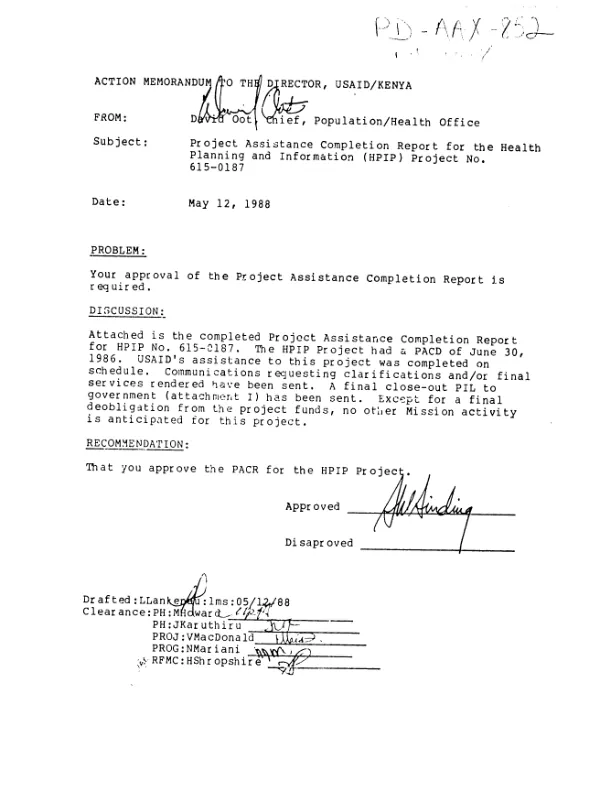
Project assistance completion report for the health planning and information (HPIP) project no. 615-0187
Sign inUSAID. MISSION TO KENYA
Project assistance completion report for the health planning and information (HPIP) project no. 615-0187
Final Mission report on a project (10/80-6/86) to strengthen health planning and information systems in Kenya's Ministry of Health (MOH).
1988
Sign in to readA free account is required to download.
Abstract
The project was a success. Specifically, it: (1) created within the MOH a senior-level management/planning committee, provincial and district health management teams, and a working group which was the predecessor of the newly formed Division of Planning and Information; (2) provided extensive provincial- and district-level training in management, planning, and budgeting; (3) established an MOH computerized data processing facility, introduced over 100 senior and mid-level managers to microcomputers, and provided extensive formal and on-the-job training in data processing. The project's major strength was the ability of TA staff to work well with counterparts. A major weakness was the administrative burden placed on this too small staff. The project fostered significant institutional change, although not always as directly as planned. MOH senior management, fearing that the full-fledged Division of Planning and Information called for in the Project Paper might inhibit decentralized planning, established instead a Health Planning Working Group. This effort, however, laid the basis for the creation - some 2 years after the PACD - of the Division initially called for. Similarly, although the envisioned "Scheme of Service" - a specialized designation and career ladder for MOH health planners - turned out to be beyond the MOH's authority, systemic changes within the MOH and the Government of Kenya (GOK) promoted the same objectives. The project put in place several concepts and structures which, along with the GOK's aggressive promotion of decentralization to the district level, laid a sound basis for the follow-on project - Information and Planning Systems. The project also validated the importance of general institutional management development to USAID/K's other population/health investments. In the past, the Mission had focused on vertical interventions rather than general institution building. Several lessons were learned. (1) Institution-building projects require long-term commitment of time and money from the start, and a compatibility between project intents and government policies. This project lacked the former but enjoyed the latter. (2) Implementation must be flexible, working within existing policies in order to change them. It is better for advisors to accomplish part of a task with counterpart participation than all of a task that is seen as irrelevant. (3) Several directions in the field of health planning and information systems emerged during the project - host government awareness of the importance of institution-building/management systems, a shifting emphasis in health information to the user level, and an increasingly multidisciplinary approach to health planning.
Related documents
![Evaluation report : FPMD [family planning management development] assistance in Kenya](https://covers.devme.ai/gen/6965.webp)
![Evaluation report : FPMD [family planning management development] assistance in Kenya](https://covers.devme.ai/gen/16375.webp)