USAID DEC
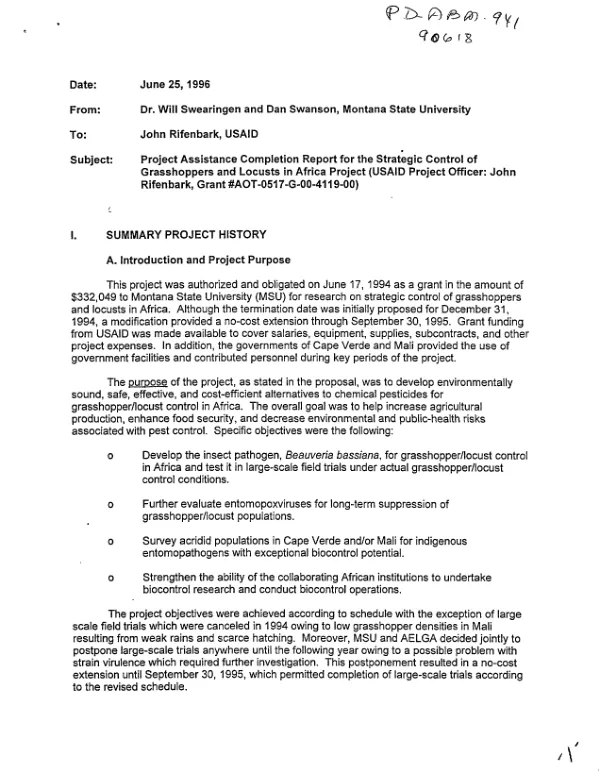
Project assistance completion report for the strategic control of grasshoppers and locusts in Africa project : grant no. AOT-0517-G-00-4119-00
Sign inMONTANA STATE UNIVERSITY AT BOZEMAN
Project assistance completion report for the strategic control of grasshoppers and locusts in Africa project : grant no. AOT-0517-G-00-4119-00
Final report by the grantee, Montana State University (MSU), on a project (6/94-9/95) to develop safe, effective, and cost-efficient alternatives to chemical pesticides for grasshopper/locust control in Africa.
Swearingen, Will|Swanson, Dan · 1996
Sign in to readA free account is required to download.
Abstract
Good progress was made. Large-scale field trials of Beauveria bassiana GHA -- a safe (EPA experimental use-permitted), cost-effective (about the same price as chemicals) fungal biocontrol agent. These trials demonstrated the feasibility of biocontrol technology for use under African conditions and carried out by African personnel. The trials identified an additive for improving the efficacy and kill speed of fungi and raised questions about the sustained efficacy of chemicals. For although the short-term efficacy of B. bassiana GHA was less than chemicals, the effect was longer lasting. Efforts underway at MSU and elsewhere are expected to eliminate the short-term efficacy gap and explain the difference in long-term effects between fungi and chemicals. The project demonstrated that USAID and its partners are on the right track in developing fungi-based biocontrol agents that are safe, effective, and manageable in Africa. The demonstration trials showed that fungus can be an effective biocontrol agent and improved MSU's understanding of what efficacy means. MSU now knows that, although B. bassiana GHA achieves respectable results, it must (1) push ahead with more virulent strains (such as a promising new Metarhizium from Madagascar) for regional development, (2) continue research on additives, and (3) compare fungi and chemical control in a longer time frame. For future large-scale trials, MSU recognizes the importance of having both untreated control plots and control plots treated with a chemical agent. Other evidence supporting the development of fungal biocontrol agents was found quite unexpectedly in trying to measure the effects of an entomopoxvirus on grasshoppers. The effects of the manually applied virus was mostly obscured by a naturally occurring epizootic of Metarhizium in the region of the field trials in Cape Verde. Such naturally occurring epizootics are the type of phenomenon which biotechnology of this sort attempts to emulate or augment. A number of lessons were learned about capacity building in Mali. It is necessary to assess the level of commitment and the time horizon of project participants, especially the project leader proposed by the government. In the training of Malian personnel, MSU's efforts were undermined when after being trained personnel were transferred, hired away, or did not get access to project resources in a way that led to sustainable work. The result was ongoing training of new faces, misallocation of equipment, and a lack of continuity and commitment to the work. This problem was exacerbated by the small number of qualified personnel in Mali, the multiple demands on their time (qualified people were transferred as a means of generating new projects to obtain donor resources), and a general cynicism among Malian project leaders about donor aid. Continuity of the work in Mali was also interrupted prior to the beginning of the project, owing to an interruption in USAID funding, which may have contributed to the turnover of Malian personnel. In Cape Verde, by contrast, the high level of personal, professional, and institutional commitment led to a positive and highly productive project. (Author abstract, modified)
Related documents