USAID DEC
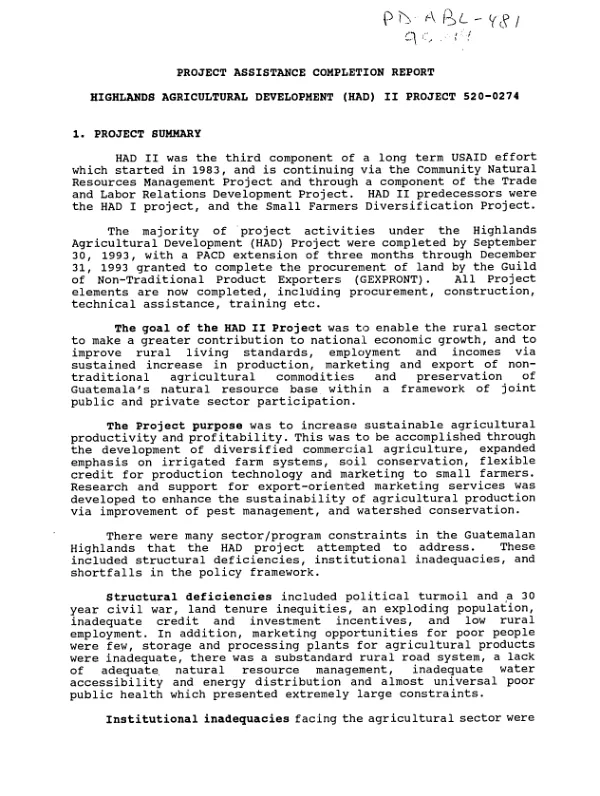
Project assistance completion report : highlands agricultural development (HAD) II project 520-0274
Sign inUSAID. MISSION TO GUATEMALA
Project assistance completion report : highlands agricultural development (HAD) II project 520-0274
PACR of a project (1988-12/93), the third in a decade-long agricultural development effort, to increase sustainable production by small and medium-sized farmers in the Guatemalan highlands.
1995
Sign in to readA free account is required to download.
Abstract
Results were mixed. There are indications that the project increased crop production and value for two-thirds of the farmers, and that it increased the use of soil conservation practices and pesticides. Also, there were some instances of increased capacity to deliver coordinated government services to farmers. However, improvements in the Ministry of Agriculture's (MAGA's) management and decisionmaking capacities seems to have been limited. In addition, farmers at upper watershed elevations have experienced shortages of water due to poor irrigation system design, escalating costs of electricity for pumping, and lack of knowledge of and money for maintenance. In fact, about one-third of the farmers, citing irrigation installation and electricity costs as well as the failure to find markets for their crops, felt their situations had become worse for participating in the project. Specifically, the project constructed 275 small-scale irrigation systems; developed 150 ha of community forests and established integrated management programs in 10 watersheds; established 26 farmers' markets, opened channels for produce exports, and created a market information service; and created a public-private applied agricultural research fund in GEXPRONT which funded 14 research projects that benefited participating farmers and was more successful in the area of research than public agencies. The national agricultural bank (BANDESA) made credit available for irrigation, agricultural production, and marketing. Other accomplishments included the formation of 88 forestry management groups (with women as full members in 33 of them), and a joint public/private sector integrated pesticide management program. However, although 70% farmers reported the use of gloves when applying pesticides, most farmers do not take enough precautions when using pesticides. The following lessons were learned. (1) Agricultural development is a long-term venture, as this three-project program proves. However, funding and implementation gaps between the three projects caused the program to lose momentum at times. (2) Since the first two projects had created a successful administrative template, there was no need to create a new bureaucracy for this project; in fact, the project administrative unit (PDA-UAP) became a politicized bureaucracy apart from MAGA that generated hard feelings concerning cashflow and delegation of responsibility. (3) The project's size and geographical reach became too extensive; the first two projects were considered successful partially because they were geographically limited. (4) Correct planning and engineering are mandatory. Frequent errors in irrigation system design constrained the project. (5) Interagency coordination was relatively easy to accomplish at the field level, but seemed to break down at the intermediate administrative levels, generally due to political influences and a lack of clear definitions of functions and resource allocation. (6) Pesticide management can be improved by requiring research institutions to provide extension materials and by enforcing pesticide laws and statutes. (7) Planning by objectives is a valid means of assuring cooperation between agencies. (8) Micro-farm enterprises involved in producing nontraditional export commodities require strong associations and cooperatives if they are to enter international markets. (9) Local agricultural technicians need to be trained in marketing, credit procedures, and farmer group organization. (10) Privatized agricultural TA appeared to be more successful than MAGA's, evidently because technicians depended on farm profits for their own incomes, compared with a competitive vacuum in the public sector; care must be taken to balance assistance to private and public sector extension agents to avoid brain drain from the public sector and keep jealousies to a minimum. (11) USAID officials should closely review initial phases of a project, especially survey designs, to ensure that projects do not become politicized. (12) The project was overevaluated and overmonitored. It would have been better served by fewer but more scientifically based surveys geared to solving farmers' practical problems.