USAID DEC
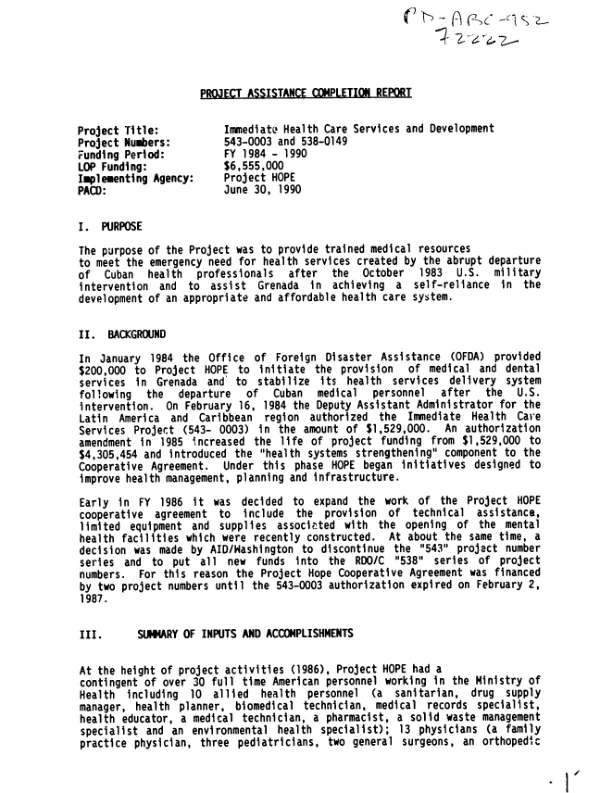
Project assistance completion report : immediate health care services and development
Sign inUSAID. BUR. FOR LATIN AMERICA AND THE CARIBBEAN. REGIONAL DEVELOPMENT OFC. CARIBBEAN
Project assistance completion report : immediate health care services and development
PACR of a cooperative agreement with Project HOPE (1984-90) to provide U.S.
1991
Sign in to readA free account is required to download.
Abstract
medical personnel and equipment to meet Grenada's need for health services created by the abrupt departure of Cuban health professionals after the U.S. invasion in 1983. Project HOPE provided 122 person-years of U.S. TA, including physicians, nurse educators, a mental health team, and allied health workers. On-the-job and special training programs were provided in nursing, cytology, ultrasound radiography, psychiatric nursing, community-based mental health, and vital/health statistics. A smaller number of health workers received third-country training in areas such as medical records keeping, biomedical technology maintenance, and environmental health. Although results were generally positive, many trainees have moved to positions outside the Ministry of Health (MOH). Through the project, Grenada was linked to the University of the West Indies's slow-scan satellite Distance Teaching Experiment system (UWIDITE), which allowed Grenadians to both receive and initiate teaching programs in health systems management; the system continues to be well-used. Another highlight was the project's multi-faceted mental health program which upgraded care from custodial to therapeutic standards. New acute and chronic care facilities were built and a community-based mental health program was introduced to reduce institutionalization. Also of note have been improvements in health budgeting. Other activities were less successful. A program to rotate UWI medical residents to the General Hospital in Grenada was discontinued due to a lack of interest and funding. Efforts to improve solid waste management were also unsuccessful, despite about 5 years of resident TA. Several lessons were learned. The project was overwhelming -- both in its scope and in the number of technical advisors sent. The large resident contingent -- over 30 strong at one point -- suggested to some that the MOH was perhaps no longer run by Cubans, but by a parallel group of Americans. In the aftermath of the invasion, Project HOPE's "take charge" approach was resented by some. This tension, along with an unrealistically broad scope of work, prevented the project from being fully integrated, despite enormous investment.