USAID DEC
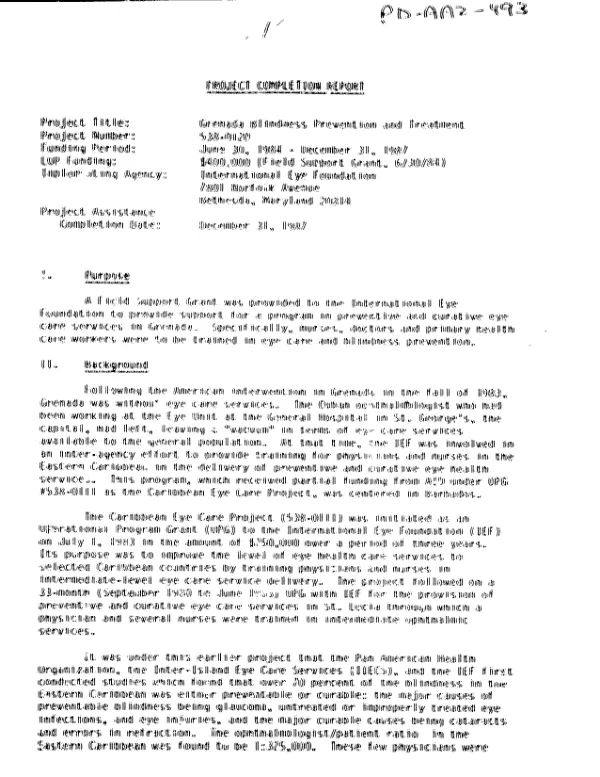
Project completion report : project title, Grenada blindness prevention and treatment
Sign inUSAID. BUR. FOR LATIN AMERICA AND THE CARIBBEAN. REGIONAL DEVELOPMENT OFC. CARIBBEAN
Project completion report : project title, Grenada blindness prevention and treatment
PACR of an OPG (6/84-12/87) to the International Eye Foundation (IEF) to train physicians, nurses, and primary health care workers in Grenada in preventive and curative eye care and blindness prevention services.
1989
Sign in to readA free account is required to download.
Abstract
The project has notably improved eye care in Grenada. The IEF Project Director, a U.S. ophthalmologist seconded to the Ministry of Health (MOH), played a central role in providing ophthalmological services to the public, training health care workers, and promoting blindness prevention as a community concern and a focus for action. As a result of the project, Grenada has an eye care infrastructure which includes not only tertiary-level care at the Eye Unit of the General Hospital in St. George's, but also primary- and secondary-level care in the districts. Several resources - schools, district health centers, the media, and community groups - have been integrated into project activities. The project provided training in ophthalmology to the nurses at the St. George's Eye Unit. These nurses now form a core group of secondary-level eye care providers with responsibility for handling most eye cases, as well as for training and supervising the district health workers who serve as primary eye care providers. The team of nurses will eventually be augmented by a Grenadian ophthalmologist who is currently receiving advanced training overseas, partially under IEF auspices. An island-wide eye care referral system has also been established. The project also had a positive impact on health care policy. The MOH and the administration of the St. George's General Hospital have agreed to retain the ophthalmic nurses in the Eye Unit rather than assign them elsewhere. This commitment to the appropriate use of nursing staff has policy implications extending beyond eye care services. The MOH and the hospital administration are also committed to instituting a fee-for-service schedule at the Eye Unit to generate the income that will be needed to finance the continued delivery of high quality eye care. If successful, this practice should serve to promote acceptance of fee-for-service throughout the hospital and other clinical service facilities. A key lesson learned concerns the need to plan for post-project requirements during project design. In this project, the sustainability of some activities was jeopardized by the short time-frame of the grant and the lack of planning concerning post-project financing.
Related documents
Documents in this collection
 2000
2000USAID DEC
International Eye Foundation : seeing 2000 program -- expansion of clinical and surgical eye care services for children through support for NGOs worldwide : final evaluation
Open record 1991
1991USAID DEC
![Extending successful hospital-based child survival strategies into surrounding urban, peri-urban, and rural communities of Boaco, Nicragua : CS-VII [child survival], grant no. PDC-0500-G-00-1064-00 -- final evaluation, September 1991-February 1995](https://covers.devme.ai/gen/5755.webp)