USAID DEC
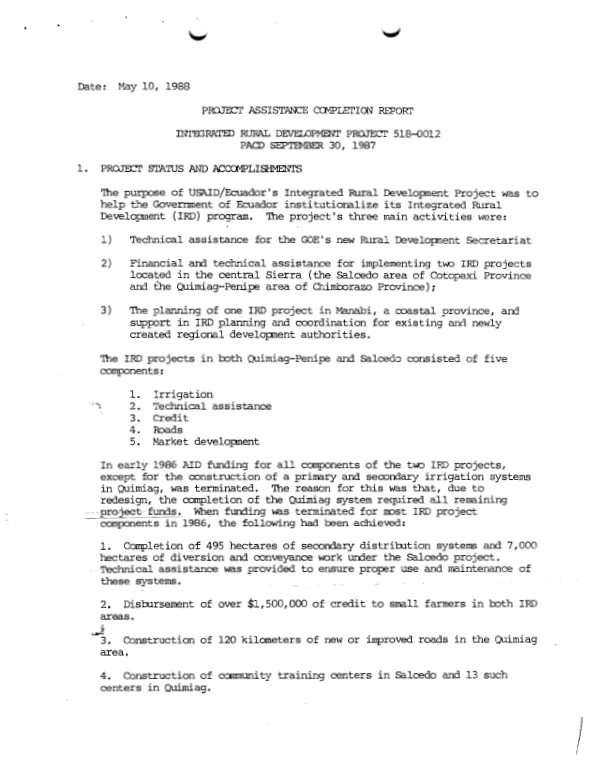
Project assistance completion report : integrated rural development project 518-0012, PACD September 30, 1987
Sign inUSAID. MISSION TO ECUADOR
Project assistance completion report : integrated rural development project 518-0012, PACD September 30, 1987
Final Mission report on a project (1981-87) to help the Government of Ecuador (GOE) institutionalize its Integrated Rural Development (IRD) Program.
1988
Sign in to readA free account is required to download.
Abstract
A major aim was to assist IRD activities in Salcedo and Quimiag. A redesign of the Quimiag irrigation system in early 1986 increased costs by over $4 million, shutting down most other project components. By that time, the project had: completed 495 ha of secondary distribution systems and 7,000 ha of diversion and conveyance work in Salcedo and provided TA for operation and maintenance; disbursed over $1.5 million in credit to small farmers; built 120 km of roads in Quimiag (though most planned road work proved unnecessary); built community training centers in both areas; and planted over 600,000 trees on farms and school grounds. By the 9/87 PACD, the primary irrigation canal in Quimiag was 90% complete and the secondary and tertiary systems 100% designed and 15% and 10% constructed, respectively. CARE, with P.L. 480 and GOE financing, is helping Ecuador's Institute for Water Resources complete the systems, which are using sprinkler technology because traditional surface irrigation would cause rapid and extensive erosion in Quimiag. A sharp rise in the value of the dollar provided much more local currency than expected. Much of this money was used for unplanned activities, e.g., schools, some of them in Jipijapa, where several activities were undertaken even though only a planning effort was envisaged. Long-term credit was to have been used for on-farm irrigation, but instead was used almost entirely to buy grazing cattle. This was partially due to the fact that farmers could use cattle for collateral, but would have had to mortgage their land to obtain credit for on-farm improvements. The GOE's new IRD Development Secretariat (SEDRI) did not fare well as implementing agency, and was dismantled in 1986. Although the project did not institutionalize IRD to the degree planned, the GOE has designed over 15 other donor-financed IRD projects. Several lessons were learned. (1) It is unwise to assign implementation for a complicated project to a new organization. (2) IRD projects should be implemented in phases. This one was not. (3) Lack of adequate technical supervision hurt almost every aspect of the project and robbed it of momentum. (4) USAID/E's management interest waned after the project began having problems. Constant attention is needed to assure implementation. (5) Because planned cooperation with the Forestry Sector Development (FSD) Project was not formalized in the Pro-Ag's for the two projects, there was no basis for overruling the SEDRI forester's decision not to work with FSD. Inter-project coordination should be built into project agreements.