USAID DEC
Project assistance completion report : International Executive Service Corps -- USAID project 522-0361
Sign inUSAID. MISSION TO HONDURAS
Project assistance completion report : International Executive Service Corps -- USAID project 522-0361
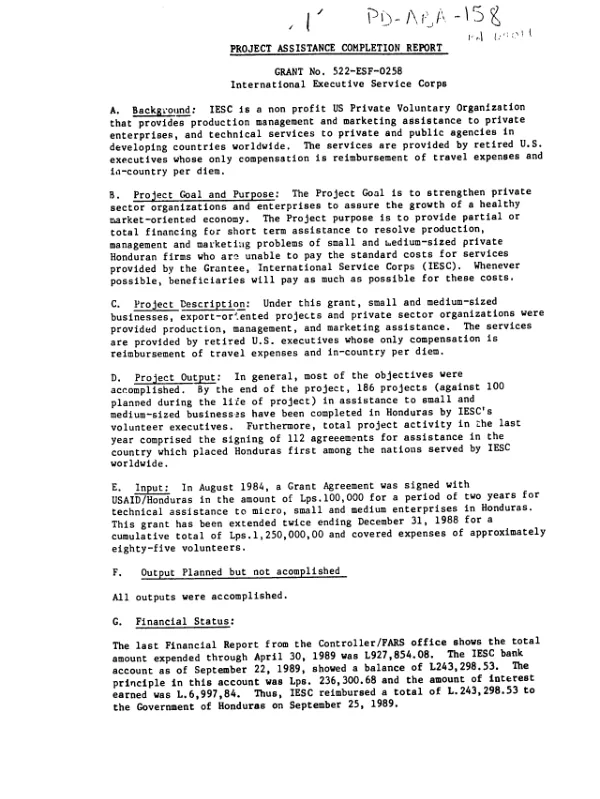
PACR on a grant (3/89-12/92) to the International Executive Service Corps (IESC) to provide TA to micro, small, and medium-sized companies in Honduras.
1994
Sign in to readA free account is required to download.
Abstract
Overall, the project was successful. IESC completed 178 TA projects, 38 more than planned, and indirectly supported 54 non-USAID financed projects. TA provided by IESC volunteer executives (VEs) was effective in upgrading client's managerial and marketing skills. Of the client companies interviewed, 85% had improved product quality, 80% had increased production, 73% had improved plant operations, 60% had strengthened management systems, 37% had implemented new marketing programs, and 24% had developed new products. Additionally, the targets for creating and for maintaining jobs were exceeded by 31% and 352%, respectively. However, while largely successful, the project suffered several deficiencies. The VEs failed to meet the expectations of some client companies; the chief complaint of the dissatisfied clients was that the VEs could not relate to very small operations, many of which used relatively obsolete shop equipment. Other clients chose not to implement the VE recommendations. VEs made more progress in increasing sales, profitability, and production and in improving product quality, than in improving management systems. The following lessons were learned. (1) IESC should make a greater effort to ensure that VEs have experience working with small companies. IESC should also expand its resource base to include qualified ex-Peace Corps volunteers or ex-small company owners and managers. In addition, the VE recruitment process should be completed swiftly so as to retain the interest and enthusiasm of clients. (2) IESC should place more emphasis on longer-term TA projects for fewer companies, and companies with greater prospects for success. (3) IESC should improve its client monitoring system and follow-up on its recommendations; firms that consistently refuse to act on VE recommendations without a valid reason should be ineligible for future A.I.D. assistance. (4) VE assistance should focus on strengthening client accounting, administrative, and managerial systems, where appropriate. (5) The system of client contributions should be analyzed and modified, including the impact of client contributions to the IESC and the quality of TA that is piggybacked, or shared among several firms. (6) The project design should include detailed cost-benefit and economic analyses. (7) Before future A.I.D. assistance is granted to IESC/Honduras, the organization's accounting and reporting systems should be assessed and given a clean bill of health. (8) Gender considerations should be analyzed and incorporated at the design stage, in the project's baseline data, and during implementation, monitoring, and reporting. Information in all project analyses and reports should be disaggregated by gender.