USAID DEC
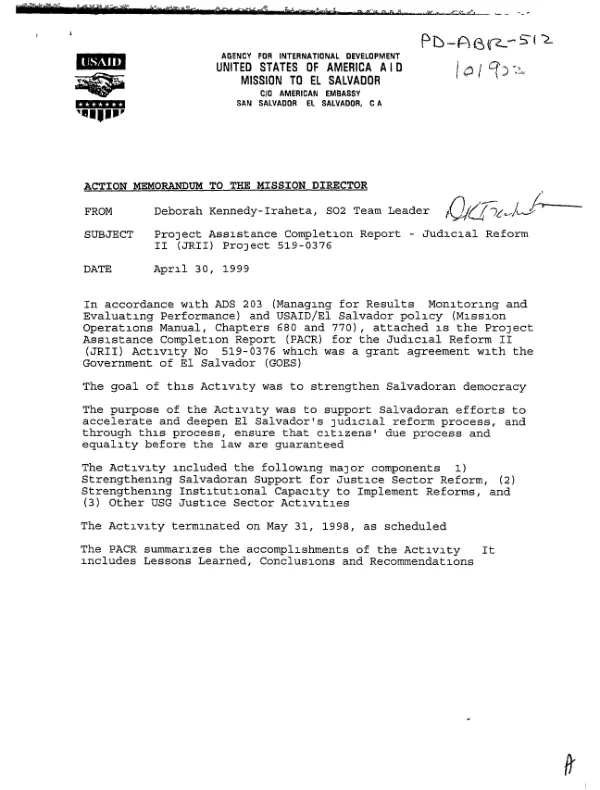
Project assistance completion report : judicial reform II (JRII) -- project 519-0376
Sign inUSAID. MISSION TO EL SALVADOR
Project assistance completion report : judicial reform II (JRII) -- project 519-0376
PACR of phase II (9/92-5/98) of a project to support judicial reform in El Salvador (JR II project).
1999
Sign in to readA free account is required to download.
Abstract
Achievements of this successful project were as follows: (1) JR II significantly reduced the criminal and civil case backlog, as well as the number of detained individuals awaiting trial or sentencing. Efforts included creating: a Case Purging Center for criminal and civil cases; a pilot court administration project in all San Salvador criminal trial courts; a unit to manage an automated management information system in 100 courts across the country; a system to control the judicial status of detained prisoners in a more equitable manner; and a reorganization, institution building, and training program for the Public Defenders office (PDO) that resulted in a near doubling in the number of persons assisted between 1995 and 1997 and a doubling of the number of persons freed in 1997. (2)With JR II assistance, the Government of El Salvador (GOES) has enacted numerous legal and administrative reforms to increase respect for due process, most importantly the Criminal Procedure Code and the Criminal Code, the Penitentiary (sentencing) and Juvenile Delinquency Laws, and the Family Code. (3) JR II financed numerous activities to increase popular understanding of the law, legal reform, and the justice sector, including six major popular education and publicity campaigns, most of them carried out by local NGOs. (4) Many JR II activities strengthened the legal framework and increased the effectiveness of the institutions charged with implementing laws, particularly with respect to the criminal, juvenile, and family law jurisdictions. JR II also assisted the GOES in undertaking organizational reform to improve the legal framework of the justice sector as a whole and its component institutions, and provided extensive assistance to modernize the legal framework in the family law area, including enactment of the new Family Code and Family Procedure Law. (5) The GOES made impressive increases in its funding for key justice sector institutions, mostly to implement the reforms enacted as a result of JR II assistance. Other donor assistance also increased dramatically. Lessons learned include the following: (1) It was strategically important to make inter-institutional coordination through the Justice Sector Coordinating Committee (JSCC) and its Technical Executive Unit (UTE) a precondition for project execution, not just a peripheral activity. Justice sector leaders took almost 2 years to realize the value of inter- institutional coordination. (2) Legal and judicial reform should not be done piecemeal. Reform legislation requires capable implementing institutions, and the latter without good legislation are useless. (3) To ensure that the system functions effectively, include all relevant justice sector institutions in designing reform strategy and ensure that all in need of institutional strengthening receive it. (4) JR II trained and incorporated into the project a cadre of enthusiastic and dynamic local consultants from a wide range of professions and organizations and left them free to choose the most appropriate reform options for El Salvador. Many of these consultants are now in leadership positions. (5) Channeling all legal training for justice sector operators through the Judicial Training School (JTS) made the JTS a stronger and more important player in the reform process. By unifying training criteria, all justice sector operators received the same message. (6) Legal reform is more the encouragement of cultural change and development than a technical exercise in drafting legislation. JR I and JR II helped develop the political support and the leadership capacity needed for reform. (7) The strategy for promoting judicial reform must be continually readjusted to national realities. Due to a crime wave, JR II"s initial focus on criminal justice system reform shifted to increasing the efficiency of the criminal justice system. (8) Observational travel was a key activity in promoting and consolidating reforms. (9) JR II should have made law school reform a priority, as JR I did. Law schools are not producing high quality, reform minded, independent lawyers because they still focus on rote memorization of codes rather than on practical skills and analytical thinking. (10) JR II should have developed a user-friendly statistics-gathering system in every justice sector institution at the outset and provided more training in its use.