USAID. MISSION TO SRI LANKA
Project assistance completion report : malaria control 383-0043
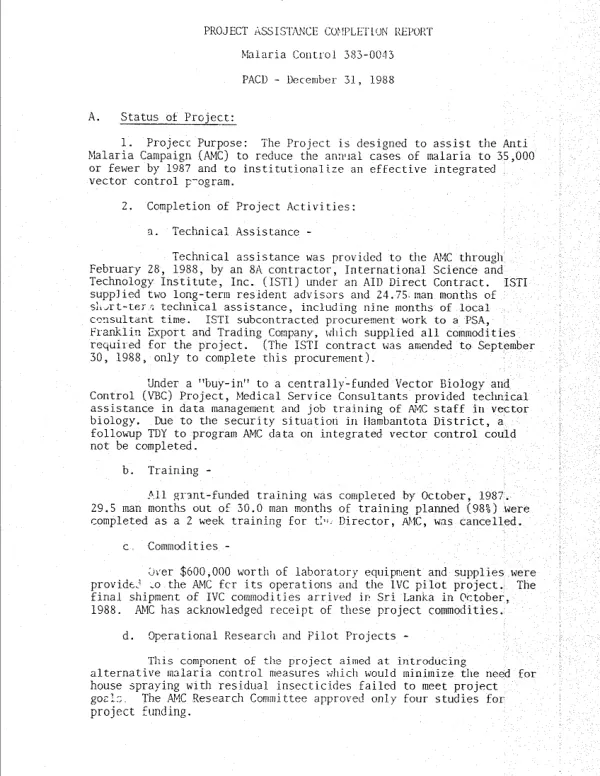
PACR of a project (1985-1988) to assist Sri Lanka's Anti-Malaria Campaign (AMC) in reducing the incidence of malaria and to institutionalize an integrated vector control program.
1988
Sign in to readA free account is required to download.
Abstract
Overall, the project was a failure. Sri Lanka's 1987 malaria count was the worst in 30 years and the current situation is the worst in South and Southeast Asia. While this was due partly to migration to the Mahaweli irrigation area, where malaria incidence is high, and partly to severe security problems in some regions, it is also a result of the AMC's lack of strong leadership and the resistance of AMC senior staff to alternative, integrated control methods. Instead, the AMC concentrated on a traditional house spraying program (conducted seasonally in all medium-risk regions and quarterly in high-risk areas), which proved ineffective due to poor supervision of field offices. An epidemiological surveillance system is operating, but it relies on data up to 2 months old due to logistic problems, including the lack of radio links between the AMC and its field offices. The project's multi-media campaign was hampered by the lack of an information center for distributing literature and posters to schools and the general public. As a result, many house owners resisted spraying activities. The project failed to achieve significant progress in planning and management. This was due in part to the AMC's refusal to decentralize and delegate more authority to the AMC regions, its inability to implement action plans, and its underutilization of the project-supplied computer. Although several hundred AMC employees were trained under the project, this component was inadequate due to the lack of qualified staff at the national training center and the termination of the training advisory committee formed early in the project. It is recommended that the Ministry of Health take a more active, positive, and emphatic role in AMC activities and support AMC management in the use of new methodologies introduced by the project. Increased attention should also be given to decentralizing malaria control to the provincial and community levels.