USAID DEC
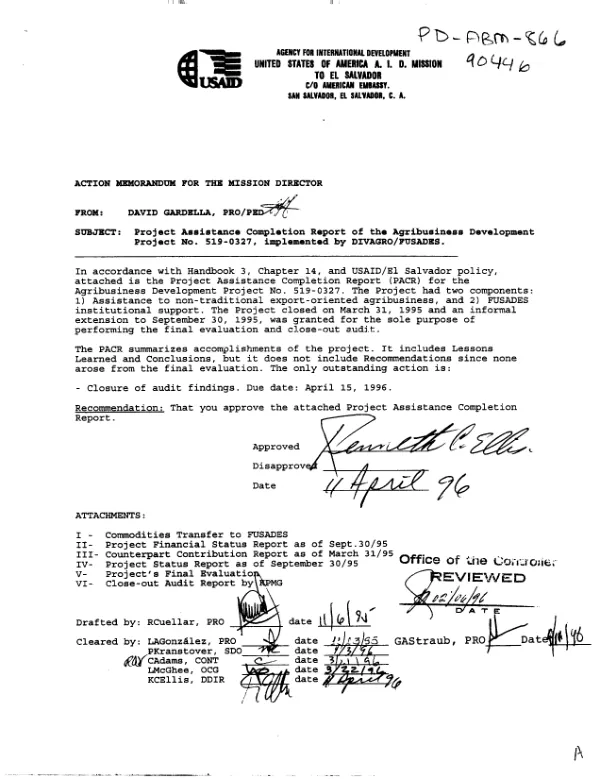
Project assistance completion report of the agribusiness development project no. 519-0327
Sign inUSAID. MISSION TO EL SALVADOR
Project assistance completion report of the agribusiness development project no. 519-0327
PACR of a project (9/87-9/95) to increase the production and export of non-traditional agricultural export products (NTAEs) in El Salvador.
1996
Sign in to readA free account is required to download.
Abstract
The project was implemented by the Salvadoran Foundation for Economic and Social Development (FUSADES). Working through DIVAGRO, its agricultural diversification unit, FUSADES provided tailored TA packages to entrepreneurs and companies in a wide variety of products in several commodity lines. Related short-term training was also provided. Credit assistance consisted of $5.47 million in loans to 43 entrepreneurs and private companies for new/expanded operations, some of them innovative, such as a shrimp hatchery and ornamental plantations. In the FUSADES institutional support component, the project built and equipped one of the most modern laboratories in Central America, and supported four agricultural experiment farms which tested a variety of crops. One of these, and the only one remaining, La Colina, a multiple use farm purchased by FUSADES's own funds and oriented to the testing and production of NTAEs, received in its last year funding for operational costs and equipment. La Colina -- a permanent symbol of USAID and FUSADES commitment to NTAEs -- is producing vegetables and vegetable seedlings, ornamentals, and pineapple, watermelon, and mangoes on a regular basis. With the 11/94 addition of a pineapple packing plant, pineapple exports are underway. The Quality Assurance Program (QAP) laboratory, added along with an aquacultural experiment station in a 7/89 amendment, is actively promoting its services to industry and agriculture in general; soil, water, foliage, and microbiology analyses, as well as pesticide residues analyses are performed routinely. A Tissue Culture unit is in charge of propagating highly priced plant varieties. At the PACD, the project had generated $57.5 million in foreign exchange for the agricultural sector vs. a target of $49 million; generated 27,346 full-time equivalent jobs vs. a target of 12,600; 20 NTAEs are being exported vs. a target of 15; and 29,106 ha have been placed under NTAEs vs. a target of 23,000. On the down side, a final external evaluation (XD-ABM-865-A) was harsh in its judgements. (1) DIVAGRO did not establish a program for continued development of NTAEs. The successful enterprises that resulted from the project have a modest impact on income, employment, and foreign exchange earnings, but they hardly justify 7 years of effort and an investment of $33 million. (2) DIVAGRO lacked the initiative or will to adapt its NTAE assistance program to the prevailing agribusiness environment, which was not conducive to implementing the program. (3) While the ornamental horticulture industry was well suited to FUSADES's NTAE strategy, its potential is limited. On the other hand, large-scale agro-industry like the Del Tropic freezing plant provided a model that combined the entrepreneurial focus of FUSADES with the land and productive capacity of the Agrarian Reform cooperatives. The option of combining post-harvest entrepreneurship with the productive capacity of the cooperatives was not pursued by DIVAGRO. (4) FUSADES disagreed with two important USAID-initiated policies that constrained project implementation, but did not vigorously attempt to change either of them: the restriction on non-traditional crop production for local markets, and the requirement that DIVAGRO develop an aquaculture industry based on cultivated shrimp. (5) La Colina is a FUSADES-owned commercial enterprise whose principal function is to generate income to support the institution. This activity comes at the expense of DIVAGRO's development function. The evaluators also added the following lessons learned (taken from XD-ABM-866-A). (1) When unalterable obstacles impede implementation of the project as designed, the implementing organization should have the flexibility to modify its implementation strategy, or the project should be redesigned. FUSADES's senior managers unanimously observed that the NTAE program was not viable under the civil war conditions and political instability of the 1980s and the early 1990s. (2) There is no substitute for effective USAID project monitoring. Even under the Cooperative Agreement mode of implementation, an involved project officer is a valuable input into the process. DIVAGRO has evolved into a commercial farming operation and in the future will most likely be almost entirely profit oriented, having minimal activities in NTAE development. With La Colina fully operational, most DIVAGRO staff are employed either at the farm or in support positions at DIVAGRO's office in San Salvador. Extension services and TA to NTAE producers are currently carried out by two DIVAGRO agronomists; conceivably, even this minimal extension and TA may be eliminated entirely if the organization runs into economic difficulty. The agribusiness loan portfolio will also be available to fund agricultural and agribusiness projects oriented to export markets, but additional loans will surely become more commercial and less developmental. A developmental loan facility for NTAEs no longer exists in El Salvador.
Related documents
![Project assistance completion report : project USAID no. 519-0303 -- water management-GOES [Gobierno de El Salvador]](https://covers.devme.ai/gen/6459.webp)
![Project assistance completion report : project USAID no. 519-0303 -- water management-GOES [Gobierno de El Salvador]](https://covers.devme.ai/gen/75206.webp)

![Microenterprise innovation program : cooperative agreement no. 940-0406-A-00-5246 [with Catholic Relief Services] -- close-out report](https://covers.devme.ai/gen/5658.webp)