USAID DEC
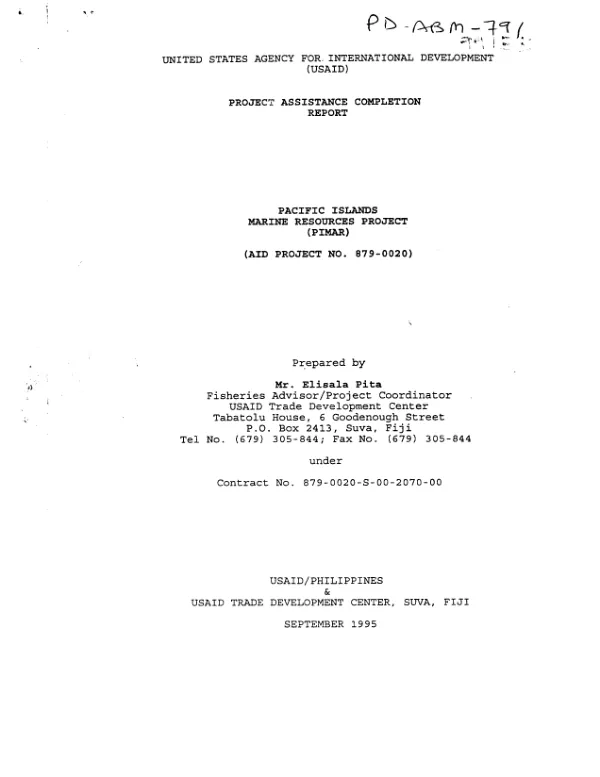
Project assistance completion report : Pacific Islands marine resources project (PIMAR)
Sign inUSAID. MISSION TO PHILIPPINES
Project assistance completion report : Pacific Islands marine resources project (PIMAR)
PACR of a project (7/90-9/95) to promote commercially sustainable uses of marine resources in selected Pacific Island countries (PIMAR project).
Pita, Elisala · 1995
Sign in to readA free account is required to download.
Abstract
PIMAR supported six bilateral subprojects -- in the Cook Islands, Kiribati, Fiji, Papua New Guinea (PNG), Tonga, and Tuvalu -- and one regional impact subproject. PIMAR contributed to achievement of the main goal of USAID/South Pacific's Regional Development Strategy Statement (RDSS) and Management Action Plan by increasing economic opportunities from the development of south Pacific marine resources. Given the wide variety of PIMAR's activities, the many start-up problems faced by the individual subprojects, and the difficulties during the project's last 2 years (budget reductions, and the closure of the USAID/SP Regional Development Office, followed by PIMAR's premature closure), the extent to which PIMAR succeeded is remarkable. PIMAR's innovative mechanisms for delivering development assistance and its new approaches resulted in the establishment of a viable commercial bottomfish fishery in Tuvalu, small-scale tuna longlining fisheries in Tonga and PNG, and research-based marine resources management plans for the Tarawa lagoon in Kiribati, and for inshore (the Tonga bottomfish management plan) and offshore resources. PIMAR also strengthened private sector fishing associations -- the Fishing Industry Association in PNG, and Deepsea Fishermen Association in Fiji -- and ensured the involvement of the private sector in the fishing industries. Despite these achievements, sustainability is dubious. Nearly all the PIMAR subprojects needed sustained funding and TA, at least for a couple of years after the PACD, to enable them to develop adequate infrastructure and logistic support, and to establish training institutions and fishing organizations. Elimination of the regional subproject increased the sustainability problem since information about project activities was not widely distributed. Another barrier to sustainability was the elimination of the planned evaluations, which could have helped in identifying appropriate activities to promote sustainability. The following lessons were learned. (1) As PIMAR was one of the first projects designed to meet the goals of the new RDSS and Management Action Plan, there should have been more time allotted for project design and discussion of the draft project paper. (2) More time should have been allowed for start-up. It took a year or more for most of the subprojects to get started, and for TA teams to reach to subproject sites. (3) Avoid closing subprojects prematurely, at the expense of the technical aspects, and allow more time for proper closeouts. For a project like this, an authorization of 6-7 seven years and an operational life of 5 years would seem reasonable. (4) Because the regional subproject was terminated prematurely, USAID missed the opportunity to introduce the technologies that had been successfully tested and proven under the subprojects. As a result, the project's results will probably not be replicated in the region. (5) The elimination of the planned evaluations illustrates the error of allowing administrative requirements (e.g., the decision to close the Mission) to be satisfied at the expense of achieving a project's objectives. (6) PIMAR's design required host countries to obtain their own vessels, resulting in delays; time, money, and frustration would have been saved had PIMAR provided funds for contractors to charter vessels and hire commercial crews. (7) Since a contractor's Chief of Party often cannot keep government agencies fully informed as to progress and problems, a counterpart co-manager should be designated to fulfill this function.