USAID DEC
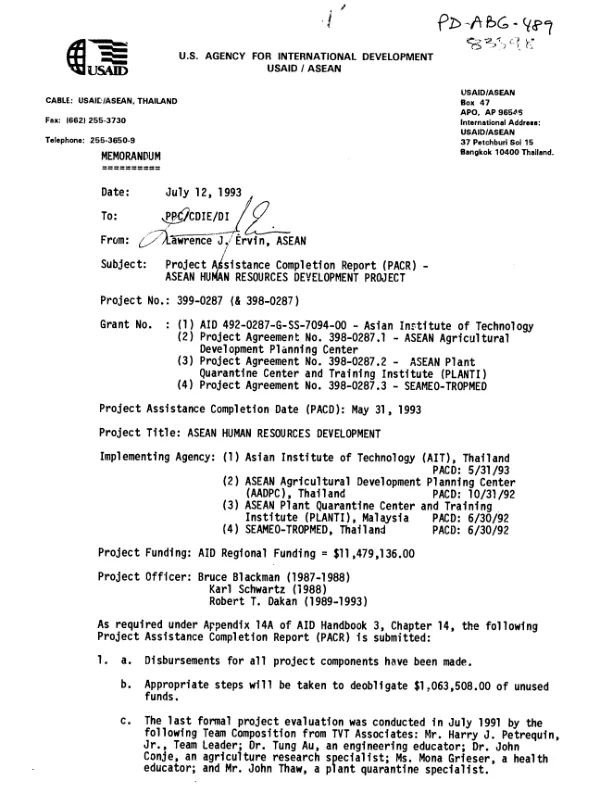
Project assistance completion report (PACR) : ASEAN human resources development project
Sign inUSAID. BUR. FOR ASIA. OFC. OF THE AID REPRESENTATIVE TO ASEAN (ASSOCIATION OF SOUTHEAST ASIAN NATIONS)
Project assistance completion report (PACR) : ASEAN human resources development project
PACR of a project (1987-93) to increase the human resource capacity of member countries of the Association of Southeast Asian Nations (ASEAN) in targeted development areas.
1993
Sign in to readA free account is required to download.
Abstract
The project consisted of grants to four regional centers: (1) the Plant Quarantine Center and Training Institute (PLANTI), Malaysia; (2) the Scholarship Program for Applied Tropical Medicine and Public Health (SEAMEO-TROPMED), Thailand; (3) the Agricultural Development Planning Center (ADPC), Thailand; and (4) the Asian Institute of Technology (AIT), Thailand. The last formal project evaluation, conducted in 7/91, found that the project was leaving in its wake a new cadre of highly trained personnel who were already playing meaningful roles in the ASEAN region. The regional centers assisted by the project have all expanded their facilities and mandates, and have responded to policy changes introduced in 1990 by the Asia Bureau by accommodating private sector participation in activity planning and benefit distribution. Achievements and lessons learned under the four project grants are detailed below. (1) PLANTI has strengthened ASEAN"s plant quarantine capacities through training and research. Five diploma, six certificate, and 54 short-term courses were conducted. Participants totalled 1,125 (vs. a target of 958), of whom 24% were female and 8% from the private sector. Lessons learned: The establishment of PLANTI as a unifying force for plant quarantine has made agriculture and agribusiness safer in the region. Also, project experience shows that quarantine research and quarantine training are more effective when they are directly related to problems in the field. (2) TROPMED organized 45 Master"s, 13 diploma, and 3 short-term courses, as well as 4 regional seminars. The number of physicians and scientists trained was 543 (vs. a target of 484); almost half were female. Lessons learned: Division of responsibilities among institutions in a region can foster the capabilities of national institutions. As a result of the TROPMED component, Indonesia has become specialized in nutrition, the Philippines in public health, Thailand in tropical medicine, and Malaysia in microbiology, parasitology, and entomology. Linking TROPMED with U.S. institutions would have led to even greater benefits. (3) ADPC trained 211 (vs. a target of 172) participants, of whom 40% were women and 9% from the private sector, in Master"s and short-term programs. In addition, 14 planning and policy studies were conducted by ASEAN experts and discussed at regional fora. ADPC"s Database and Information System has proven useful in policy and planning for government ministries, private companies, private research foundations, and consultants. For example, a study on food security resulted in an inter-country agreement to establish an emergency stockpile of rice. Lessons learned: The exchange of participants" experience in comparative case studies resulted in more effective policy and agricultural planning in member countries. The long-lasting camaraderie developed among the participants was an added benefit. Additionally, when proposing regional agricultural development programs, it is important to recognize the varying capacity of each country to analyze its own problems. (4) AIT trained 926 participants (vs. a target of 414): 25 in Master"s, 108 in certificate, and 793 in short-term programs. Roughly 30% of the participants were female and 13% from the private sector. Participants were trained in environmental engineering, agricultural and food engineering, computer science, water resources engineering, energy technology, geotechnical and transportation engineering, and management. Short-term courses covered a range of fields from management to computer applications and pollution abatement. Lessons learned: The component demonstrated that the promotion of social and economic development in a region requires a well established regional institution to serve as an effective implementing agent. Development of mutual trust and cooperation with such an institution requires constant and long-term nurturing.