USAID DEC
Project assistance completion report : Central American peace scholarship project (CAPS 596-0130)
Sign inUSAID. BUR. FOR LATIN AMERICA AND THE CARIBBEAN
Project assistance completion report : Central American peace scholarship project (CAPS 596-0130)
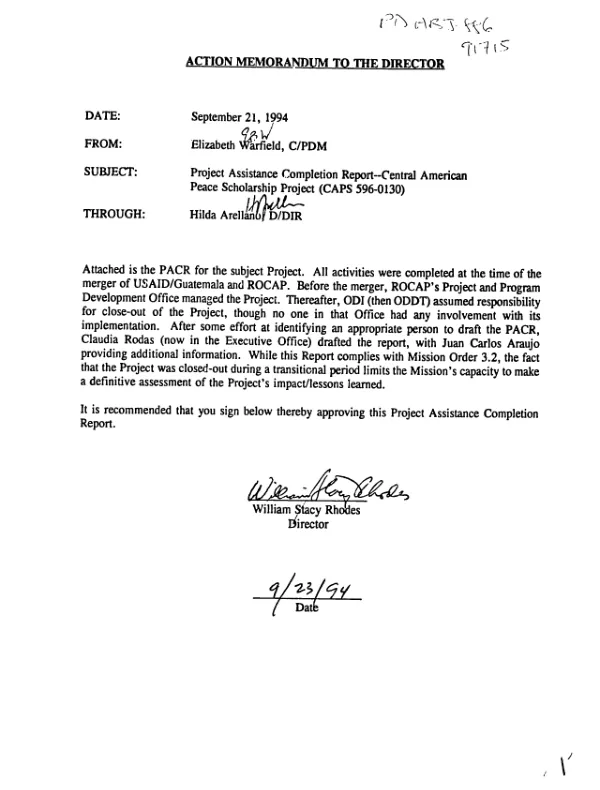
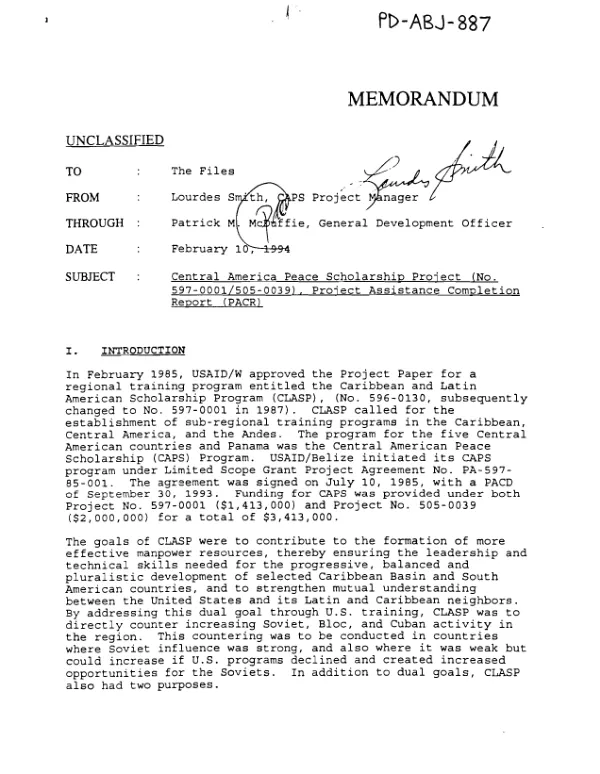
PACR of a project (1985-93) to provide Central American rural leaders with technical and academic training in the United States and at the Central American Institute for Business Administration (INCAE) in Costa Rica and the Agricultural Panamerican School (Zamorano) in Honduras.
1994
Sign in to readA free account is required to download.
Abstract
The project exceeded its targets, providing training to a total of 718 participants, 60% of whom were socially and economically disadvantaged and 28% of whom were women. Training included: (1) long-term (i.e., 6 months-3 years) training in Honduras and the United States for 40 participants on topics such as general agriculture, management control systems, farm machinery, business management, horticulture, and animal science; and (2) short-term (less than 6 months) training for 678 participants (cooperative and small business owners [PYME-COOP], agricultural teachers, and public auditors) in Costa Rica, Honduras, and the United States. The project also published and distributed a newsletter to all returnees, U.S. Mission staff, and other interested parties throughout the region and the United States. Of the three main groups trained under the project, PYME-COOP has been the most active, and has formed the "Fundacion Centroamericana PYME-COOP y Sector Informal," which is in the process of being registered as a private nonprofit organization. Returned public auditor trainees have held several regional meetings and are taking steps to form regional and national-level associations; several international institutions have offered the prospective regional association financial assistance for seminars, conferences, and workshops. The group of agricultural teachers has been less active, although they have maintained close contact with each other, including the sharing of experiences through several workshops. Several of the participating Central American countries expressed an interest in incorporating project participants into their national follow-on programs under the Caribbean and Latin American Scholarships Program (CLASP). Audits of INCAE (8/92 and 8/93) and Zamorano (8/90) resulted in the suspension of disbursements to both institutions for over a year. Disbursements to Zamorano were resumed after the school assured compliance with the Mission. Plans to install a financial management system by 6/94 will be implemented by the RENARM project (5960150). INCAE overhauled its financial management system with help from a ROCAP-financed financial analyst. However, issues with INCAE were not cleared during the active life of the project, and disbursements and several follow-on activities planned for FY 93 were suspended. The following lessons were learned. (1) Problems dealing with advance reimbursement would have been avoided if the criteria being used now were established at the time the project started. (2) Overhead methodology should be established from the beginning and certified by the Mission soon after the project is started.