USAID DEC
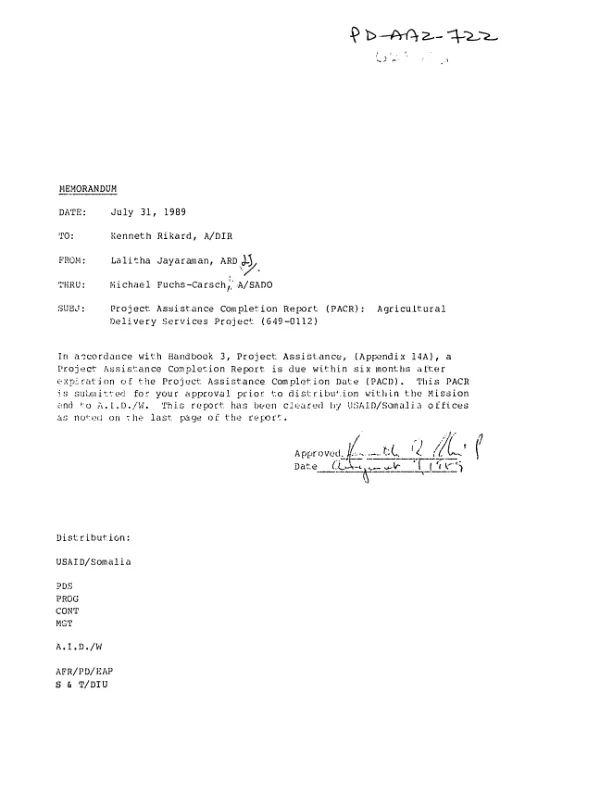
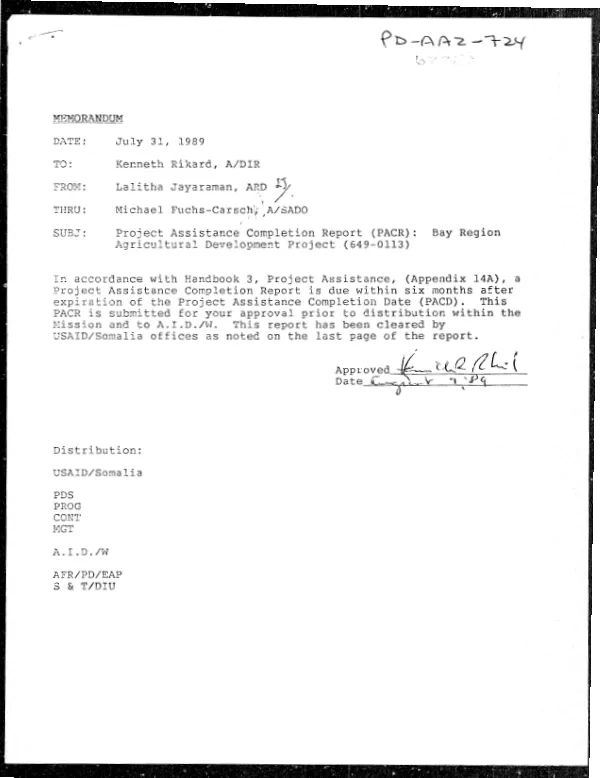
Project assistance completion report (PACR) : bay region agricultural development project (649-0113)
Sign inUSAID. MISSION TO SOMALIA
Project assistance completion report (PACR) : bay region agricultural development project (649-0113)
PACR of a project (8/80-5/88) to increase agricultural production in the Bay Region of Somalia by upgrading institutions, personnel, and infrastructure.
1989
Sign in to readA free account is required to download.
Abstract
The project was a multi-donor integrated rural development project supported by A.I.D., World Bank, IFAD, African Development Fund (ADF), and the Somali government (GSDR). The project produced varied results. Many components cannot be fully evaluated, however, since no baseline survey was conducted at the start of the project. Delays in the arrival of the University of Wyoming TA team are primarily responsible for this problem. The project constructed a functioning crop research station and a 100-ha seed farm at Bonka. Research efforts at these facilities failed to identify improved sorghum varieties, due in part to (a) a drought during the 2 years of TA and (b) inefficiency and a lack of dedication by the TA team leader for this activity. The project then attempted to distribute imported sorghum varieties (Dabar and GPR 148), but these were rejected by farmers when no yield improvements where seen. Pulse improvement activities proved more successful, however, with over 70 mungbean varieties being tested, and Filsan (an early-maturing mungbean) being accepted by farmers. Soybeans were also field tested and identified as an alternative cash crop for the region. Because of problems in varietal identification and distribution, the use of the seed farm shifted from research and extension to that of training staff in mechanized crop production. Veterinary services were expanded in the Bay region with the establishment of 3 mobile teams, capable of vaccinating 242,000 cattle per year. Fourteen dispensaries were also built, but not all could be fully staffed because of the shortage of veterinary assistants willing to work in remote areas. Long-term training had a return rate of only 30%. While the project sent 16 participants to U.S. institutions, only 5 returned to Somalia, and the whereabouts of the others are unknown. All 11 short-term training participants did return to the project, however. Finally, the project underestimated the cost of various components, especially road construction and well drilling. Consquently, only 300 km of the targeted 600 km of roads were constructed. Several lessons were learned. (1) Overambitious goals and false assumptions can be avoided in the project design stage through careful research and consultations with local personnel. (2) In a multi-donor project, donors should plan the project/components jointly but implement each component separately. (3) Agricultural research in Somalia should conducted by a multidisciplinary TA team. (4) To measure progress, baseline surveys must be conducted at the start of the project. (5) Efforts should be made in agricultural development projects to communicate with the local farmers before activities begin. (6) Training activities must address the problems of patronage in trainee selection, course relevance, low return rate, and participant failure rate.