USAID DEC
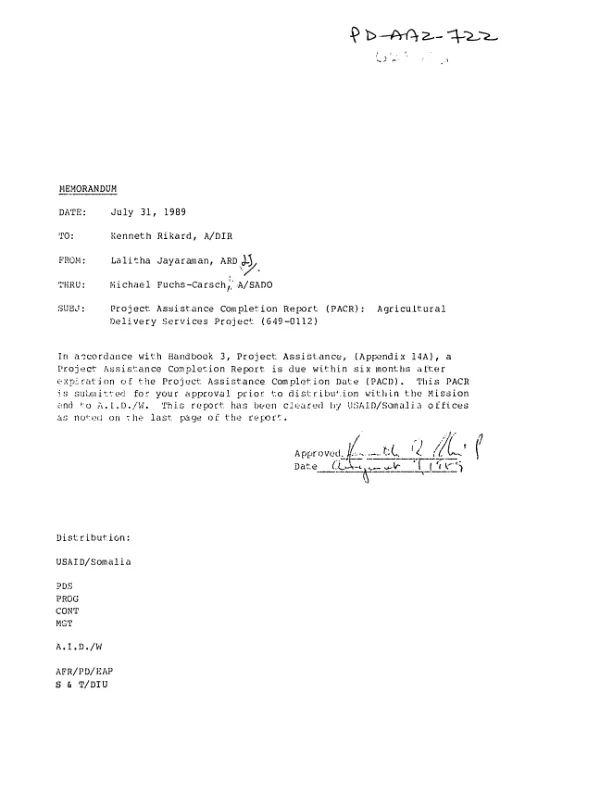
Project assistance completion report (PACR) : agricultural delivery services project (649-0112)
Sign inUSAID. MISSION TO SOMALIA
Project assistance completion report (PACR) : agricultural delivery services project (649-0112)
PACR of a project (7/79-9/88) to strengthen Somali agricultural research and extension capabilities by providing training, equipment, and TA to the National Extension Services (NES) and the Farm Management Extension Training Center (FMETC).
1989
Sign in to readA free account is required to download.
Abstract
The A.I.D. project, part of a multi-donor effort, was extremely successful in upgrading NES research and extension staffs in the 33 target districts. Whereas very little technology transfer to farmers was occurring prior to the project, NES personnel are now capable of the task. Training consisted of in-country university courses for about 70 extension agents, overseas long-term academic training for 22 staff members (20 Master's degrees and 2 Ph.D.'s), and short-term courses for about 50 staff members. Extension agents trained under the project now plan and conduct seminars and workshops for small farmers and encourage policymakers to focus on strategies for small farmer production. In the field, extension agents use a problem-solving approach which is useful and widely accepted by farmers. On the negative side, only half of the long-term participants returned to Somalia after training completion, and the overall return rate of participants was only 67%. Research and extension services were further strengthened by high-quality TA and the provision of commodities, equipment, and vehicles. The TA team generated a wealth of information, including guidelines for doubling maize yield with just a few changes in management practices. A research strategy was developed and trials are being conducted by the National Extension Training Centers at Ganale and Jowhar. However, further progress needs to be made in establishing formal linkages between the agricultural research institutes and the NES. Several lessons were learned. (1) Multi-donor project implementation is extremely difficult for the A.I.D. Mission and contractor and should be avoided whenever possible. (2) Advanced solutions to crop production problems are not urgent during the initial project phase, since low-technology improvements, which can be explained by a relatively inexperienced extension staff, will have a marked impact on yields. (3) Farmers must be involved in demonstrations of recommended production and management practices. (4) Long-term (more than 10 years) support for agricultural research and extension is needed to increase significantly small farmer productivity. (5) A strong research program is necessary before an extension service can be effective in the field. (6) When attempting to identify a technology that can be recommended to farmers, one has to consider all production seasons in a given production cycle.
![Project assistance completion report : UAF/GRTSM [University of Agriculture, Faisalabad/Grain Research, Training and Storage Management (Cell)] project activities, July - August, 1994](https://covers.devme.ai/gen/7043.webp)