USAID DEC
Project assistance completion report (PACR) : Caribbean Financial Services Corporation
Sign inUSAID. BUR. FOR LATIN AMERICA AND THE CARIBBEAN. REGIONAL DEVELOPMENT OFC. CARIBBEAN
Project assistance completion report (PACR) : Caribbean Financial Services Corporation
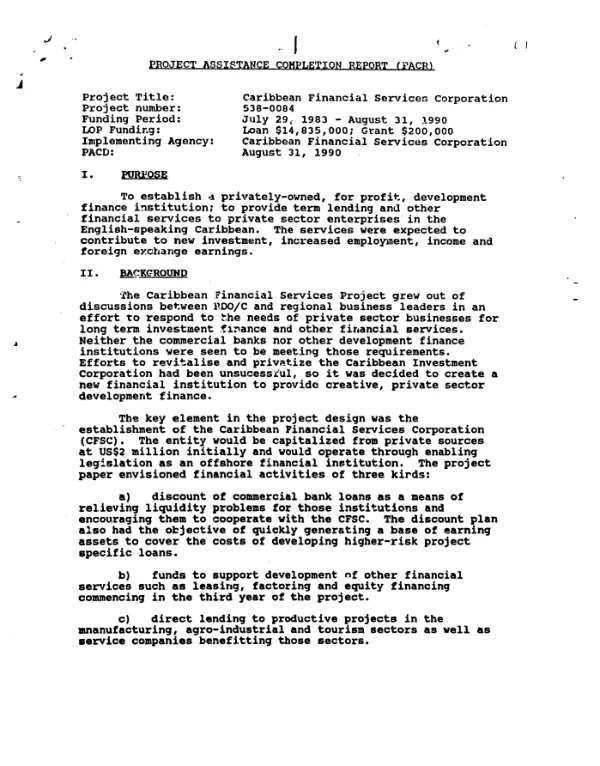
PACR of a project (7/83-8/90) to establish the Caribbean Financial Services Corporation (CFSC) as a private, for profit, development finance institution to provide term lending and other financial services to private enterprises in the English-speaking Caribbean.
1993
Sign in to readA free account is required to download.
Abstract
CFSC was successfully established as a responsive long-term lender to manufacturing, service, and tourism ventures. Its management has demonstrated willingness to base loan decisions on expected cash flow rather than restrictive collateral requirements, and to take security positions secondary to those of shorter-term lenders. At PACD, CFSC's loan and investment portfolio showed 76 cumulative approvals valued at $22.7 million, with the outstanding portfolio being $16.12 million. Some $14.775 million of the USAID obligated amount of $14.835 million was drawn down for 50 loans, primarily to agro-industry, manufacturing, and tourism, with a significant portion going to small and medium-sized firms. Shareholders' equity at the PACD was $3.012 million. In the area of services, CFSC took a very cautious approach, although it does participate in the Barbados Stock Exchange and provides brokerage services for clients. The CFSC report for the period ending 9/90 indicates that 834 long-term jobs resulted from its investments and estimates foreign exchange earnings at $32.55 million. According to a 1987 evaluation, CFSC's foreign exchange figures represent gross rather than net earnings, and its job impact figures fail to consider the effects of replacement equipment or construction activity. Nonetheless, the evaluation considered the CFSC project a success in terms of total investment, employment, net foreign exchange earnings, and prospects for sustainability. Three lessons were learned. (1) A project which responds to a specific market need will succeed in meeting its objectives. (2) The involvement of private sector personnel in project design is very likely to result in their commitment to achieving outputs. (3) Unnecessary exposure of development projects to foreign exchange risks should be avoided.